Search for "best password manager for enterprise" and Google puts a page called "The Best Enterprise Password Managers of 2026" at number three. Current year, right category, strong ranking. Exactly what the advice tells you to do.
The AI Overview above it does not quote that page. It quotes a Reddit thread instead.
That is not a one-off. It happened on 161 of the searches I looked at: a page in the top three carrying the current year, passed over, while the AI Overview led with something undated. That was not what I expected. I assumed an AI Overview would lean on the title at least as heavily as Google's ranking system does.
It does not.
Method
I tested 1,000 search terms across 20 industries, 50 queries per industry, stratified by intent and competition.
For each search I collected Google's top 20 results and, where one appeared, the AI Overview and every source it cited. Both came back in the same request, so the rankings and the citations describe an identical results page at an identical moment.
An AI Overview appeared on 947 of the 1,000 searches, producing 5,834 citations across 17,240 ranking pages.
Most pages do not use a year
Before worrying about whether you are behind, look at the base rate. Four out of five pages currently ranking carry no year in the title. Adding one is still a minority practice.
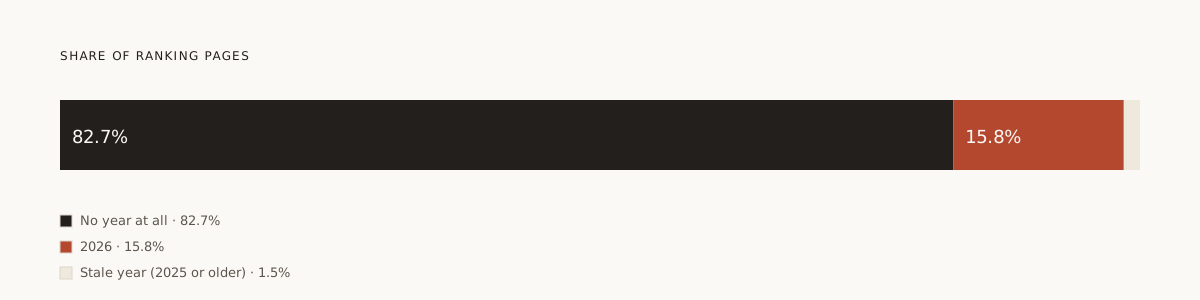
| Title contains | Share of ranking pages |
|---|---|
| No year at all | 82.7% |
| 2026 | 15.8% |
| A stale year (2025 or older) | 1.5% |
It looks like it works
At first glance the data appears to support the usual advice.
For every search I compared the pages carrying a year against the pages that were not, on that same search. That keeps the comparison between pages competing for the same thing rather than pulling from completely different queries.
Most pages in either group were not quoted at all. Only a small number of sources make it into any individual AI Overview. So the question is not what share of the citations each group won. It is what share of each group got picked.
Among pages carrying a year, roughly one in four was quoted. Among pages without one, roughly one in seven. In percentages, 24.5% against 14.8%, a gap of about ten points. The pattern appeared in 19 of the 20 industries.
So the raw difference is real. The question is what causes it.
What the year is actually measuring
Two things, and neither of them is the title.
Age
Pages saying 2026 had a median age of 93 days. Pages with no year had a median age of 448 days. These were never the same pages with and without a year added to the title. The year group was made up of much newer pages.
Page type
Year-titled pages were overwhelmingly ordinary editorial articles. The comparison group held a far larger share of YouTube videos and retail listings, which are quoted less often as written sources and cannot really carry a meaningful year in the title.
| Kind of page | Pages | Quoted | Share of year group | Share of no-year group |
|---|---|---|---|---|
| Editorial articles | 13,251 | 21.4% | 94.6% | 73.1% |
| UGC (video, forums, social) | 3,251 | 16.5% | 5.4% | 21.7% |
| Retail and shop listings | 738 | 5.4% | 0.0% | 5.2% |
That makes the original comparison misleading. If pages with years are newer and more likely to be editorial articles, they should be cited more often even if the year itself has nothing to do with it.
So I compared more similar pages.
Making the comparison fair
I started with pages competing on the same search, then held ranking position roughly constant, then freshness, and finally compared only pages Google reported as being the same age. Each step removes another difference between the two groups that has nothing to do with the title.
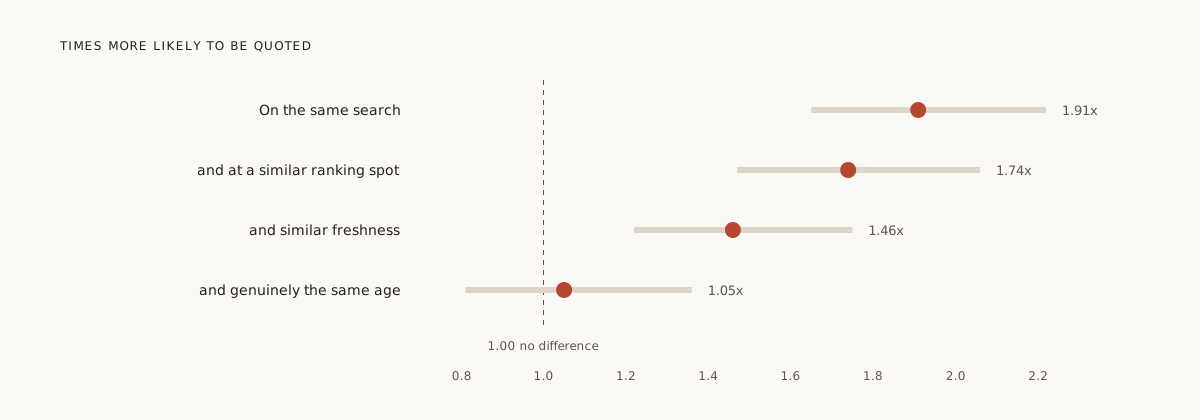
| Comparing pages that share | Times more likely to be quoted | Realistic range | Pages | Verdict |
|---|---|---|---|---|
| On the same search | 1.91x | 1.65 to 2.22 | 7,797 | A real advantage |
| and at a similar ranking spot | 1.74x | 1.47 to 2.06 | 7,797 | A real advantage |
| and similar freshness | 1.46x | 1.22 to 1.75 | 7,797 | A real advantage |
| and genuinely the same age | 1.05x | 0.81 to 1.36 | 3,793 | No measurable advantage |
The same conclusion appears without any model at all. Reweight the two groups so they have the same spread of page ages, which is arithmetic on the raw counts, and the advantage does not merely shrink. It reverses slightly.
| Comparison | Year titled | No year | Gap |
|---|---|---|---|
| As collected | 23.18% | 21.12% | 2.06 points |
| Matched on page age | 17.62% | 21.13% | -3.51 points |
Google's own update dates show the same thing. Within four of the five freshness bands, pages carrying a year were quoted slightly less often than pages without one.
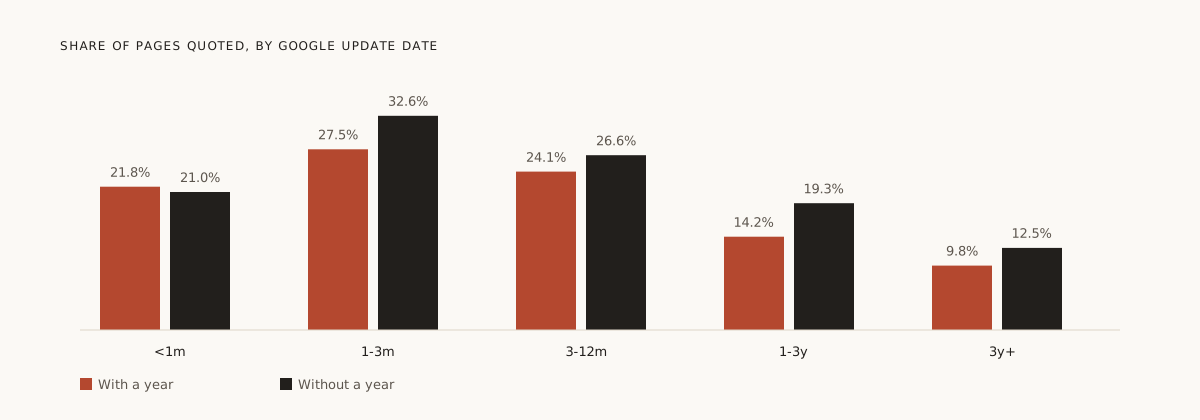
| Google says updated | With a year | Without a year | Difference | Pages (year / no year) |
|---|---|---|---|---|
| <1m | 21.8% | 21.0% | +0.8 points | 395 / 272 |
| 1-3m | 27.5% | 32.6% | -5.1 points | 524 / 429 |
| 3-12m | 24.1% | 26.6% | -2.5 points | 822 / 1,445 |
| 1-3y | 14.2% | 19.3% | -5.1 points | 204 / 1,747 |
| 3y+ | 9.8% | 12.5% | -2.7 points | 51 / 1,123 |
An expired year is worse than no year
One part of the result does carry a clear practical implication. Pages with an outdated year were quoted less often than pages that never mentioned a year at all.
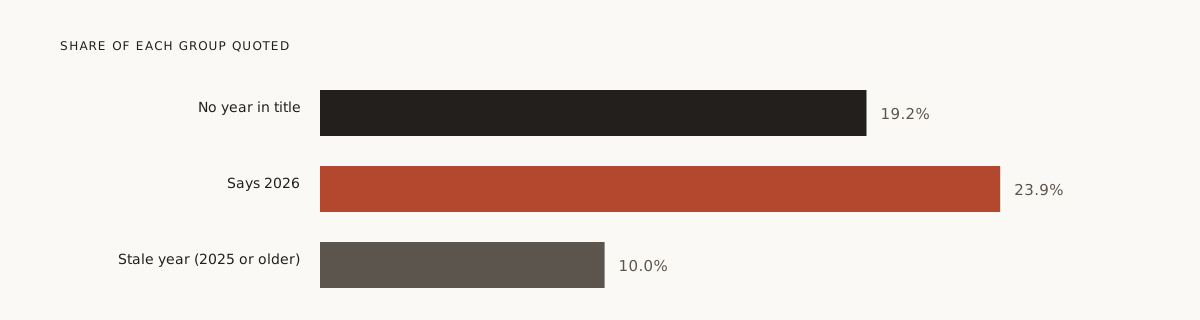
| Group | Pages | Share of that group quoted | Median age (days) |
|---|---|---|---|
| No year in title | 14,249 | 19.2% | 448 |
| Says 2026 | 2,731 | 23.9% | 93 |
| Stale year (2025 or older) | 260 | 10.0% | 548 |
Only 10.0% of pages carrying an expired year were quoted, against 19.2% of pages that never mentioned one. Those pages were also older, with a median age of 548 days. The outdated year makes that lack of freshness explicit.
The lesson is straightforward. If you put a year in a title, keep it current.
Google rewards it. AI Overviews do not.
This is the comparison that makes the result interesting, and both halves come from the same pages at the same moment.
Ordinary Google results
2.00
positions gained from a year in the title. About 1.4 of those positions remain after accounting for how fresh the page is.
The AI Overview
No effect
Once pages of the same age are compared, the difference is too small to measure.
Google rewards the label. The AI Overview rewards the work the label is supposed to represent.
The cautious reading is that AI Overviews look past the title and put more weight on the page underneath it. The other possibility is simply that they weigh different signals, and the year is not one of the important ones.
Either way the practical consequence is the same. Adding a year to an unchanged title was not a useful AI Overview tactic in this dataset.
Where the tactic is common, the advantage disappears
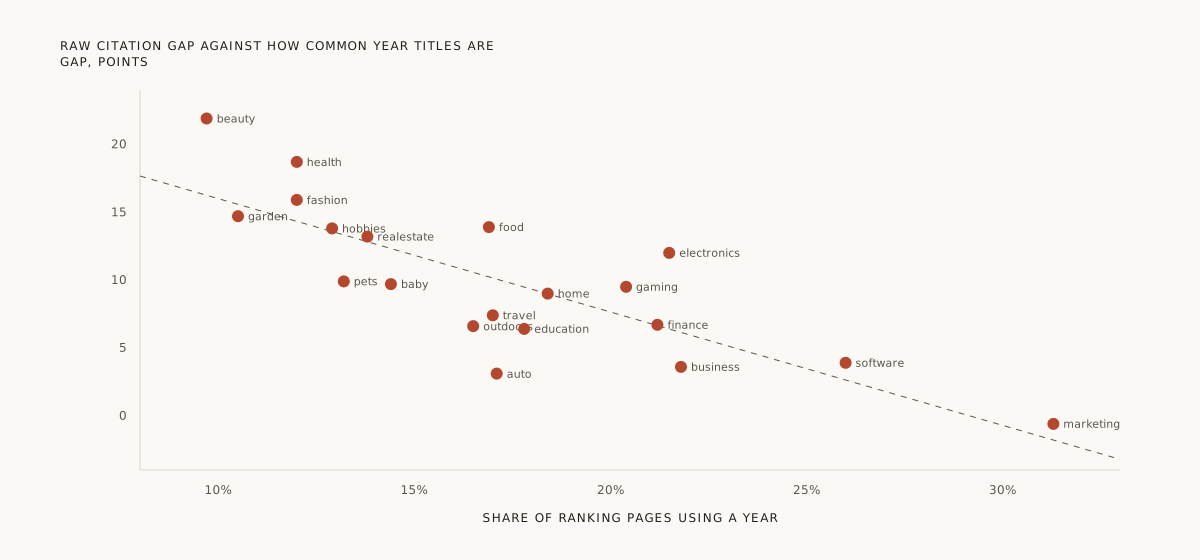
The strongest secondary pattern runs across industries. The more common year titles are within an industry, the smaller the raw advantage tends to be.
| Industry | Pages using a year | Raw gap (points) |
|---|---|---|
| beauty | 9.7% | +21.9 |
| health | 12.0% | +18.7 |
| fashion | 12.0% | +15.9 |
| garden | 10.5% | +14.7 |
| food | 16.9% | +13.9 |
| hobbies | 12.9% | +13.8 |
| realestate | 13.8% | +13.2 |
| electronics | 21.5% | +12.0 |
| pets | 13.2% | +9.9 |
| baby | 14.4% | +9.7 |
| gaming | 20.4% | +9.5 |
| home | 18.4% | +9.0 |
| travel | 17.0% | +7.4 |
| finance | 21.2% | +6.7 |
| outdoors | 16.5% | +6.6 |
| education | 17.8% | +6.4 |
| software | 26.0% | +3.9 |
| business | 21.8% | +3.6 |
| auto | 17.1% | +3.1 |
| marketing | 31.3% | -0.6 |
In marketing and software, where roughly a quarter to a third of ranking pages carry a year, the raw advantage is almost gone. In beauty, health and garden, where the practice is much less common, the raw gap is far larger.
That is what you would expect if the year is a marker rather than a cause. When only a few publishers use it, a year can genuinely identify pages that have recently been reviewed or rebuilt. When almost everyone adds one, it tells you much less.
A signal everybody sends stops being much of a signal.
What should you do?
| If this is your situation | Then | Why |
|---|---|---|
| You already have years in your titles | Keep them current. | Expired-year pages were quoted 10.0% of the time, against 19.2% for pages with no year. |
| The page really was rebuilt this year | Use the year, and show the update date on the page. | It accurately tells the reader the content is current. Just do not expect the year itself to earn the citation. |
| The page has not been touched in a year | Update the page before changing the title. | Changing 2025 to 2026 without improving the content showed no citation benefit in this study. |
| You have one hour and a choice | Spend it on the page, not the title. | Once pages were compared at the same age, the year itself gave no measurable advantage. |
| You work in marketing, software or business content | Do not add a year just for AI Overviews. | The tactic is already common in these industries, and the raw advantage is small or absent. |
| You publish evergreen explainers | Do not add one solely to chase AI Overview citations. | There was no evidence here that the year itself provides a citation advantage. |
The simplest version: if the page needs updating, update the page. Do not just update the year.
What the study does and does not show
- It measured citations, not traffic. Being quoted in an AI Overview and getting a click from one are different things. This only measures the first.
- It is observational. I measured pages that already exist rather than changing titles and watching what happened, so it shows associations rather than definitive causation.
- The year cannot be fully separated from the work behind it. A publisher producing "Best X of 2026" has often retested products and substantially rewritten the page. The data supports the narrower conclusion that the year itself does not appear to add a citation advantage once page age and page type are accounted for.
- The freshness analysis only covers pages Google showed an update date for, which is about half of the results.
- AI Overviews change over time. This is a snapshot of the searches tested, and the same searches may cite different sources later.
The narrow conclusion is the useful one. Adding a year to an otherwise unchanged title did not increase the chance of being cited by an AI Overview in this dataset.
The wider pattern
A year in a title is a visible signal standing in for something more valuable: a page somebody is actually maintaining. Changing the year takes seconds. Properly updating the page takes considerably longer.
Google's ranking system still rewards the visible signal. In this test the AI Overview did not show the same preference once the differences between pages were accounted for.
That changes the advice. If you are updating a page, update it because the information has changed, the recommendations have changed, the products have changed, or the page can simply be made better. If none of that has happened, changing the year is unlikely to make the page more useful to an AI Overview, or to the person reading it.
And once a tactic becomes universal, it stops being much of a signal anyway.
Test the things that might actually matter. Do not spend your time polishing the decoration.
Reuse this
The full dataset is available: every ranking page, every citation, the age and title coding for each, and the working behind every figure. If you republish any of the figures, a link back is appreciated. If you find an error in the numbers, please let me know so it can be corrected.