Skip to content
← AI Search Infographics
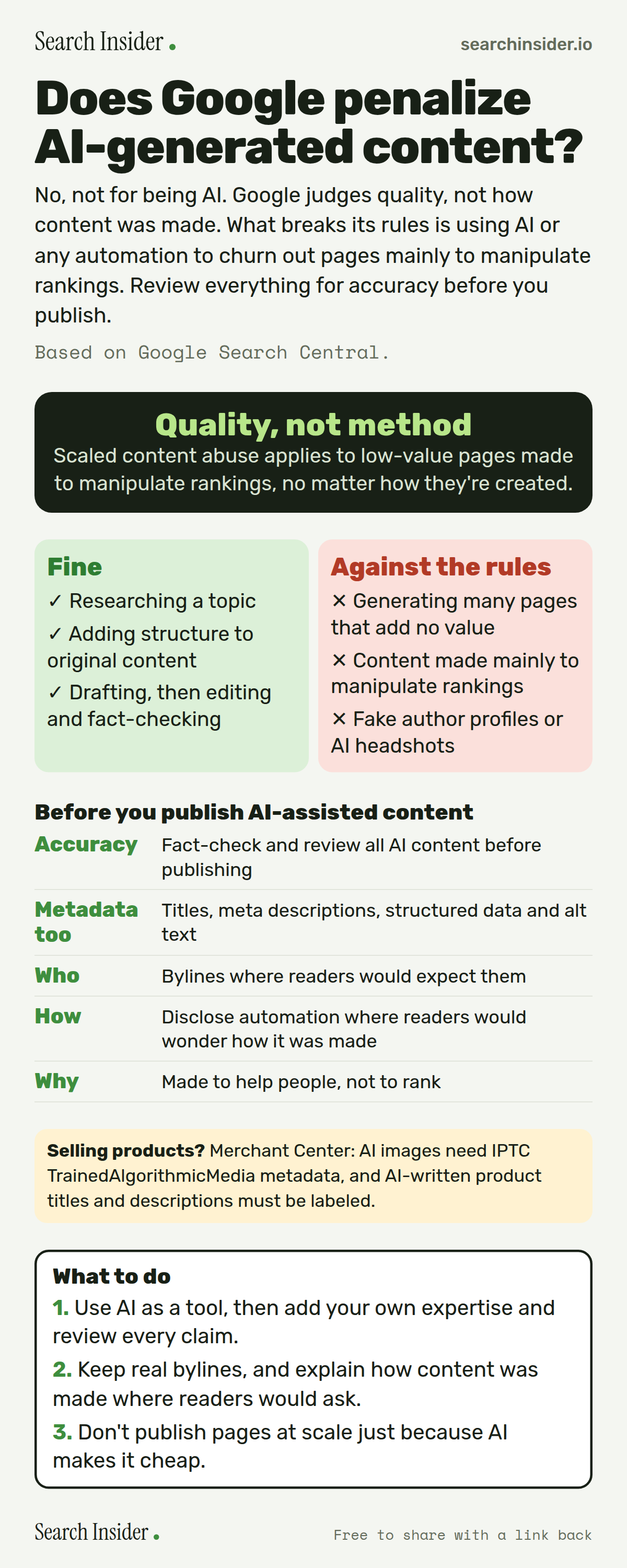
AI-generated content infographic: a quality not method banner, a split of fine uses versus uses against Google's rules, a pre-publish checklist (accuracy, metadata, who, how, why), a Merchant Center note on labeling AI images and product data, and three steps on what to do.

Oct 6, 2026

Does Google Penalize AI Content? (Infographic)

Google's stance on AI-generated content: quality over production method, what breaks the scaled content abuse policy, and a checklist before publishing AI-assisted content.

Embed this infographic

Every infographic here is free to republish, on any site, with a link back to the study it comes from. Paste this code and the credit is done for you.

<a href="https://searchinsider.io/infographics/ai-generated-content"><img src="https://searchinsider.io/research/ai-generated-content/ai-generated-content-infographic.png" alt="AI-generated content infographic: a quality not method banner, a split of fine uses versus uses against Google's rules, a pre-publish checklist (accuracy, metadata, who, how, why), a Merchant Center note on labeling AI images and product data, and three steps on what to do." style="max-width:680px;width:100%;height:auto;" /></a><p>Source: <a href="https://searchinsider.io/infographics/ai-generated-content">AI-generated content infographic</a> by Search Insider.</p>

Does Google penalize AI-generated content?

The short answer: No, not for being AI. Google judges quality, not how content was made. What breaks its rules is using AI or any automation to churn out pages mainly to manipulate rankings. Review everything for accuracy before you publish.

Based on Google Search Central.

What it shows

  • Google focuses on the quality of content rather than how it's produced.
  • Generating many pages with AI without adding value may violate the scaled content abuse policy, which applies no matter how content is created.
  • Google says to fact-check and review all AI-generated content before publishing, including titles, meta descriptions, structured data and alt text.
  • Google's Who, How and Why questions cover bylines, disclosure of automation, and purpose.
  • Fabricating creator profiles, such as AI headshots or made-up names, is deception.
  • Merchant Center requires AI-generated images and product data to be labeled.

What to do

  • Drafting: Use AI as a tool, add expertise and review every claim.
  • Transparency: Keep real bylines and disclose where readers would ask.
  • Scale: Don't publish pages just because AI makes it cheap.

The walkthrough

Does Google penalize AI-generated content?

Not for being AI-generated. Google has said appropriate use of AI or automation isn't against its guidelines and that it focuses on content quality rather than how content is produced, as reported by Search Engine Land [4]. Using automation, including AI, to produce content primarily to manipulate rankings violates Google's spam policies [3].

What is scaled content abuse?

Scaled content abuse is when many pages are generated mainly to manipulate search rankings and not to help users, producing low-value content no matter how it's created [2]. Google's first example is using generative AI tools to generate many pages without adding value [2].

How should you use generative AI for content?

Google says generative AI can be particularly useful for researching a topic and adding structure to original content [1]. It says it's critical to manually fact-check and review AI-generated content for accuracy before publishing, including title elements, meta descriptions, structured data and image alt text [1].

Should you disclose AI-generated content?

Google's helpful content guidance asks whether the use of automation is self-evident to visitors through disclosures, and says such disclosures are useful where someone might wonder how content was created [3]. It also says fabricating creator profiles, such as AI-generated headshots or made-up names, is deception [3].

Should AI be listed as the author?

Google has said giving AI an author byline is probably not the best way to make clear AI was involved, as reported by Search Engine Land [4]. Its guidance asks whether pages carry a byline where one would be expected [3].

Are there rules for AI content in Google Shopping?

Yes. Merchant Center requires AI-generated images to carry IPTC DigitalSourceType TrainedAlgorithmicMedia metadata, and AI-generated product titles and descriptions to be labeled as AI-generated [1].

More digital marketing infographics

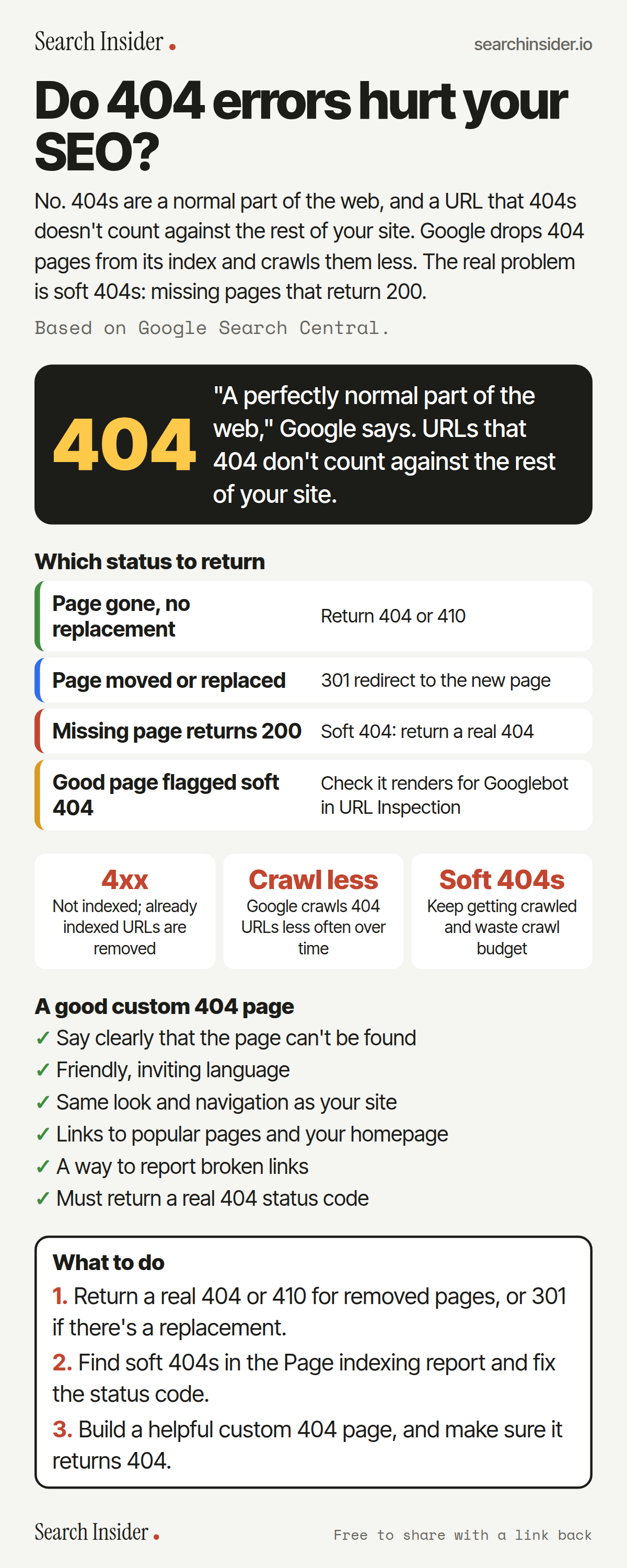
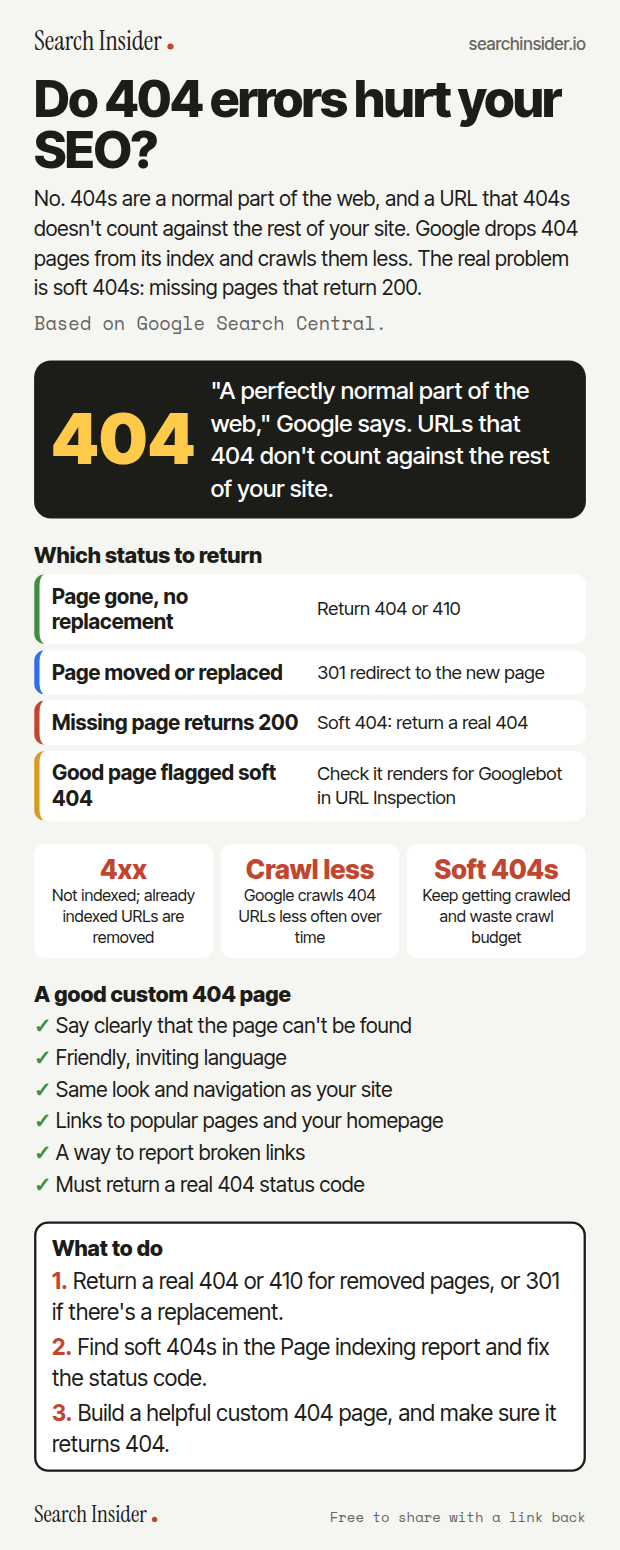
404 errors infographic: a 404 banner with Google's view that 404s are normal, which status to return in four cases, three facts on how Google treats 4xx and soft 404s, a checklist for a good custom 404 page, and three steps on what to do.

SEO · Oct 6, 2026

Do 404 errors hurt your SEO?

Do 404 errors hurt SEO? How Google treats 404s, why soft 404s are the real problem, which status code to return, and how to build a good custom 404 page.

Embed code
<a href="https://searchinsider.io/infographics/404-errors"><img src="https://searchinsider.io/research/404-errors/404-errors-infographic.png" alt="404 errors infographic: a 404 banner with Google's view that 404s are normal, which status to return in four cases, three facts on how Google treats 4xx and soft 404s, a checklist for a good custom 404 page, and three steps on what to do." style="max-width:680px;width:100%;height:auto;" /></a><p>Source: <a href="https://searchinsider.io/infographics/404-errors">404 errors infographic</a> by Search Insider.</p>
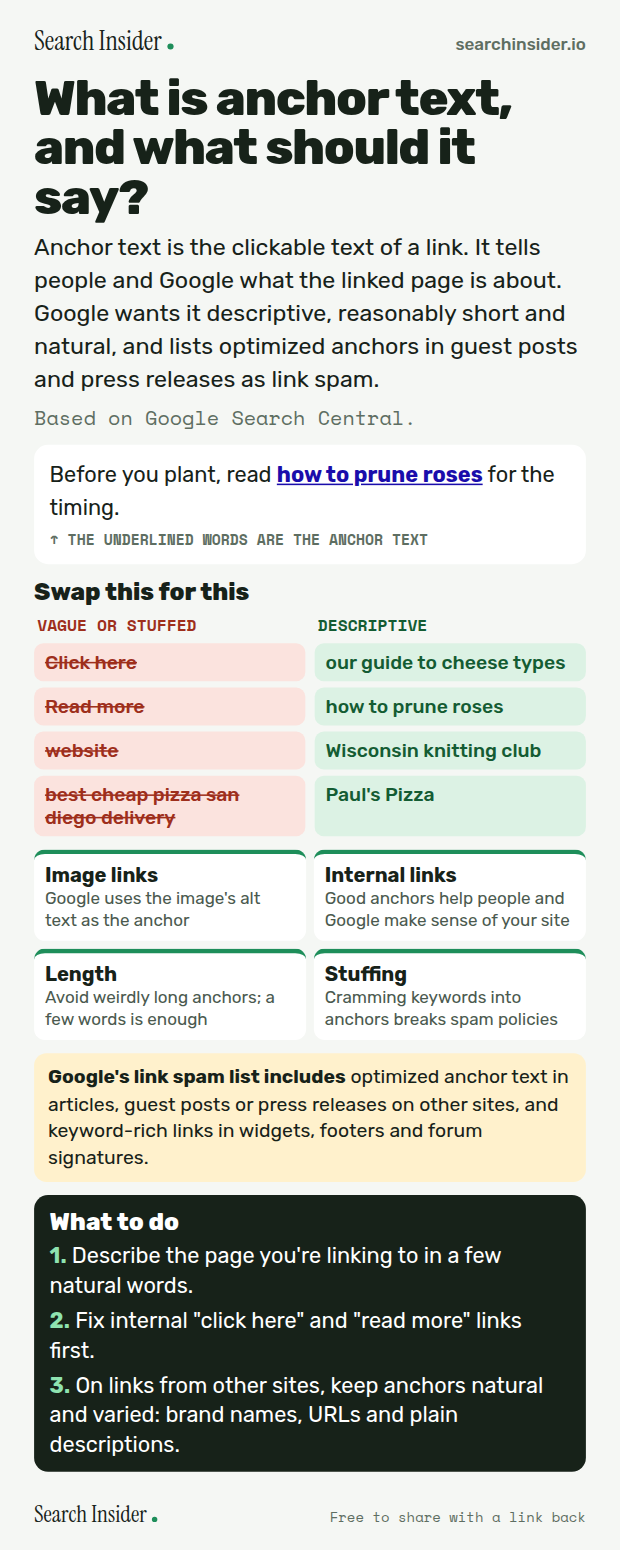
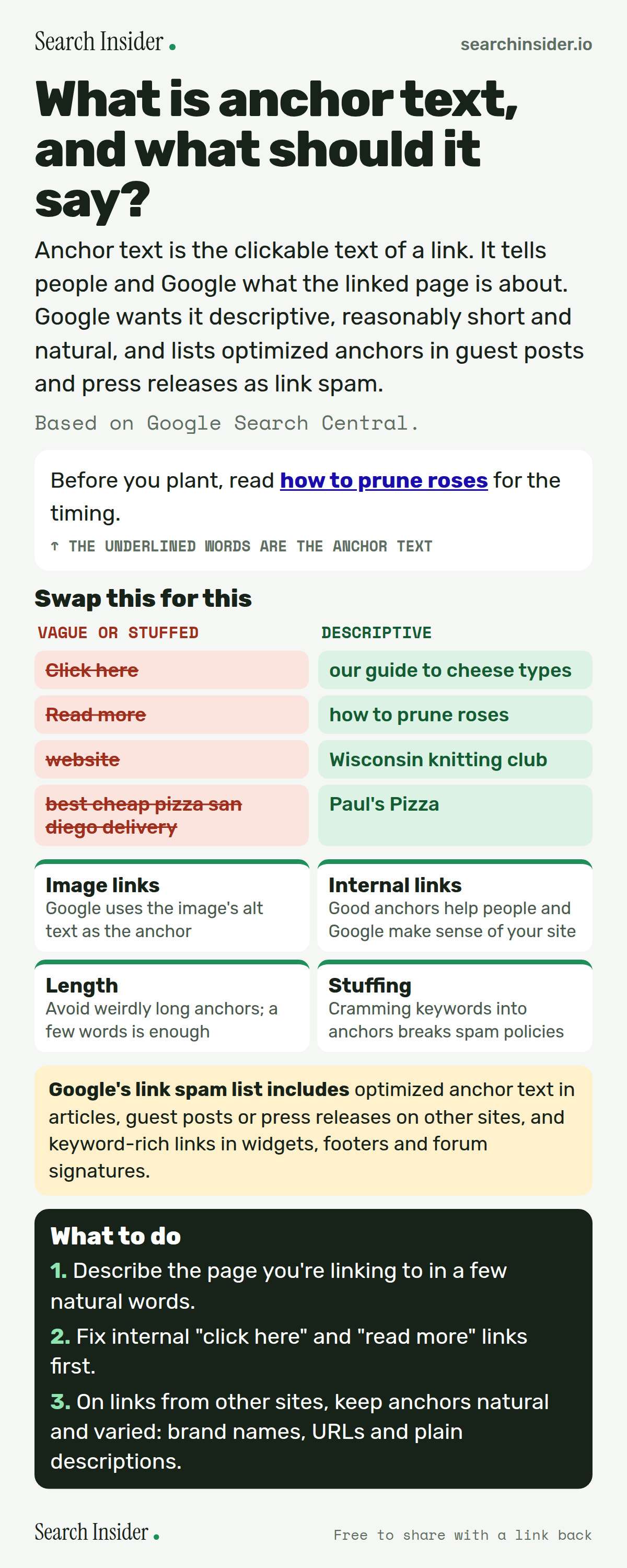
Anchor text infographic: an example link with the anchor text underlined, four vague or stuffed anchors swapped for descriptive ones, four rules on image links, internal links, length and keyword stuffing, a note on Google's link spam examples, and three steps on what to do.

SEO · Oct 6, 2026

What is anchor text, and what should it say?

What anchor text is, what Google says it should say, good and bad examples, image link alt text, and which anchor practices Google lists as link spam.

Embed code
<a href="https://searchinsider.io/infographics/anchor-text"><img src="https://searchinsider.io/research/anchor-text/anchor-text-infographic.png" alt="Anchor text infographic: an example link with the anchor text underlined, four vague or stuffed anchors swapped for descriptive ones, four rules on image links, internal links, length and keyword stuffing, a note on Google's link spam examples, and three steps on what to do." style="max-width:680px;width:100%;height:auto;" /></a><p>Source: <a href="https://searchinsider.io/infographics/anchor-text">Anchor text infographic</a> by Search Insider.</p>
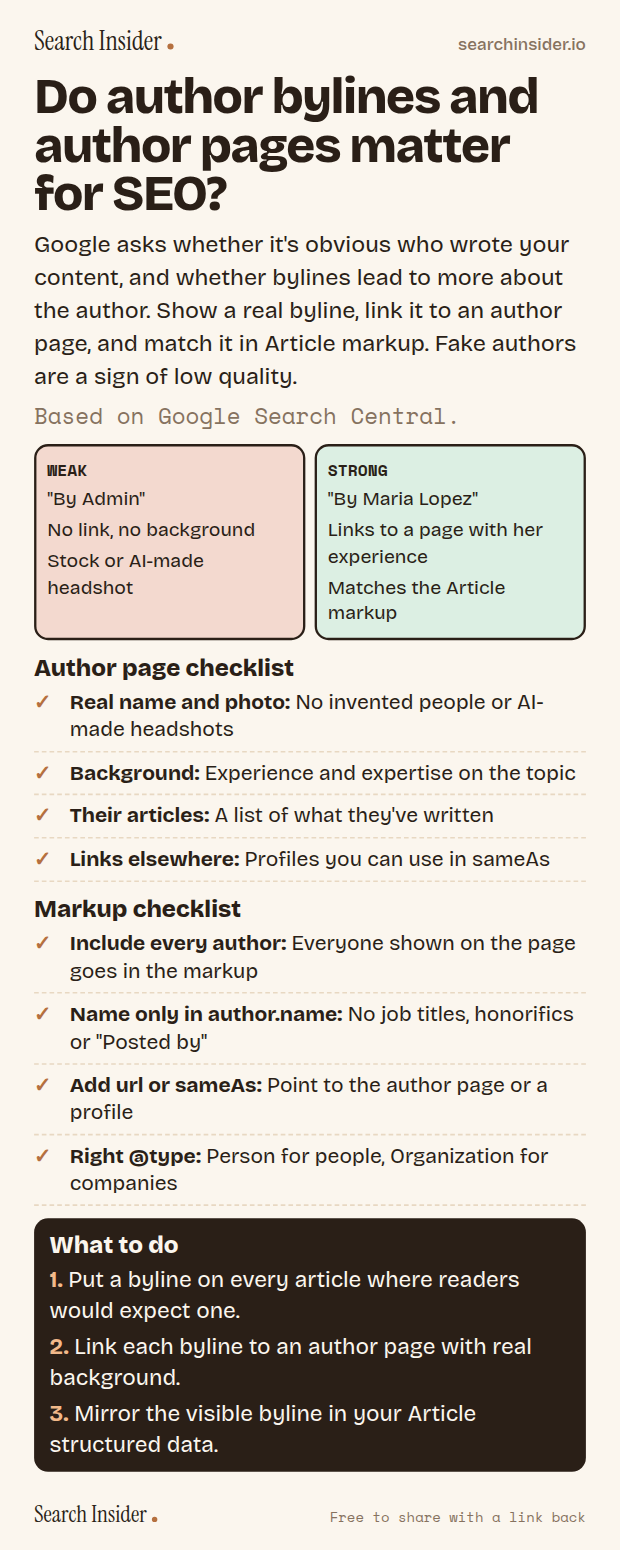
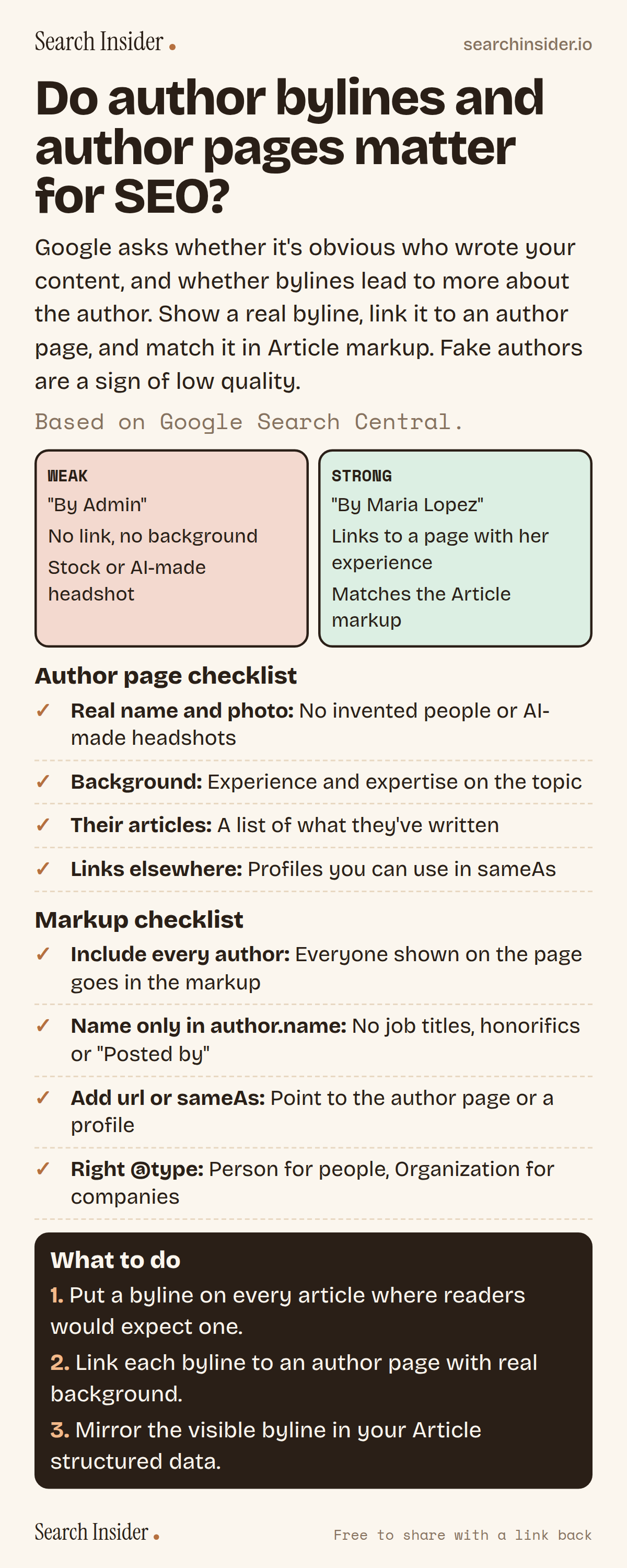
Author bylines infographic: a weak versus strong byline comparison, an author page checklist (real name and photo, background, their articles, links elsewhere), an author markup checklist (include every author, name only, url or sameAs, the right type), and three steps on what to do.

Content · Oct 6, 2026

Do author bylines and author pages matter for SEO?

Do author bylines and author pages matter for SEO? What Google asks about authorship, what an author page should include, and Google's author markup best practices.

Embed code
<a href="https://searchinsider.io/infographics/author-bylines"><img src="https://searchinsider.io/research/author-bylines/author-bylines-infographic.png" alt="Author bylines infographic: a weak versus strong byline comparison, an author page checklist (real name and photo, background, their articles, links elsewhere), an author markup checklist (include every author, name only, url or sameAs, the right type), and three steps on what to do." style="max-width:680px;width:100%;height:auto;" /></a><p>Source: <a href="https://searchinsider.io/infographics/author-bylines">Author bylines and author pages infographic</a> by Search Insider.</p>