Skip to content
← SEO Infographics
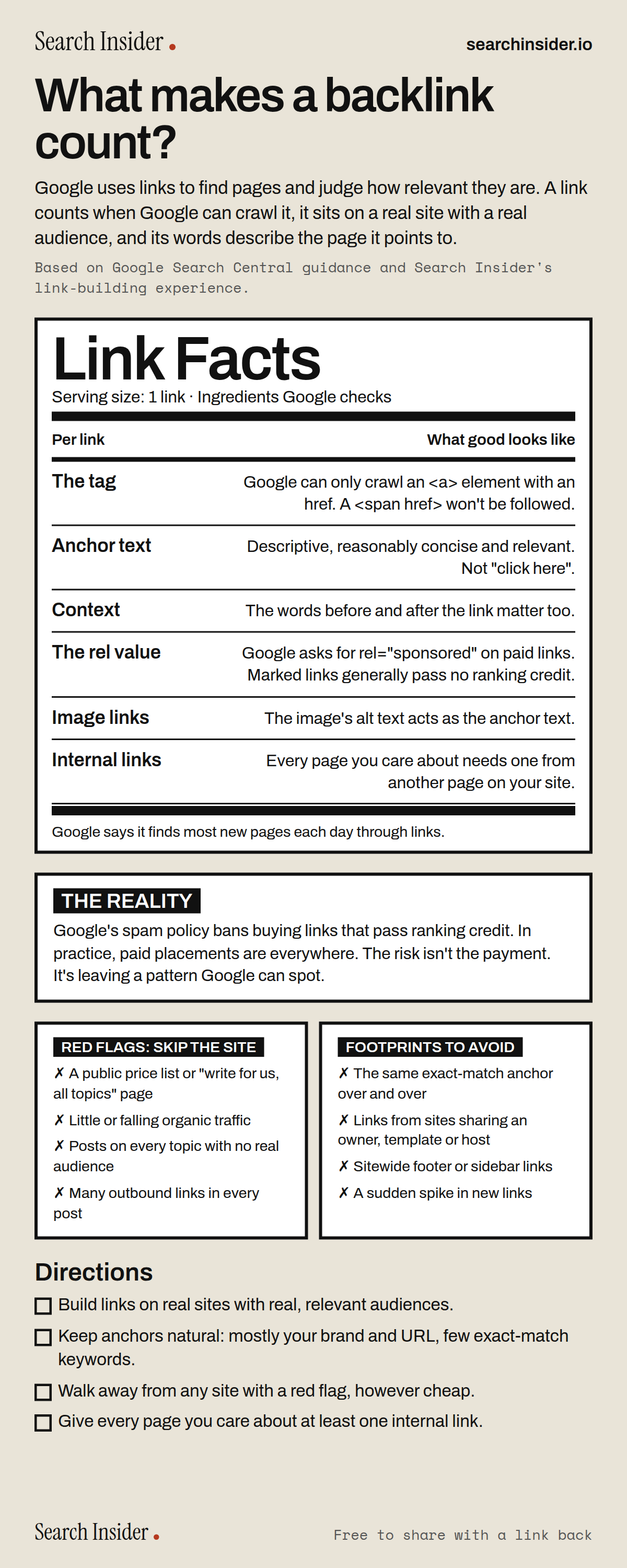
Anatomy of a backlink infographic styled as a nutrition label: Link Facts covering the tag, anchor text, context, rel value, image links and internal links, then the reality of paid links, red flags that mean skip the site, footprints to avoid, and four directions.

Oct 5, 2026

Anatomy of a Backlink Infographic: What Makes a Link Count

What makes a backlink count: the parts Google reads in every link, the red flags that make a site worth skipping, and the footprints to avoid.

Embed this infographic

Every infographic here is free to republish, on any site, with a link back to the study it comes from. Paste this code and the credit is done for you.

What makes a backlink count?

The short answer: Google uses links to find pages and judge how relevant they are. A link counts when Google can crawl it, it sits on a real site with a real audience, and its words describe the page it points to.

Based on Google Search Central guidance and Search Insider's link-building experience.

What it shows

  • The tag: Google can only crawl an <a> element with an href.
  • Anchor text: descriptive, reasonably concise and relevant.
  • Context: the words before and after the link matter.
  • Image links: the image's alt text acts as the anchor text.
  • Internal links: every page you care about needs one.
  • Google's policy bans buying links that pass ranking credit. In practice paid placements are everywhere; the risk is leaving a pattern Google can spot.
  • Red flags: public price lists, little or falling traffic, posts on every topic, many outbound links per post.
  • Footprints: repeated exact-match anchors, sites sharing an owner or template, sitewide links, sudden link spikes.

What to do

  • Choosing sites: Build links on real sites with real, relevant audiences, and walk away from any site with a red flag.
  • Choosing anchors: Keep them natural: mostly your brand and URL, few exact-match keywords.
  • On your own site: Give every page you care about at least one internal link.

The walkthrough

What makes a backlink count for SEO?

Google uses links as a signal when determining the relevancy of pages and to find new pages to crawl [1]. A link helps when Google can crawl it, it sits on a real site with a real audience, and its anchor text and surrounding words describe the page it points to.

What does a crawlable link look like?

Google can only crawl a link if it's an HTML element with an href attribute [1]. Links built with other elements, such as a span with an href, aren't reliably followed [1]. For image links, Google uses the image's alt text as the anchor text [1].

What is good anchor text?

Google describes good anchor text as descriptive, reasonably concise, and relevant to both the page it's on and the page it links to [1]. The words before and after a link matter too [1]. For backlinks, a natural profile leans on brand names and plain URLs, with exact-match keyword anchors used sparingly.

Is buying backlinks against Google's rules?

Google's spam policies list buying or selling links for ranking purposes as link spam, and Google asks that paid links be marked with rel="sponsored" or rel="nofollow" [2][3]. In practice, paid placements are common across the industry. Search Insider's view is that the real risk lies in footprints: patterns that make paid links easy to identify.

What are the red flags of a site that sells links?

Skip sites with a public price list or a "write for us" page that accepts any topic, little or falling organic traffic, posts on every subject with no real audience, or many outbound links in every post. Those signs make a link easy to spot and unlikely to help.

What link footprints should you avoid?

Avoid the same exact-match anchor repeated across many links, links from sites that share an owner, template or host, sitewide footer or sidebar links, and sudden spikes in new links. Google's own spam policy names widely distributed footer and template links as a problem [2]. Search Insider does not support or suggest the use of private blog networks.

Do internal links matter?

Yes. Google says every page you care about should have a link from at least one other page on your site [1], and that the vast majority of new pages it finds every day are found through links [4].

More digital marketing infographics

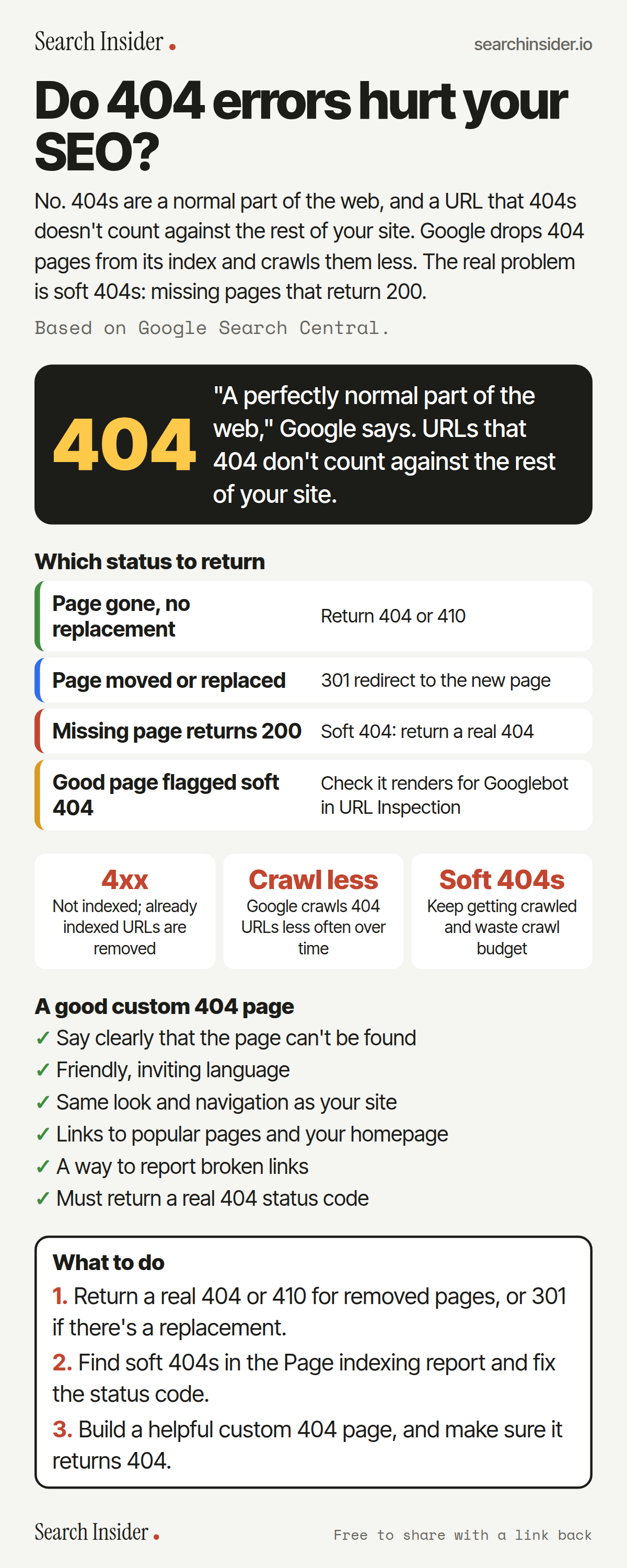
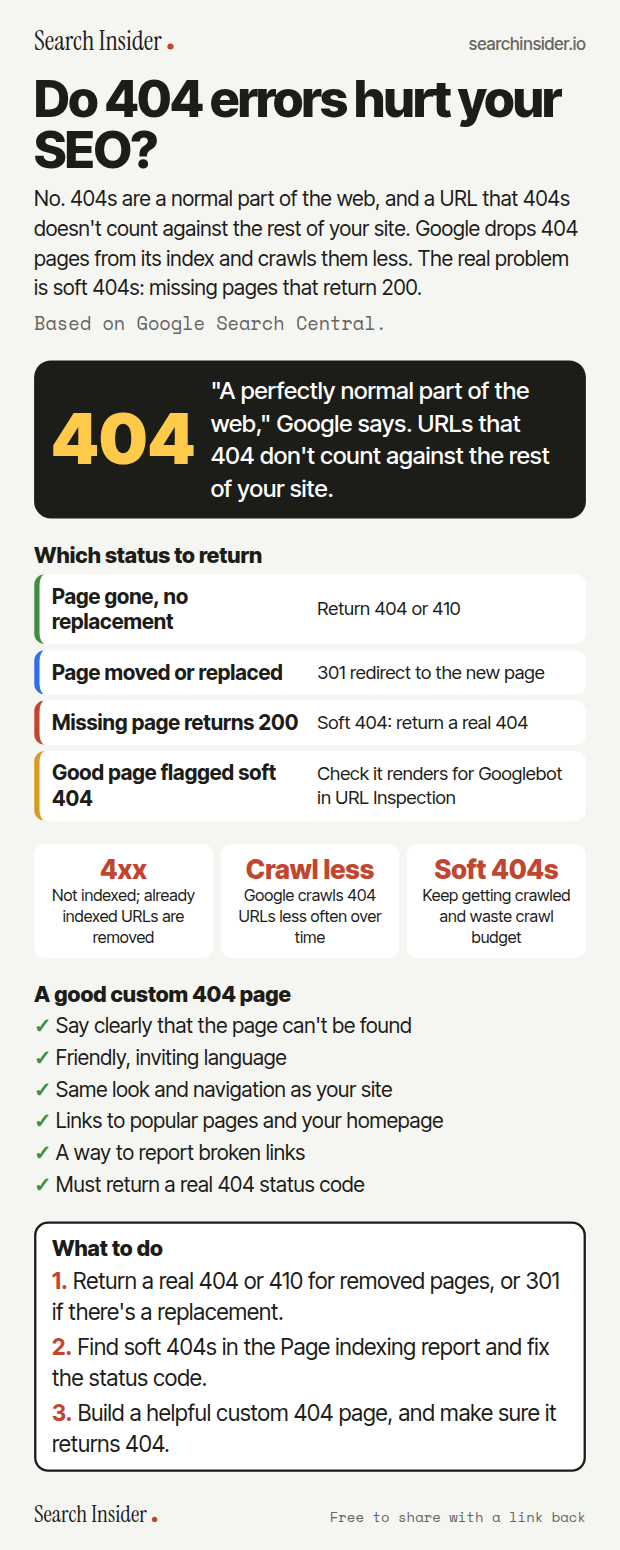
404 errors infographic: a 404 banner with Google's view that 404s are normal, which status to return in four cases, three facts on how Google treats 4xx and soft 404s, a checklist for a good custom 404 page, and three steps on what to do.

SEO · Oct 6, 2026

Do 404 errors hurt your SEO?

Do 404 errors hurt SEO? How Google treats 404s, why soft 404s are the real problem, which status code to return, and how to build a good custom 404 page.

Embed code
<a href="https://searchinsider.io/infographics/404-errors"><img src="https://searchinsider.io/research/404-errors/404-errors-infographic.png" alt="404 errors infographic: a 404 banner with Google's view that 404s are normal, which status to return in four cases, three facts on how Google treats 4xx and soft 404s, a checklist for a good custom 404 page, and three steps on what to do." style="max-width:680px;width:100%;height:auto;" /></a><p>Source: <a href="https://searchinsider.io/infographics/404-errors">404 errors infographic</a> by Search Insider.</p>
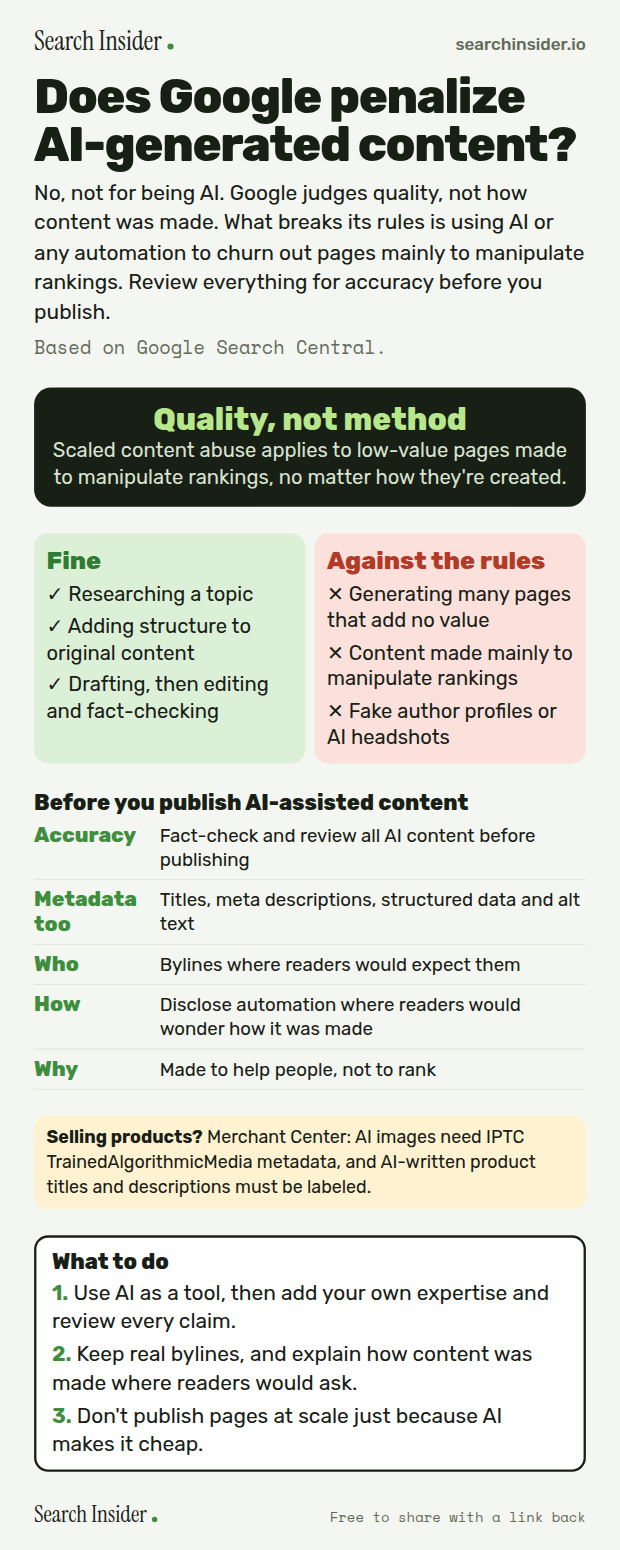
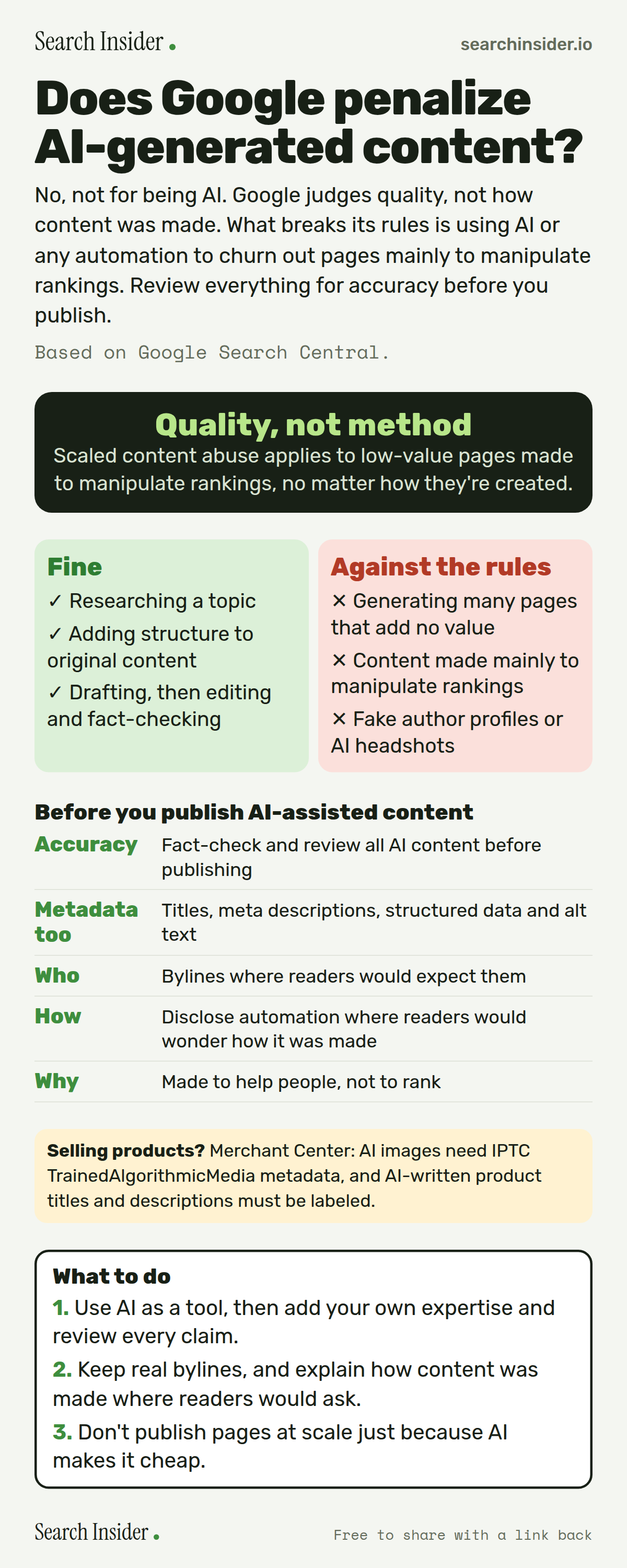
AI-generated content infographic: a quality not method banner, a split of fine uses versus uses against Google's rules, a pre-publish checklist (accuracy, metadata, who, how, why), a Merchant Center note on labeling AI images and product data, and three steps on what to do.

AI search · Oct 6, 2026

Does Google penalize AI-generated content?

Google's stance on AI-generated content: quality over production method, what breaks the scaled content abuse policy, and a checklist before publishing AI-assisted content.

Embed code
<a href="https://searchinsider.io/infographics/ai-generated-content"><img src="https://searchinsider.io/research/ai-generated-content/ai-generated-content-infographic.png" alt="AI-generated content infographic: a quality not method banner, a split of fine uses versus uses against Google's rules, a pre-publish checklist (accuracy, metadata, who, how, why), a Merchant Center note on labeling AI images and product data, and three steps on what to do." style="max-width:680px;width:100%;height:auto;" /></a><p>Source: <a href="https://searchinsider.io/infographics/ai-generated-content">AI-generated content infographic</a> by Search Insider.</p>
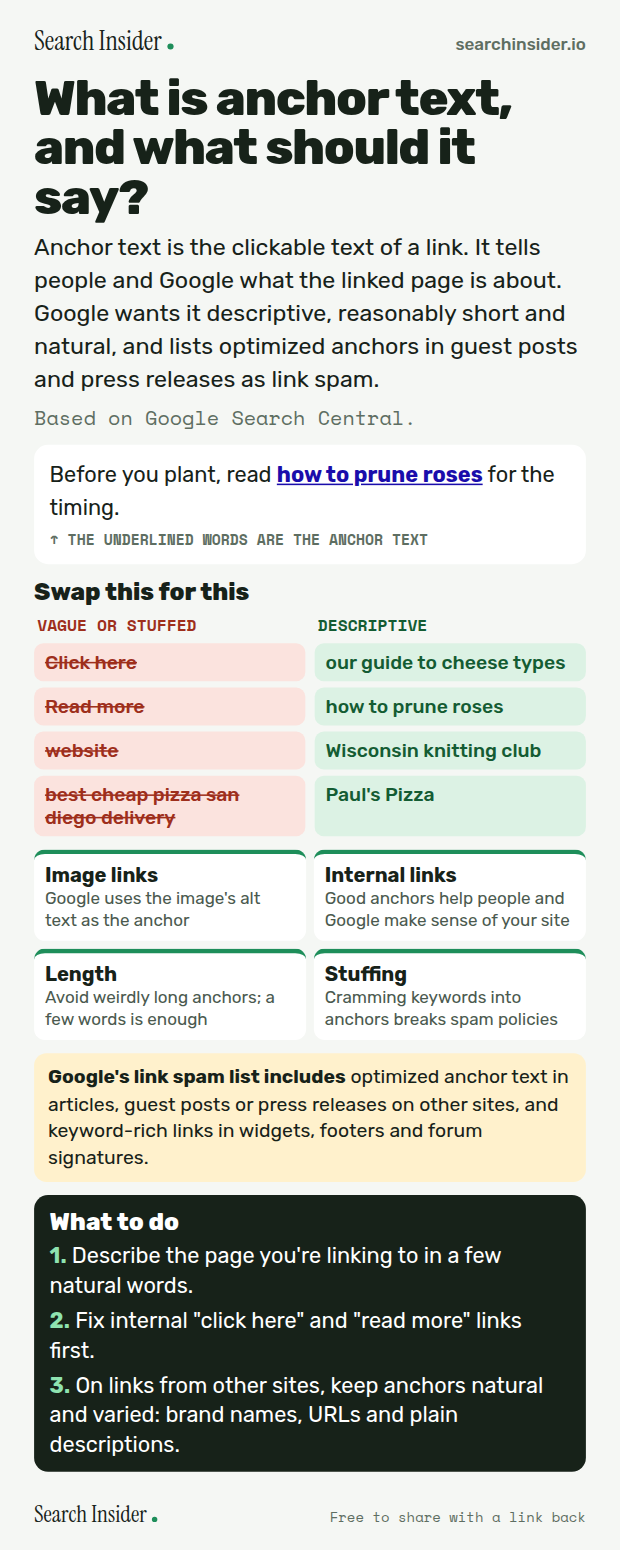
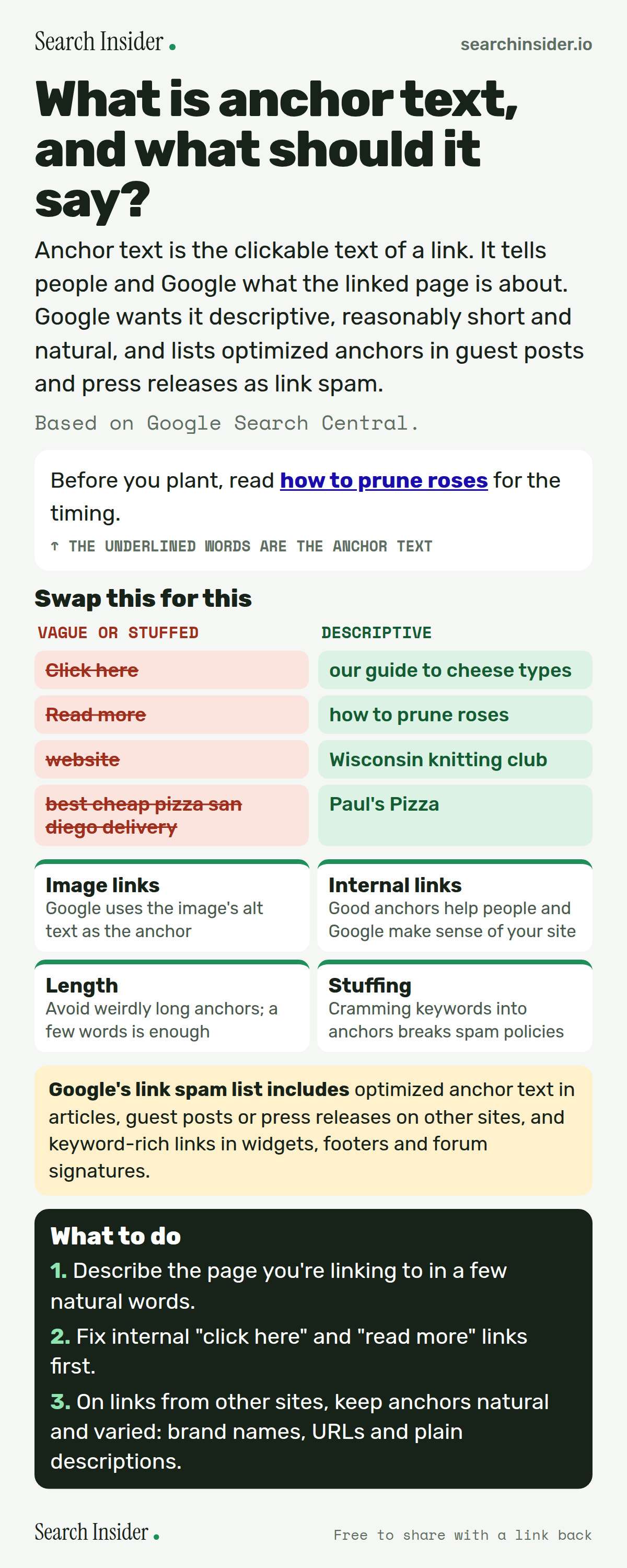
Anchor text infographic: an example link with the anchor text underlined, four vague or stuffed anchors swapped for descriptive ones, four rules on image links, internal links, length and keyword stuffing, a note on Google's link spam examples, and three steps on what to do.

SEO · Oct 6, 2026

What is anchor text, and what should it say?

What anchor text is, what Google says it should say, good and bad examples, image link alt text, and which anchor practices Google lists as link spam.

Embed code
<a href="https://searchinsider.io/infographics/anchor-text"><img src="https://searchinsider.io/research/anchor-text/anchor-text-infographic.png" alt="Anchor text infographic: an example link with the anchor text underlined, four vague or stuffed anchors swapped for descriptive ones, four rules on image links, internal links, length and keyword stuffing, a note on Google's link spam examples, and three steps on what to do." style="max-width:680px;width:100%;height:auto;" /></a><p>Source: <a href="https://searchinsider.io/infographics/anchor-text">Anchor text infographic</a> by Search Insider.</p>