Skip to content
← SEO Infographics
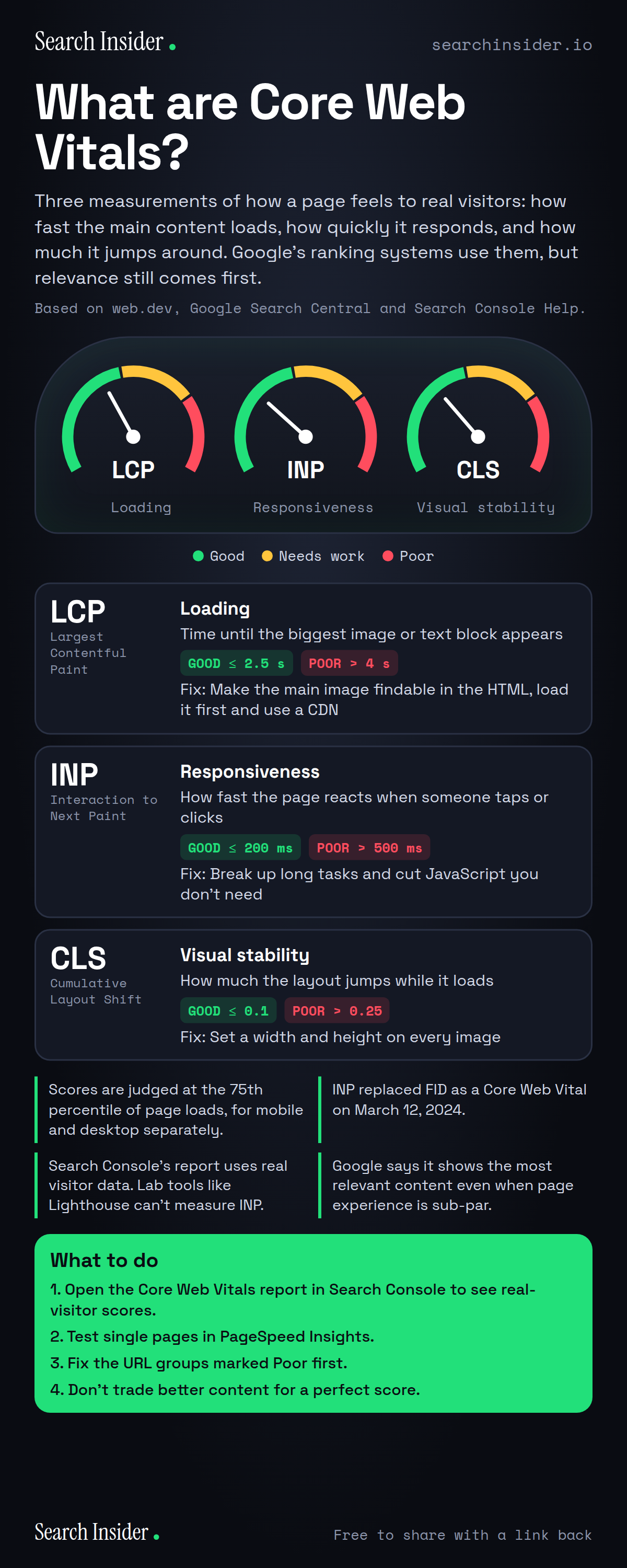
Core Web Vitals infographic styled as a car dashboard: three gauges for LCP, INP and CLS, cards with what each measures, good and poor thresholds and the main fix, key facts about how scores are measured, and four steps to take.

Oct 5, 2026

Core Web Vitals Infographic: LCP, INP and CLS Explained

Core Web Vitals explained: what LCP, INP and CLS measure, the good and poor thresholds, how to fix each, and how much they matter for rankings.

Embed this infographic

Every infographic here is free to republish, on any site, with a link back to the study it comes from. Paste this code and the credit is done for you.

<a href="https://searchinsider.io/infographics/core-web-vitals"><img src="https://searchinsider.io/research/core-web-vitals/core-web-vitals-infographic.png" alt="Core Web Vitals infographic styled as a car dashboard: three gauges for LCP, INP and CLS, cards with what each measures, good and poor thresholds and the main fix, key facts about how scores are measured, and four steps to take." style="max-width:680px;width:100%;height:auto;" /></a><p>Source: <a href="https://searchinsider.io/infographics/core-web-vitals">Core Web Vitals explained infographic</a> by Search Insider.</p>

What are Core Web Vitals?

The short answer: Three measurements of how a page feels to real visitors: how fast the main content loads, how quickly it responds, and how much it jumps around. Google's ranking systems use them, but relevance still comes first.

Based on web.dev, Google Search Central and Search Console Help.

What it shows

  • LCP (loading): good is 2.5 seconds or less, poor is over 4 seconds.
  • INP (responsiveness): good is 200 ms or less, poor is over 500 ms.
  • CLS (visual stability): good is 0.1 or less, poor is over 0.25.
  • Scores are judged at the 75th percentile of page loads, mobile and desktop separately.
  • INP replaced FID as a Core Web Vital on March 12, 2024.
  • Google shows the most relevant content even when page experience is sub-par.

What to do

  • First: Open the Core Web Vitals report in Search Console.
  • Testing: Check single pages in PageSpeed Insights.
  • Fixing: Start with URL groups marked Poor.

The walkthrough

What are Core Web Vitals?

Core Web Vitals are a set of metrics that measure real-world user experience for loading performance, interactivity and visual stability [1]. The three metrics are Largest Contentful Paint (LCP), Interaction to Next Paint (INP) and Cumulative Layout Shift (CLS) [2].

What are good Core Web Vitals scores?

LCP is good at 2.5 seconds or less and poor above 4 seconds. INP is good at 200 milliseconds or less and poor above 500 milliseconds. CLS is good at 0.1 or less and poor above 0.25 [3]. Google measures each at the 75th percentile of page loads, segmented across mobile and desktop [2].

What does LCP measure and how do you fix it?

LCP reports the render time of the largest image, text block or video visible in the viewport [4]. To improve it, make sure the LCP resource is discoverable from the HTML source and prioritized, and use a CDN to cut server response time [5].

What does INP measure and how do you fix it?

INP measures how quickly a page responds to interactions such as taps and clicks [2]. It replaced First Input Delay as a Core Web Vital on March 12, 2024 [6]. To improve it, yield often to break up long tasks and avoid unnecessary JavaScript [5].

What does CLS measure and how do you fix it?

CLS measures visual stability: how much the layout shifts while the page loads [2]. The best way to fix shifts caused by unsized images is to set explicit width and height attributes [5].

Do Core Web Vitals affect Google rankings?

Yes, but they are not everything. Google says Core Web Vitals are used by its ranking systems [7], and that Search always seeks to show the most relevant content, even if the page experience is sub-par [7].

How do you check Core Web Vitals?

The Search Console Core Web Vitals report shows real-world usage data from the Chrome UX Report, grouped into similar pages and split by mobile and desktop [3]. PageSpeed Insights and Lighthouse test individual URLs [3]. Lab tools that load pages without a real user cannot measure INP [2].

More digital marketing infographics

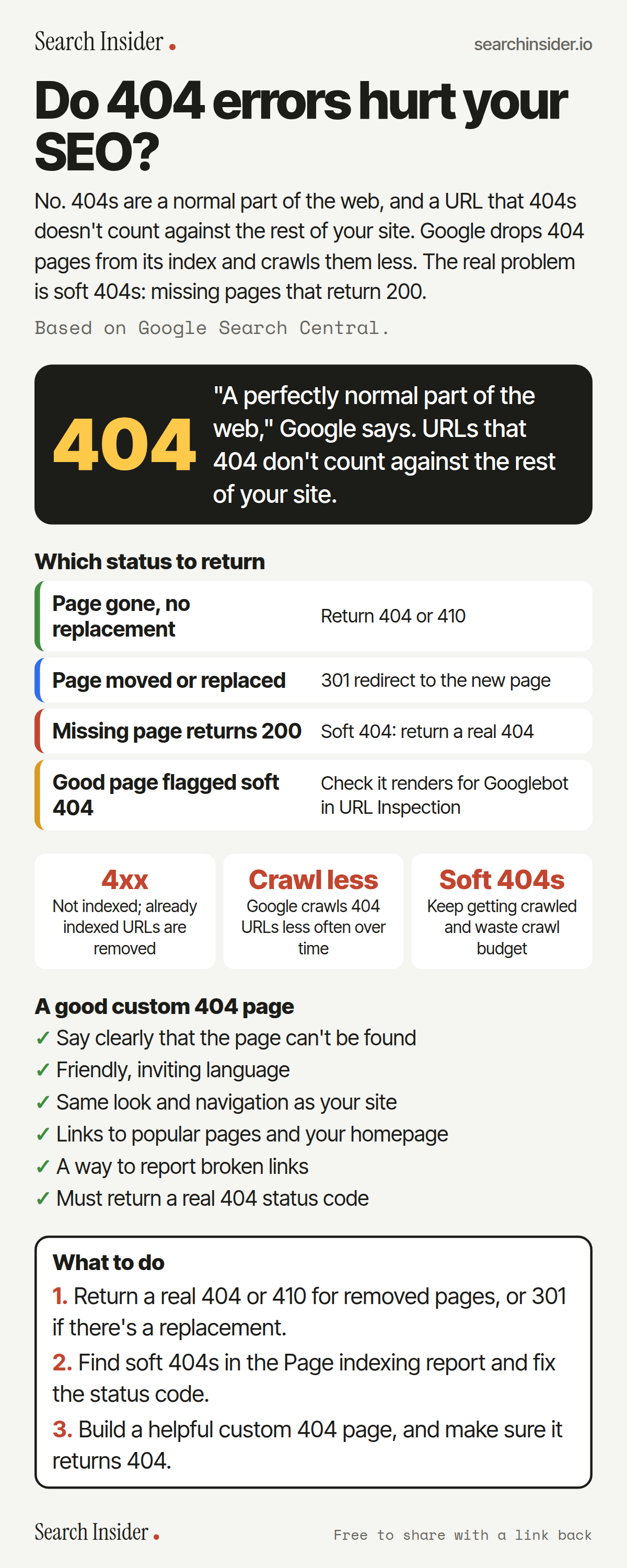
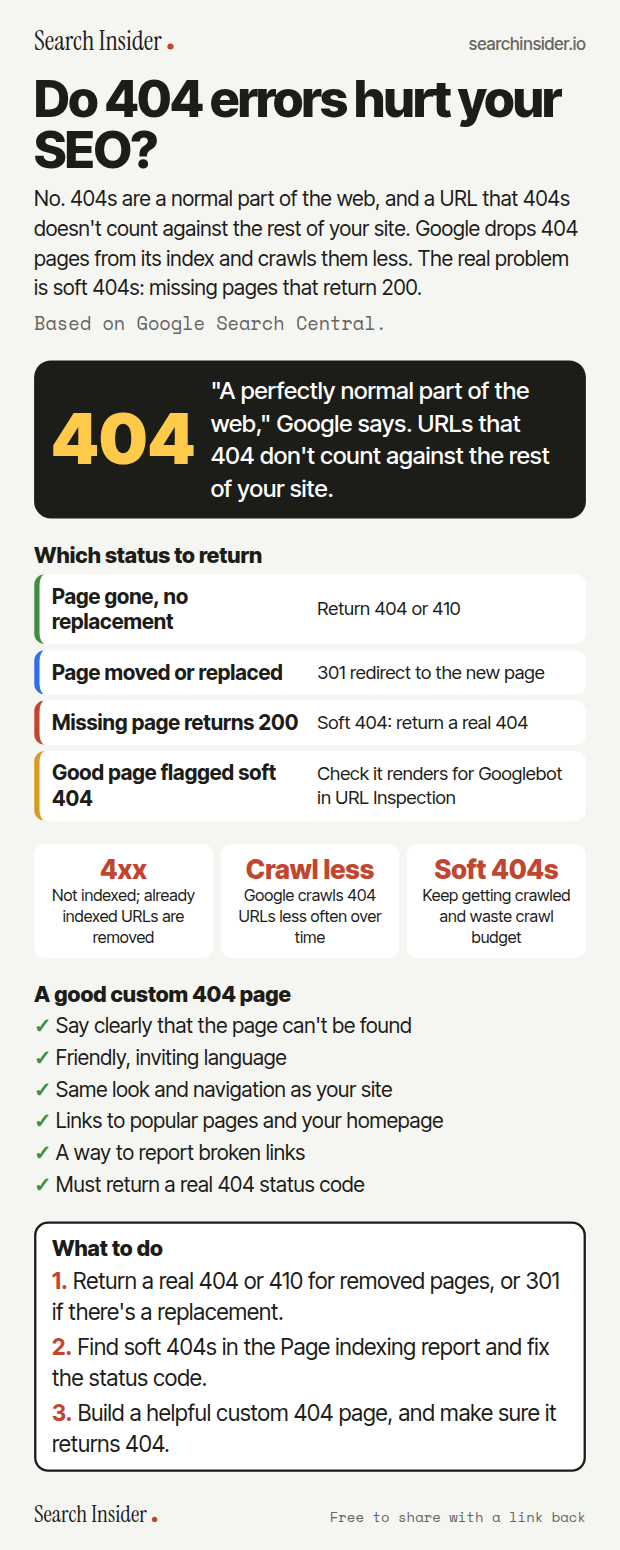
404 errors infographic: a 404 banner with Google's view that 404s are normal, which status to return in four cases, three facts on how Google treats 4xx and soft 404s, a checklist for a good custom 404 page, and three steps on what to do.

SEO · Oct 6, 2026

Do 404 errors hurt your SEO?

Do 404 errors hurt SEO? How Google treats 404s, why soft 404s are the real problem, which status code to return, and how to build a good custom 404 page.

Embed code
<a href="https://searchinsider.io/infographics/404-errors"><img src="https://searchinsider.io/research/404-errors/404-errors-infographic.png" alt="404 errors infographic: a 404 banner with Google's view that 404s are normal, which status to return in four cases, three facts on how Google treats 4xx and soft 404s, a checklist for a good custom 404 page, and three steps on what to do." style="max-width:680px;width:100%;height:auto;" /></a><p>Source: <a href="https://searchinsider.io/infographics/404-errors">404 errors infographic</a> by Search Insider.</p>
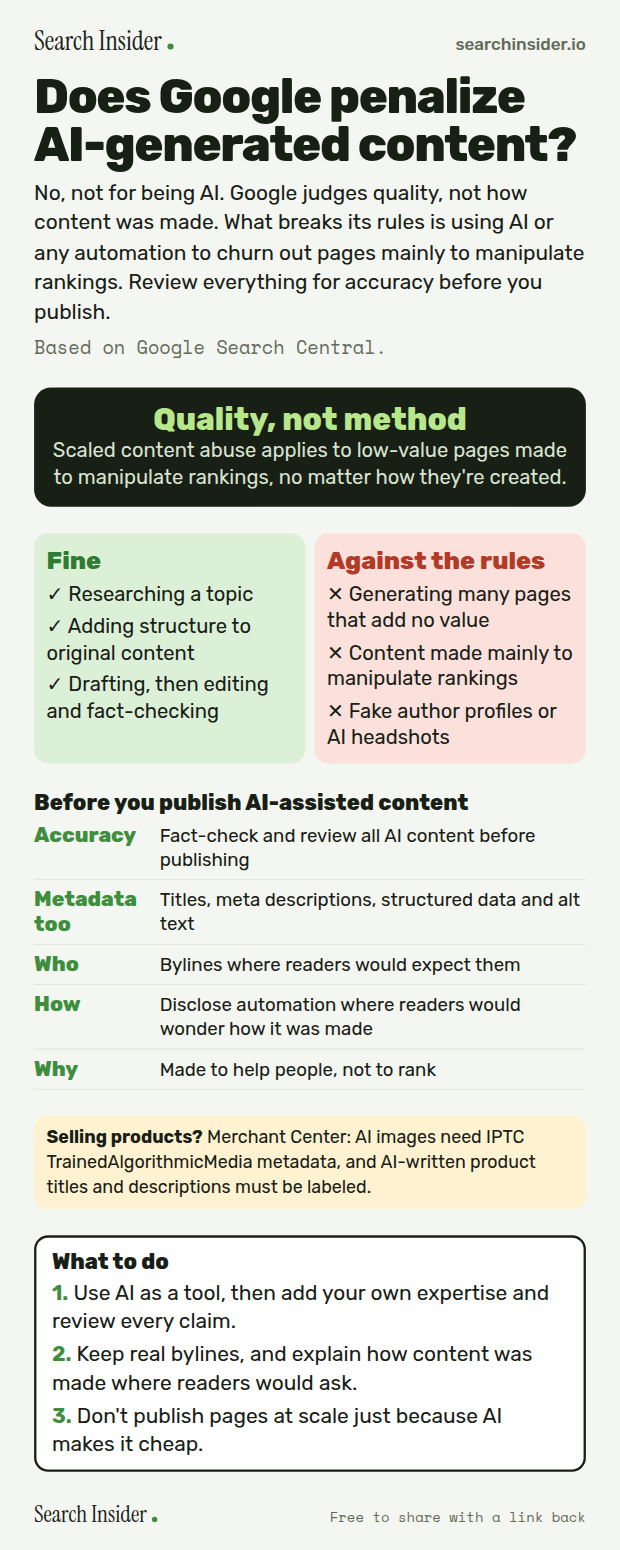
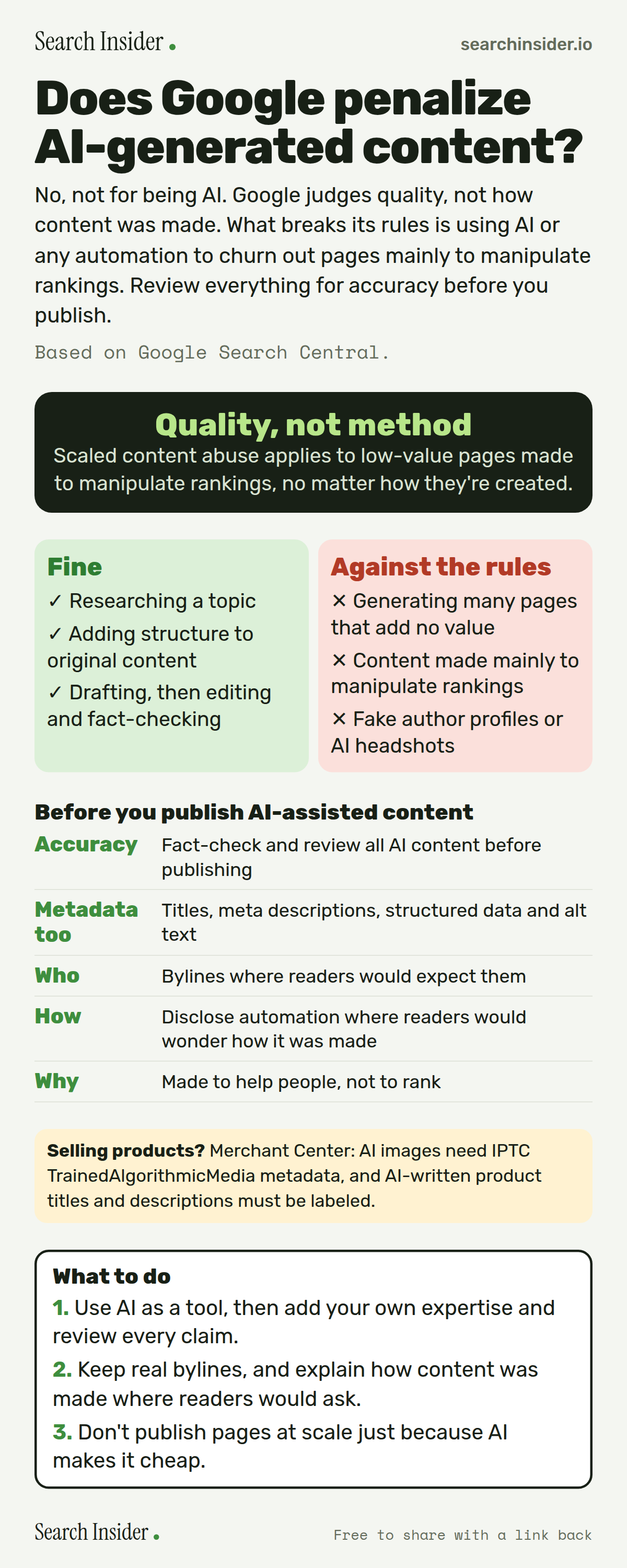
AI-generated content infographic: a quality not method banner, a split of fine uses versus uses against Google's rules, a pre-publish checklist (accuracy, metadata, who, how, why), a Merchant Center note on labeling AI images and product data, and three steps on what to do.

AI search · Oct 6, 2026

Does Google penalize AI-generated content?

Google's stance on AI-generated content: quality over production method, what breaks the scaled content abuse policy, and a checklist before publishing AI-assisted content.

Embed code
<a href="https://searchinsider.io/infographics/ai-generated-content"><img src="https://searchinsider.io/research/ai-generated-content/ai-generated-content-infographic.png" alt="AI-generated content infographic: a quality not method banner, a split of fine uses versus uses against Google's rules, a pre-publish checklist (accuracy, metadata, who, how, why), a Merchant Center note on labeling AI images and product data, and three steps on what to do." style="max-width:680px;width:100%;height:auto;" /></a><p>Source: <a href="https://searchinsider.io/infographics/ai-generated-content">AI-generated content infographic</a> by Search Insider.</p>
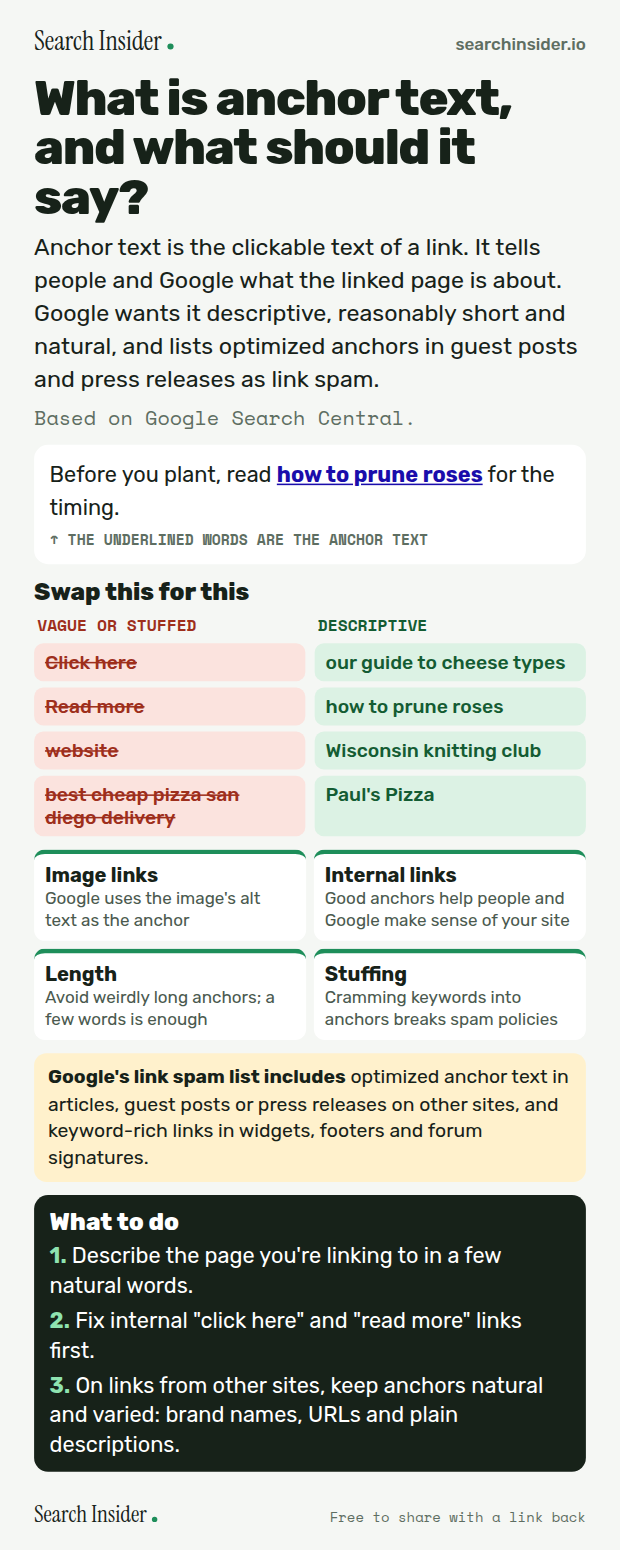
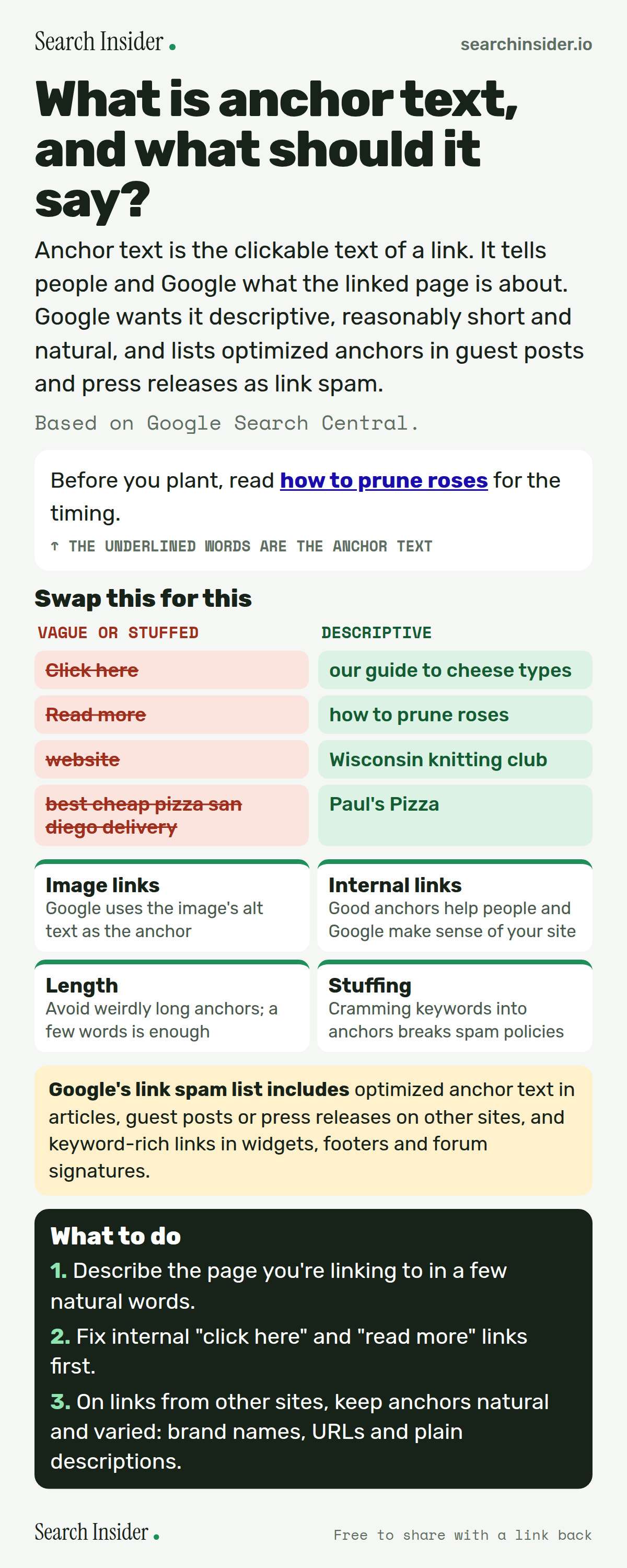
Anchor text infographic: an example link with the anchor text underlined, four vague or stuffed anchors swapped for descriptive ones, four rules on image links, internal links, length and keyword stuffing, a note on Google's link spam examples, and three steps on what to do.

SEO · Oct 6, 2026

What is anchor text, and what should it say?

What anchor text is, what Google says it should say, good and bad examples, image link alt text, and which anchor practices Google lists as link spam.

Embed code
<a href="https://searchinsider.io/infographics/anchor-text"><img src="https://searchinsider.io/research/anchor-text/anchor-text-infographic.png" alt="Anchor text infographic: an example link with the anchor text underlined, four vague or stuffed anchors swapped for descriptive ones, four rules on image links, internal links, length and keyword stuffing, a note on Google's link spam examples, and three steps on what to do." style="max-width:680px;width:100%;height:auto;" /></a><p>Source: <a href="https://searchinsider.io/infographics/anchor-text">Anchor text infographic</a> by Search Insider.</p>