Skip to content
← Content Marketing Infographics
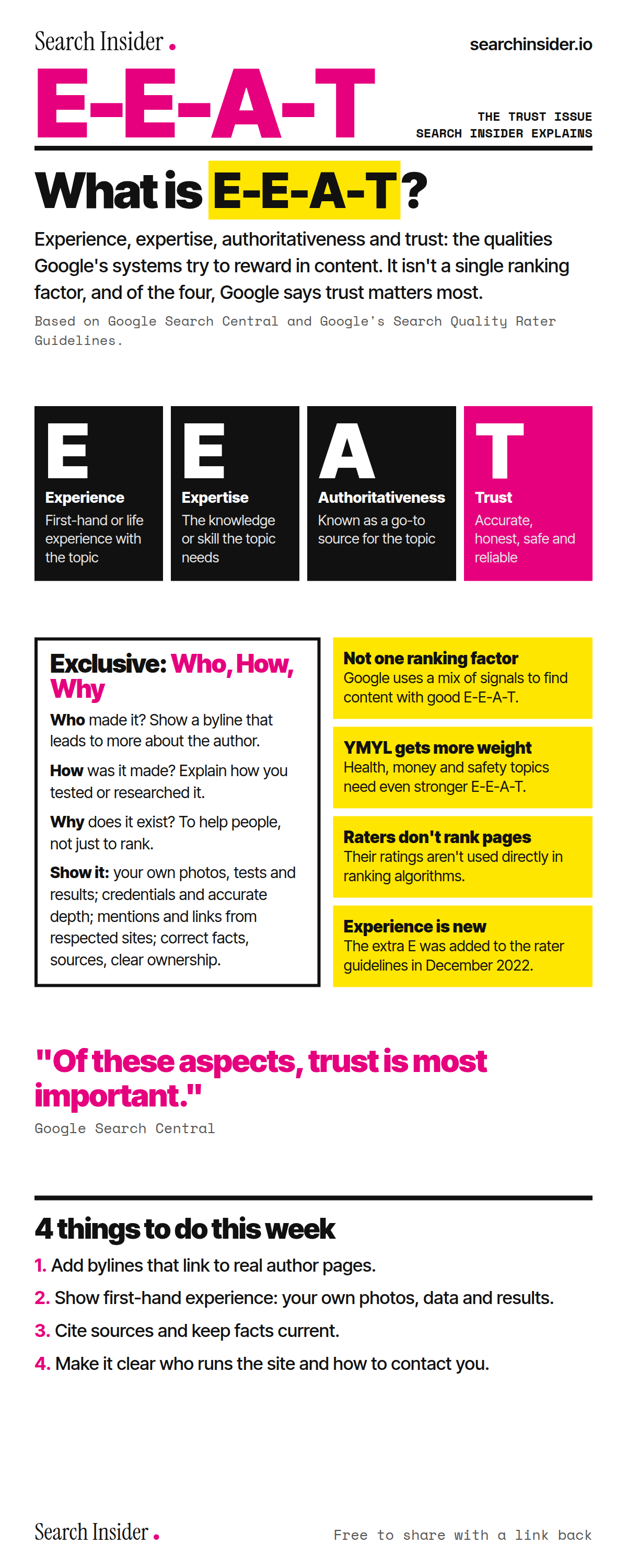
E-E-A-T infographic styled as a magazine cover: four large letter blocks for experience, expertise, authoritativeness and trust, a Who, How and Why panel, four key facts, a pull quote that trust is most important, and four things to do this week.

Oct 5, 2026

E-E-A-T Infographic: Experience, Expertise, Authority, Trust

E-E-A-T explained: what experience, expertise, authoritativeness and trust mean, why trust matters most, the Who, How and Why test, and what to do this week.

Embed this infographic

Every infographic here is free to republish, on any site, with a link back to the study it comes from. Paste this code and the credit is done for you.

<a href="https://searchinsider.io/infographics/eeat"><img src="https://searchinsider.io/research/eeat/eeat-infographic.png" alt="E-E-A-T infographic styled as a magazine cover: four large letter blocks for experience, expertise, authoritativeness and trust, a Who, How and Why panel, four key facts, a pull quote that trust is most important, and four things to do this week." style="max-width:680px;width:100%;height:auto;" /></a><p>Source: <a href="https://searchinsider.io/infographics/eeat">What is E-E-A-T? infographic</a> by Search Insider.</p>

What is E-E-A-T?

The short answer: Experience, expertise, authoritativeness and trust: the qualities Google's systems try to reward in content. It isn't a single ranking factor, and of the four, Google says trust matters most.

Based on Google Search Central and Google's Search Quality Rater Guidelines.

What it shows

  • Experience: first-hand or life experience with the topic.
  • Expertise: the knowledge or skill the topic needs.
  • Authoritativeness: known as a go-to source for the topic.
  • Trust: accurate, honest, safe and reliable. Google says trust is most important.
  • E-E-A-T is not a single ranking factor.
  • YMYL topics like health, money and safety get even more weight on E-E-A-T.
  • Raters don't rank pages.
  • The extra E for Experience was added in December 2022.

What to do

  • Authors: Add bylines that link to real author pages.
  • Content: Show first-hand experience, cite sources and keep facts current.
  • Site: Make it clear who runs the site and how to contact you.

The walkthrough

What does E-E-A-T stand for?

E-E-A-T stands for experience, expertise, authoritativeness and trustworthiness [1]. Google's rater guidelines define experience as first-hand or life experience with the topic, expertise as the necessary knowledge or skill, authoritativeness as being known as a go-to source, and trust as the extent to which a page is accurate, honest, safe and reliable [2].

Which part of E-E-A-T matters most?

Trust. Google says that of these aspects, trust is most important [1]. Its rater guidelines add that untrustworthy pages have low E-E-A-T no matter how experienced, expert or authoritative they may seem [2].

Is E-E-A-T a ranking factor?

Not directly. Google says E-E-A-T itself isn't a specific ranking factor, but its systems use a mix of factors that can identify content with good E-E-A-T [1]. Search quality raters help Google evaluate its systems, but rater data is not used directly in ranking algorithms [1].

What is YMYL and why does it matter for E-E-A-T?

YMYL, short for Your Money or Your Life, covers topics that could significantly impact the health, financial stability or safety of people, or the welfare of society [1]. Google says its systems give even more weight to content with strong E-E-A-T on these topics [1].

How do you show E-E-A-T?

Google suggests judging content by Who, How and Why: make it clear who created it, explain how it was produced, and make sure the reason it exists is to help people [1]. Google also asks whether pages carry a byline where one would be expected, leading to more information about the author [1].

When was Experience added to E-A-T?

Google added the extra E for Experience to its quality rater guidelines in December 2022, turning E-A-T into E-E-A-T [3].

More digital marketing infographics

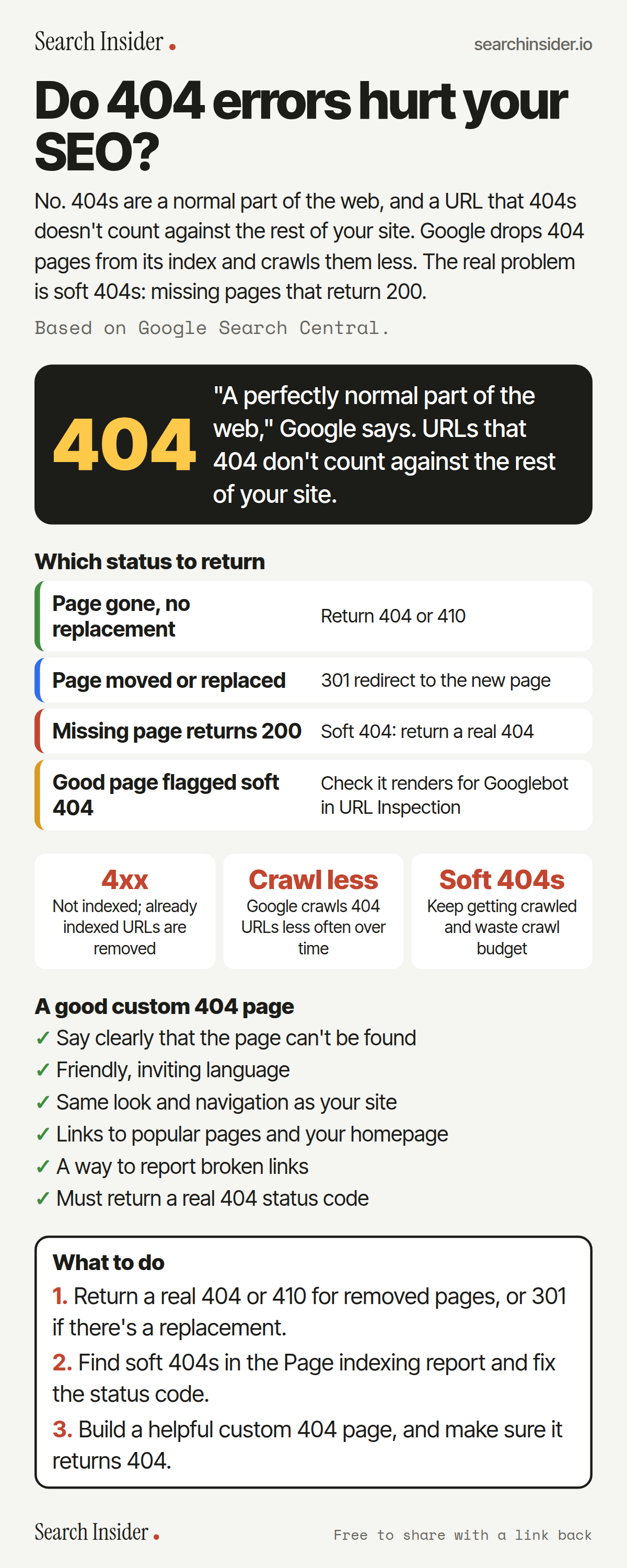
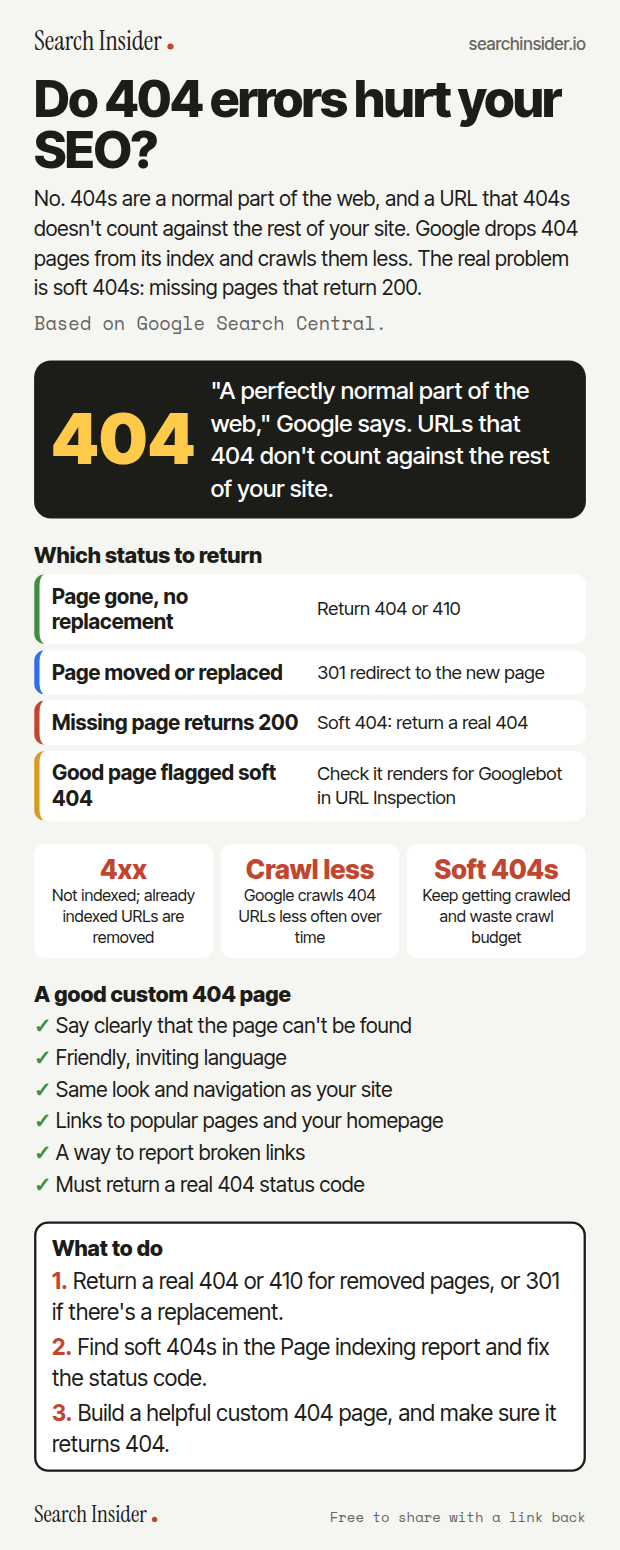
404 errors infographic: a 404 banner with Google's view that 404s are normal, which status to return in four cases, three facts on how Google treats 4xx and soft 404s, a checklist for a good custom 404 page, and three steps on what to do.

SEO · Oct 6, 2026

Do 404 errors hurt your SEO?

Do 404 errors hurt SEO? How Google treats 404s, why soft 404s are the real problem, which status code to return, and how to build a good custom 404 page.

Embed code
<a href="https://searchinsider.io/infographics/404-errors"><img src="https://searchinsider.io/research/404-errors/404-errors-infographic.png" alt="404 errors infographic: a 404 banner with Google's view that 404s are normal, which status to return in four cases, three facts on how Google treats 4xx and soft 404s, a checklist for a good custom 404 page, and three steps on what to do." style="max-width:680px;width:100%;height:auto;" /></a><p>Source: <a href="https://searchinsider.io/infographics/404-errors">404 errors infographic</a> by Search Insider.</p>
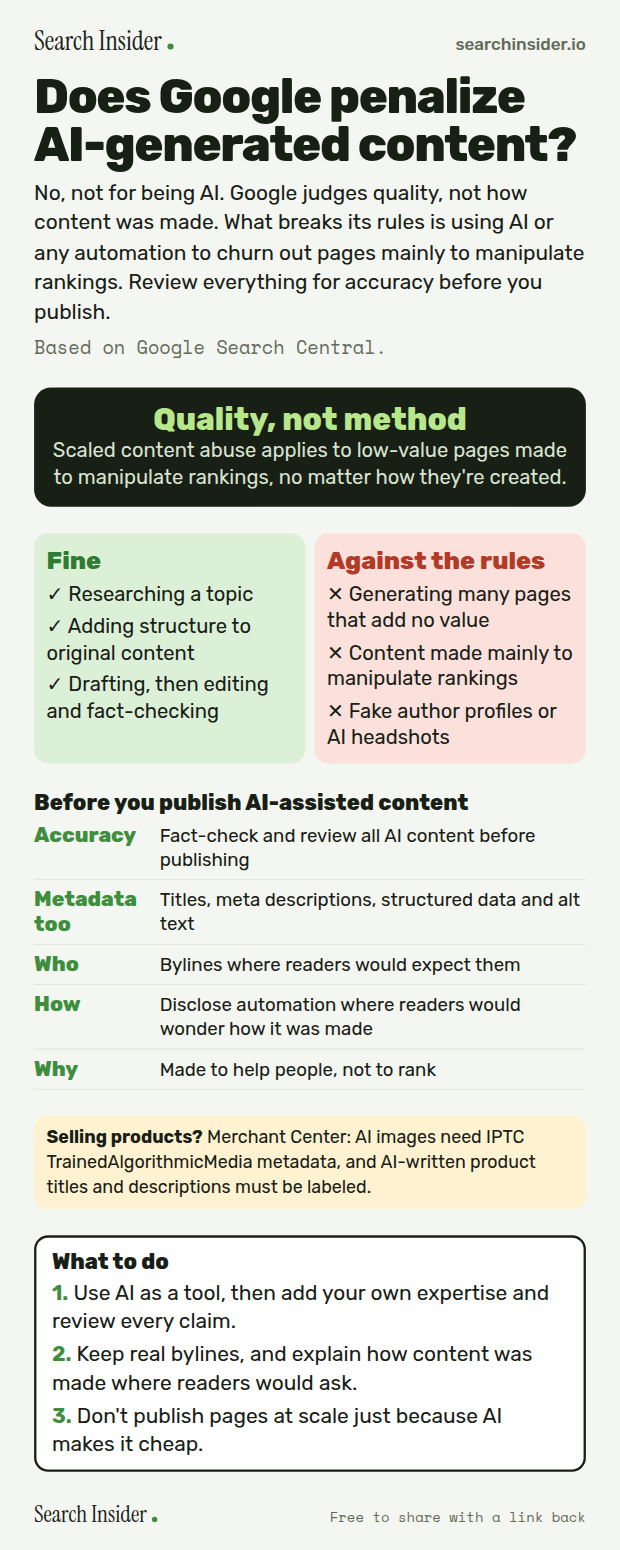
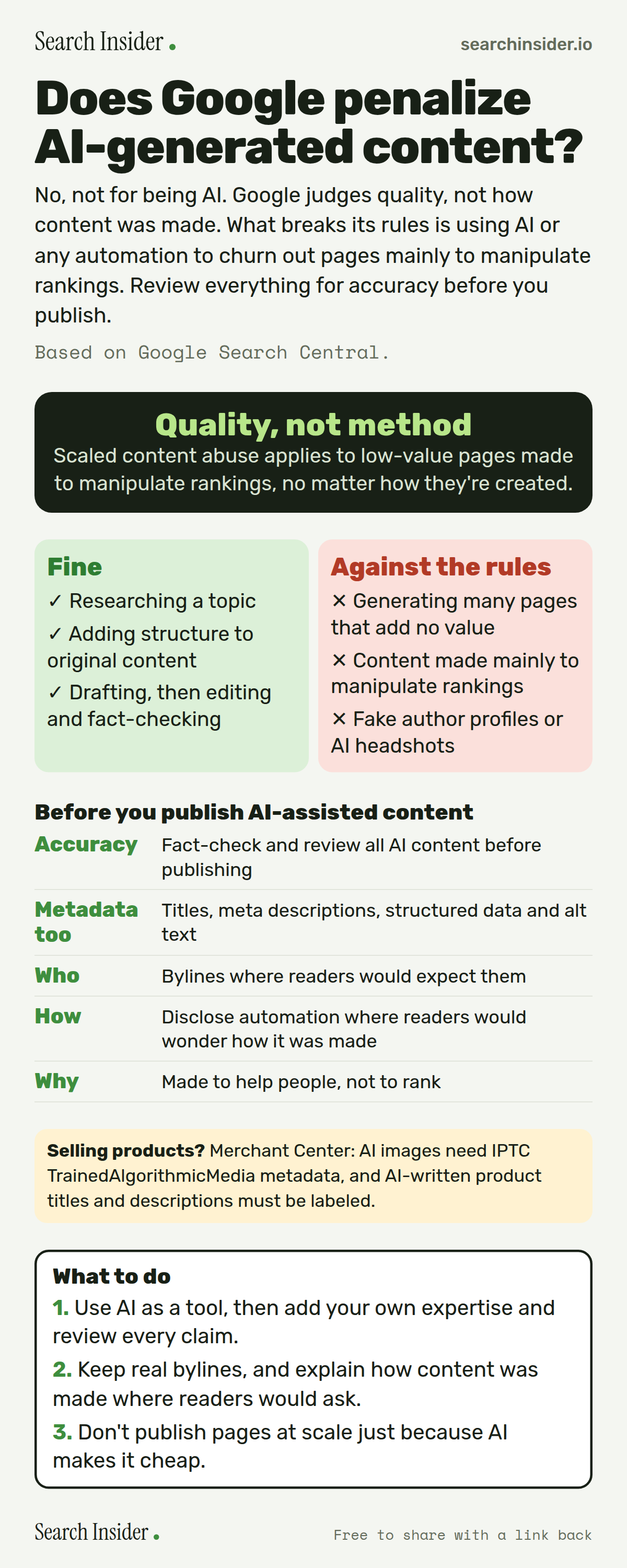
AI-generated content infographic: a quality not method banner, a split of fine uses versus uses against Google's rules, a pre-publish checklist (accuracy, metadata, who, how, why), a Merchant Center note on labeling AI images and product data, and three steps on what to do.

AI search · Oct 6, 2026

Does Google penalize AI-generated content?

Google's stance on AI-generated content: quality over production method, what breaks the scaled content abuse policy, and a checklist before publishing AI-assisted content.

Embed code
<a href="https://searchinsider.io/infographics/ai-generated-content"><img src="https://searchinsider.io/research/ai-generated-content/ai-generated-content-infographic.png" alt="AI-generated content infographic: a quality not method banner, a split of fine uses versus uses against Google's rules, a pre-publish checklist (accuracy, metadata, who, how, why), a Merchant Center note on labeling AI images and product data, and three steps on what to do." style="max-width:680px;width:100%;height:auto;" /></a><p>Source: <a href="https://searchinsider.io/infographics/ai-generated-content">AI-generated content infographic</a> by Search Insider.</p>
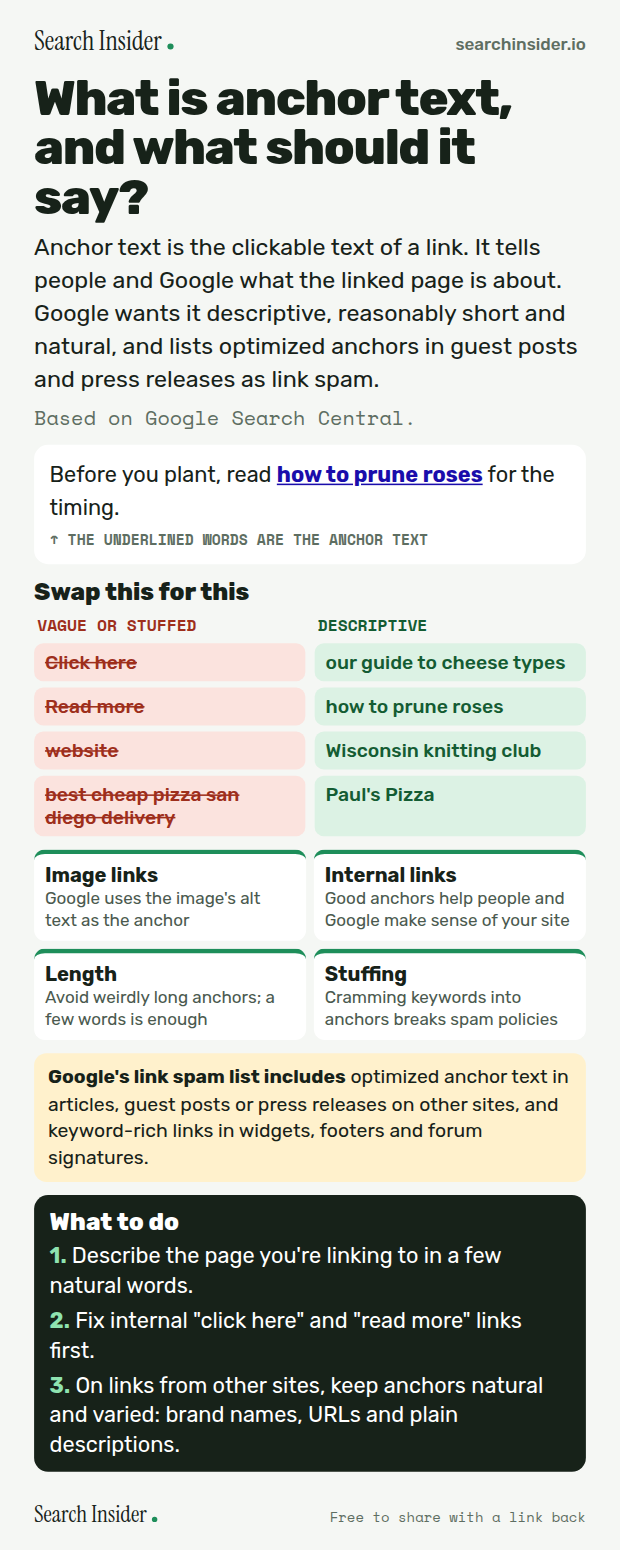
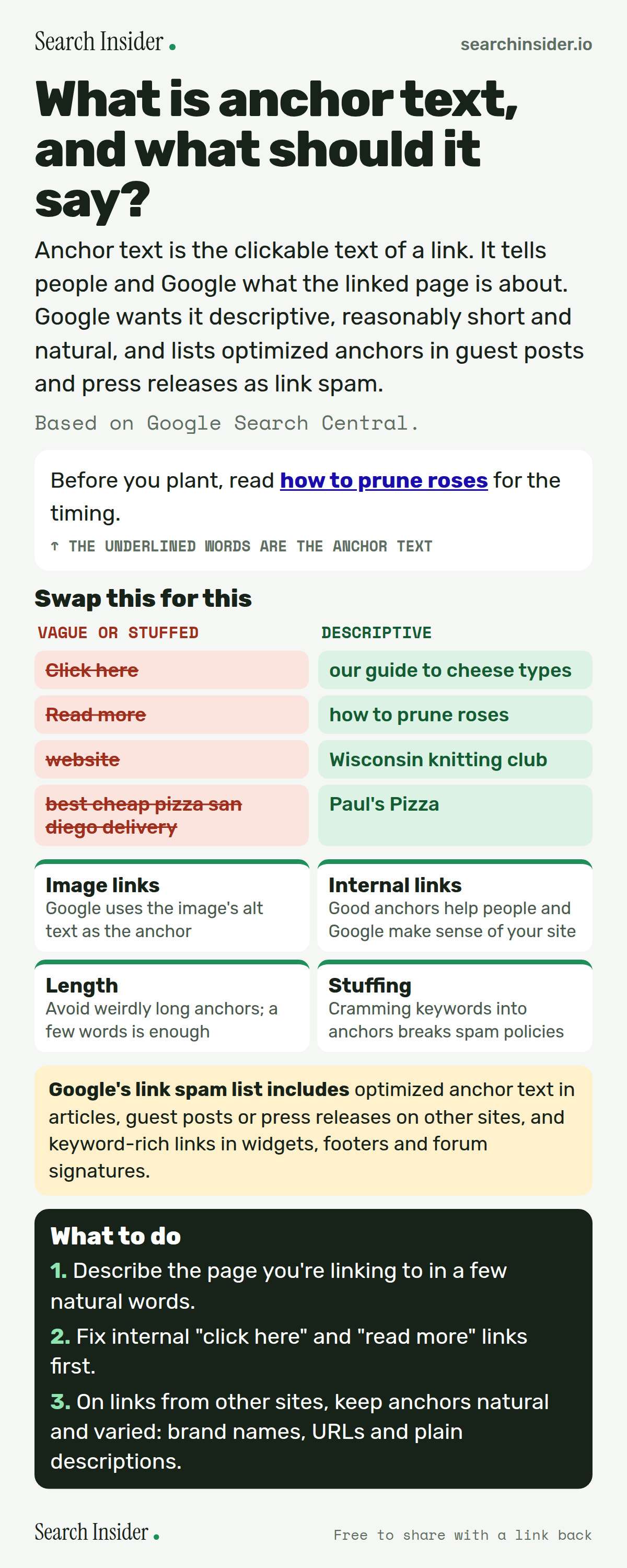
Anchor text infographic: an example link with the anchor text underlined, four vague or stuffed anchors swapped for descriptive ones, four rules on image links, internal links, length and keyword stuffing, a note on Google's link spam examples, and three steps on what to do.

SEO · Oct 6, 2026

What is anchor text, and what should it say?

What anchor text is, what Google says it should say, good and bad examples, image link alt text, and which anchor practices Google lists as link spam.

Embed code
<a href="https://searchinsider.io/infographics/anchor-text"><img src="https://searchinsider.io/research/anchor-text/anchor-text-infographic.png" alt="Anchor text infographic: an example link with the anchor text underlined, four vague or stuffed anchors swapped for descriptive ones, four rules on image links, internal links, length and keyword stuffing, a note on Google's link spam examples, and three steps on what to do." style="max-width:680px;width:100%;height:auto;" /></a><p>Source: <a href="https://searchinsider.io/infographics/anchor-text">Anchor text infographic</a> by Search Insider.</p>