Skip to content
← SEO Infographics
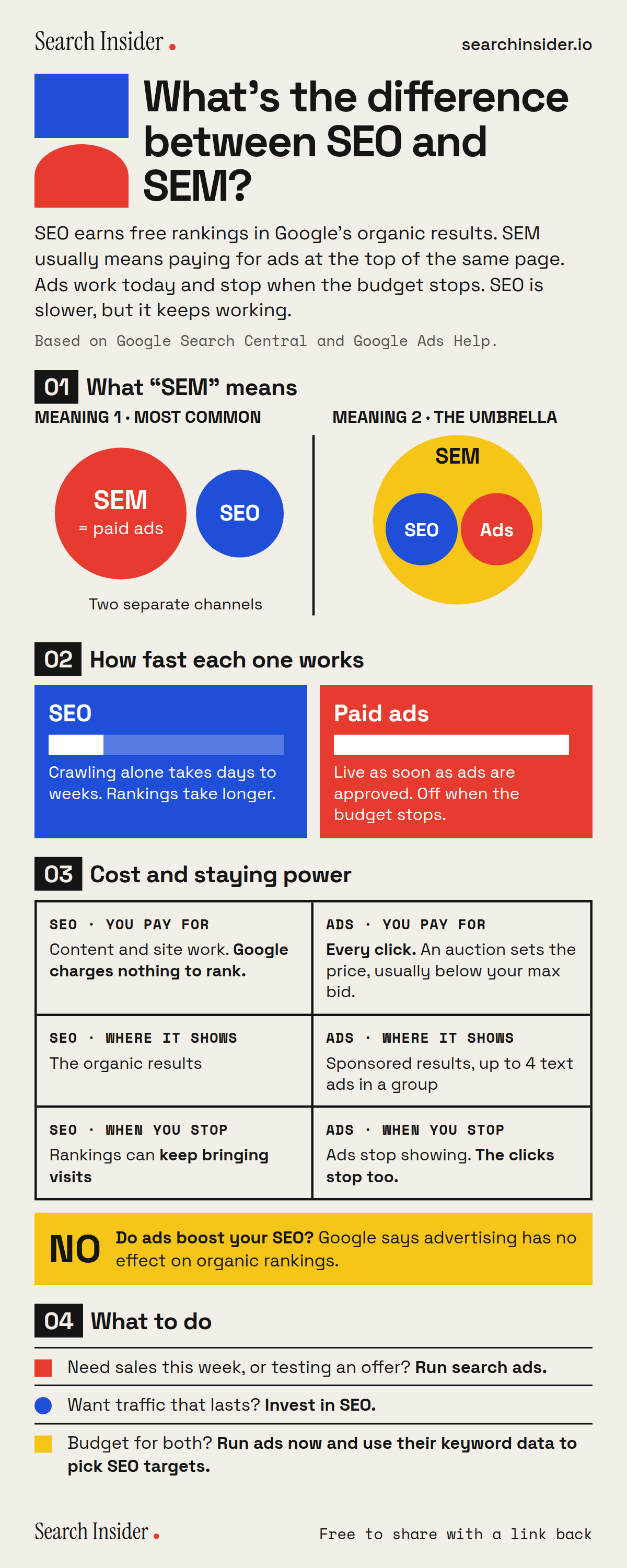
SEO vs SEM infographic: what's the difference between SEO and SEM? Circle diagrams of the two meanings of SEM, a speed comparison, a grid comparing cost, placement and what happens when you stop, a myth box saying ads don't boost SEO, and three steps on what to do.

Oct 5, 2026

SEO vs SEM Infographic: What's the Difference?

The difference between SEO and SEM in one page: both meanings of SEM, what you pay for, where each shows, how fast it works and what happens when you stop.

Embed this infographic

Every infographic here is free to republish, on any site, with a link back to the study it comes from. Paste this code and the credit is done for you.

<a href="https://searchinsider.io/infographics/seo-vs-sem"><img src="https://searchinsider.io/research/seo-vs-sem/seo-vs-sem-infographic.png" alt="SEO vs SEM infographic: what's the difference between SEO and SEM? Circle diagrams of the two meanings of SEM, a speed comparison, a grid comparing cost, placement and what happens when you stop, a myth box saying ads don't boost SEO, and three steps on what to do." style="max-width:680px;width:100%;height:auto;" /></a><p>Source: <a href="https://searchinsider.io/infographics/seo-vs-sem">SEO vs SEM infographic</a> by Search Insider.</p>

What's the difference between SEO and SEM?

The short answer: SEO earns free rankings in Google's organic results. SEM usually means paying for ads at the top of the same page. Ads work today and stop when the budget stops. SEO is slower, but it keeps working.

Based on Google Search Central and Google Ads Help.

What it shows

  • SEM has two meanings: paid search ads only (the most common use today), or the umbrella term for SEO plus paid search (the original meaning).
  • SEO: you pay for content and site work. Google charges nothing to rank in organic results.
  • Paid search: you pay for every click. An auction sets the price, usually below your max bid.
  • Paid ads show as sponsored results, up to 4 text ads in a group. SEO shows in the organic results.
  • Speed: crawling alone can take days to weeks, and rankings take longer. Ads go live once they are approved.
  • When you stop: rankings can keep bringing visits. Paused ads stop showing and stop costing.
  • Myth: buying Google ads does not help your organic rankings.

What to do

  • Need sales this week, or testing an offer?: Run search ads.
  • Want traffic that lasts?: Invest in SEO.
  • Budget for both?: Run ads now and use their keyword data to pick SEO targets.

The walkthrough

What is the difference between SEO and SEM?

SEO (search engine optimization) is the work of earning unpaid rankings in Google's organic results. SEM (search engine marketing) most often means paid search: buying ads that appear in the same results page. The practical difference is how you pay and how long the results last. Ads bring visits as soon as they run and stop when the budget stops. SEO takes longer to build, but rankings can keep bringing visits after the work is done.

Does SEM include SEO?

It depends who is talking. SEM was first used as an umbrella term for SEO and paid search working together, and some marketers still use it that way [7]. Much of the industry now uses SEM to mean paid search ads only [7]. This infographic uses the paid-only meaning. When comparing agency quotes or job descriptions, check which meaning someone has in mind.

How much does SEO cost compared with SEM?

Google charges nothing to appear in its organic search results [1], so SEO costs are the content, technical work and time needed to earn rankings. Paid search charges you when someone clicks your ad [2]. Your actual cost per click is set in an auction and is usually less than your maximum bid, because you pay just enough to beat the advertiser below you [2].

Where do SEO and SEM results appear in Google?

Search ads can appear above or below the organic results on Google Search [3]. Google groups text ads under a single "Sponsored results" label, with no more than four text ads in a grouping, and searchers can hide that group with one click [4]. SEO earns a place in the organic results, the unpaid listings that sit around the ads.

Which is faster, SEO or SEM?

Paid search is faster. Ads can show as soon as they are approved and the campaign is live. SEO is slower because Google first has to crawl a page, which can take anywhere from a few days to a few weeks [5], and earning strong rankings usually takes longer than that.

What happens when you stop paying for ads?

Paused ads stop running and don't accrue charges while paused [6], so the traffic they bring stops too. You can resume them later without sending them through review again [6]. Organic rankings work differently: a page that ranks can keep bringing visits after you stop actively working on it, although competitors and updates can move it over time.

Do Google Ads improve your SEO rankings?

No. Google states that advertising with Google has no effect on a site's presence in its search results, and that it never accepts money to include or rank sites in organic results [1]. Ads can still help SEO indirectly: the search terms that convert in a paid campaign show which keywords are worth targeting with content.

Should you choose SEO or SEM?

Use paid search when you need visits this week, are launching something time-sensitive or want to test whether an offer converts before investing in content. Invest in SEO when you want traffic that keeps arriving without paying for each click. With budget for both, run ads while SEO builds, and use the ad campaign's keyword data to choose which pages to create first.

More digital marketing infographics

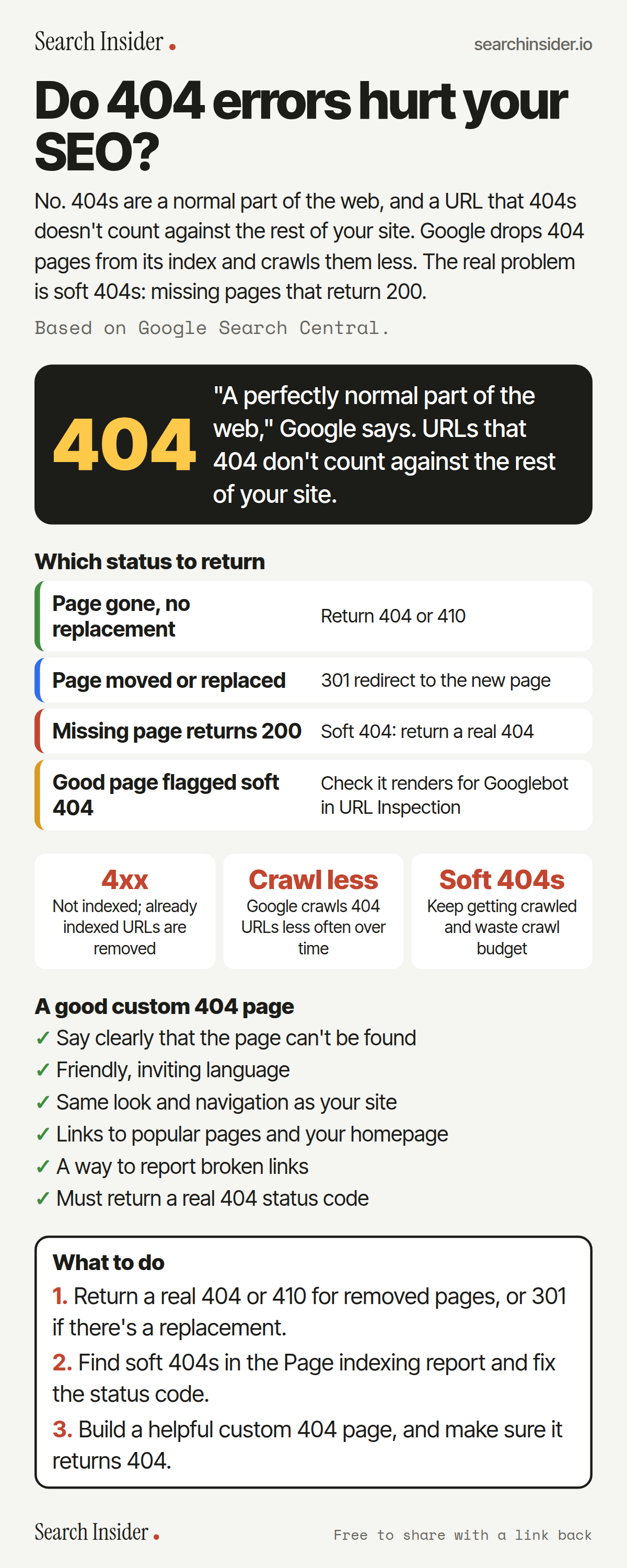
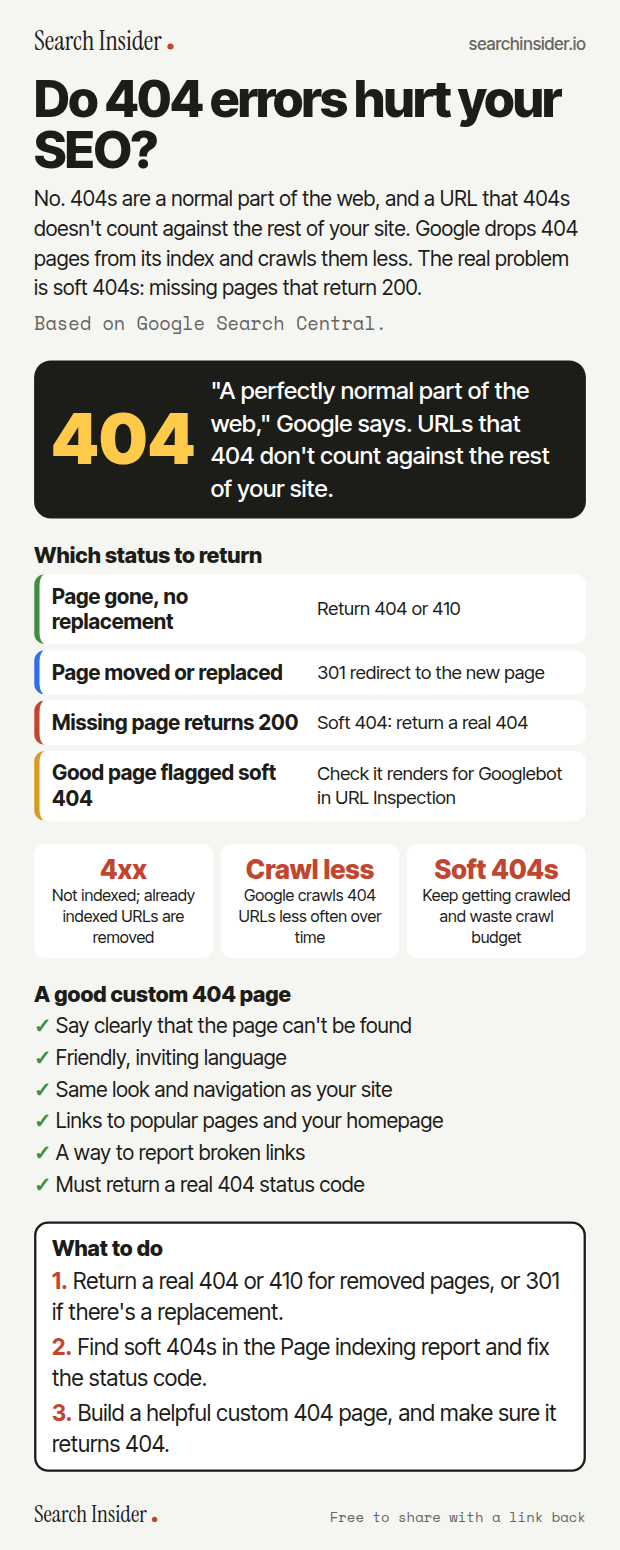
404 errors infographic: a 404 banner with Google's view that 404s are normal, which status to return in four cases, three facts on how Google treats 4xx and soft 404s, a checklist for a good custom 404 page, and three steps on what to do.

SEO · Oct 6, 2026

Do 404 errors hurt your SEO?

Do 404 errors hurt SEO? How Google treats 404s, why soft 404s are the real problem, which status code to return, and how to build a good custom 404 page.

Embed code
<a href="https://searchinsider.io/infographics/404-errors"><img src="https://searchinsider.io/research/404-errors/404-errors-infographic.png" alt="404 errors infographic: a 404 banner with Google's view that 404s are normal, which status to return in four cases, three facts on how Google treats 4xx and soft 404s, a checklist for a good custom 404 page, and three steps on what to do." style="max-width:680px;width:100%;height:auto;" /></a><p>Source: <a href="https://searchinsider.io/infographics/404-errors">404 errors infographic</a> by Search Insider.</p>
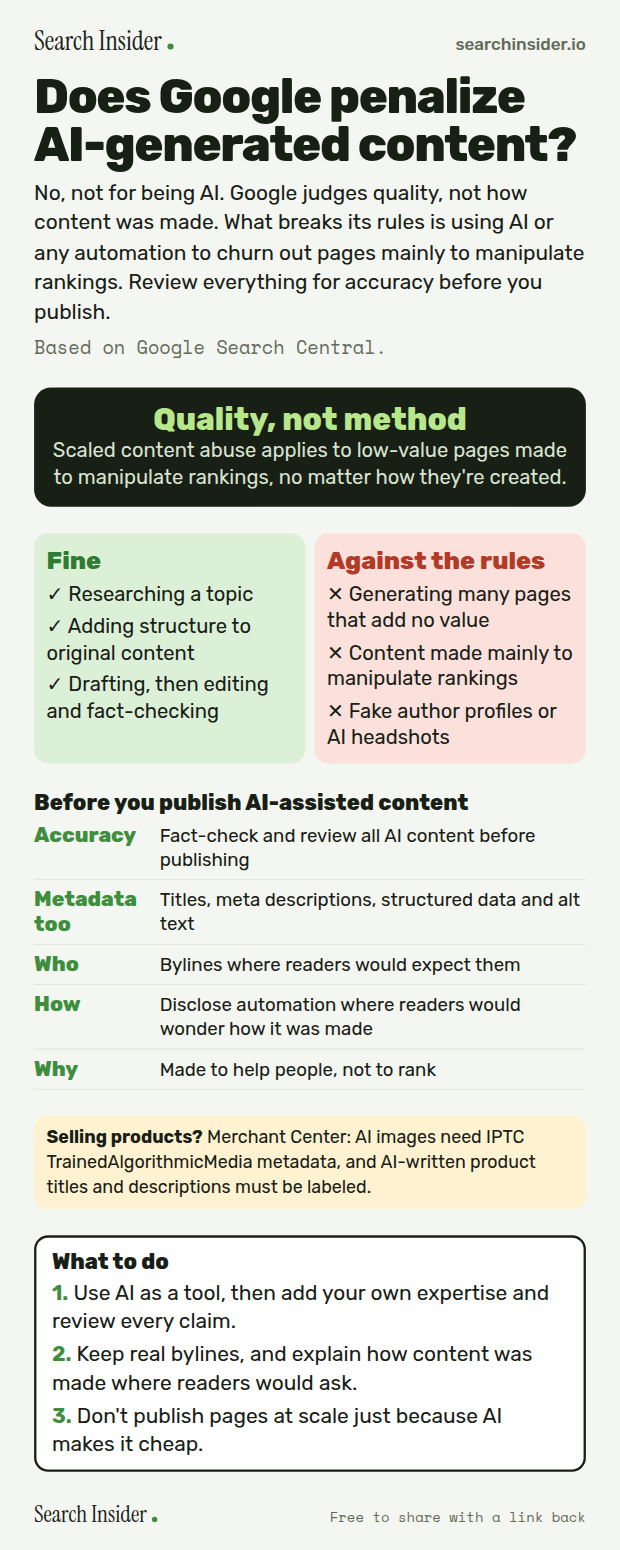
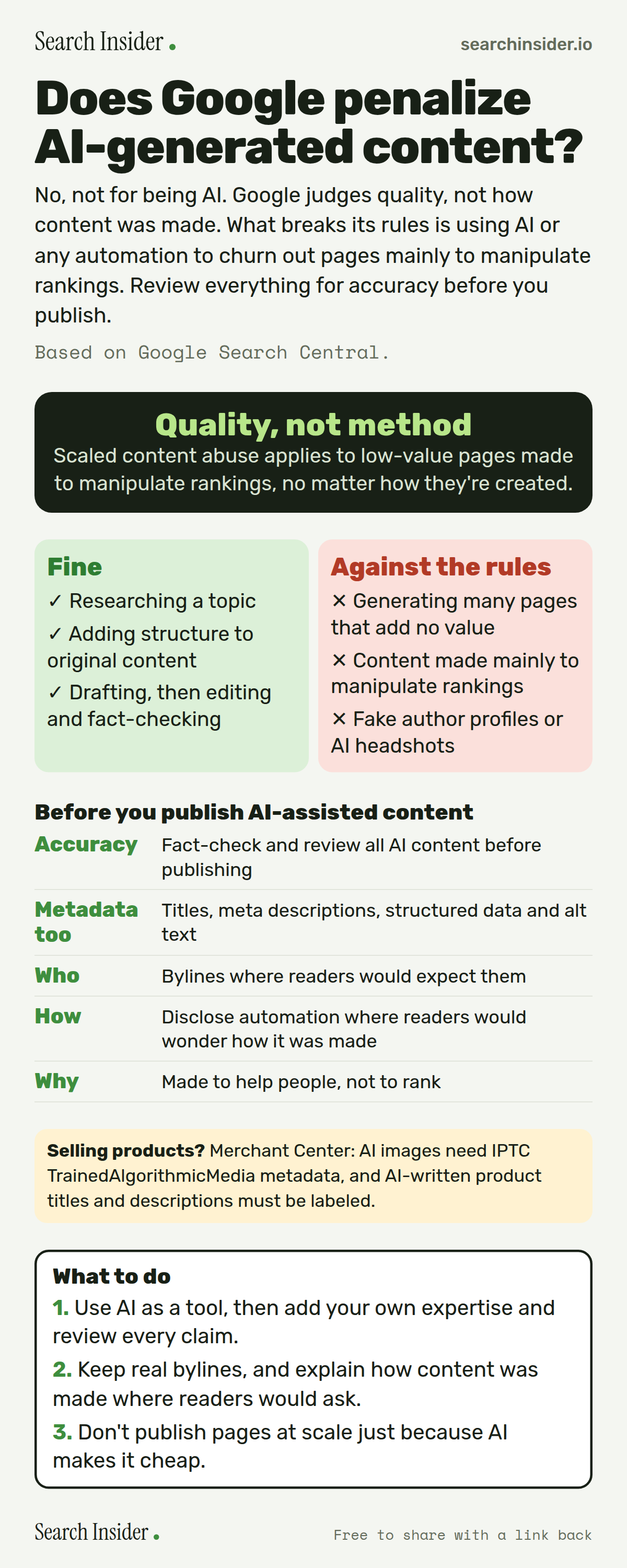
AI-generated content infographic: a quality not method banner, a split of fine uses versus uses against Google's rules, a pre-publish checklist (accuracy, metadata, who, how, why), a Merchant Center note on labeling AI images and product data, and three steps on what to do.

AI search · Oct 6, 2026

Does Google penalize AI-generated content?

Google's stance on AI-generated content: quality over production method, what breaks the scaled content abuse policy, and a checklist before publishing AI-assisted content.

Embed code
<a href="https://searchinsider.io/infographics/ai-generated-content"><img src="https://searchinsider.io/research/ai-generated-content/ai-generated-content-infographic.png" alt="AI-generated content infographic: a quality not method banner, a split of fine uses versus uses against Google's rules, a pre-publish checklist (accuracy, metadata, who, how, why), a Merchant Center note on labeling AI images and product data, and three steps on what to do." style="max-width:680px;width:100%;height:auto;" /></a><p>Source: <a href="https://searchinsider.io/infographics/ai-generated-content">AI-generated content infographic</a> by Search Insider.</p>
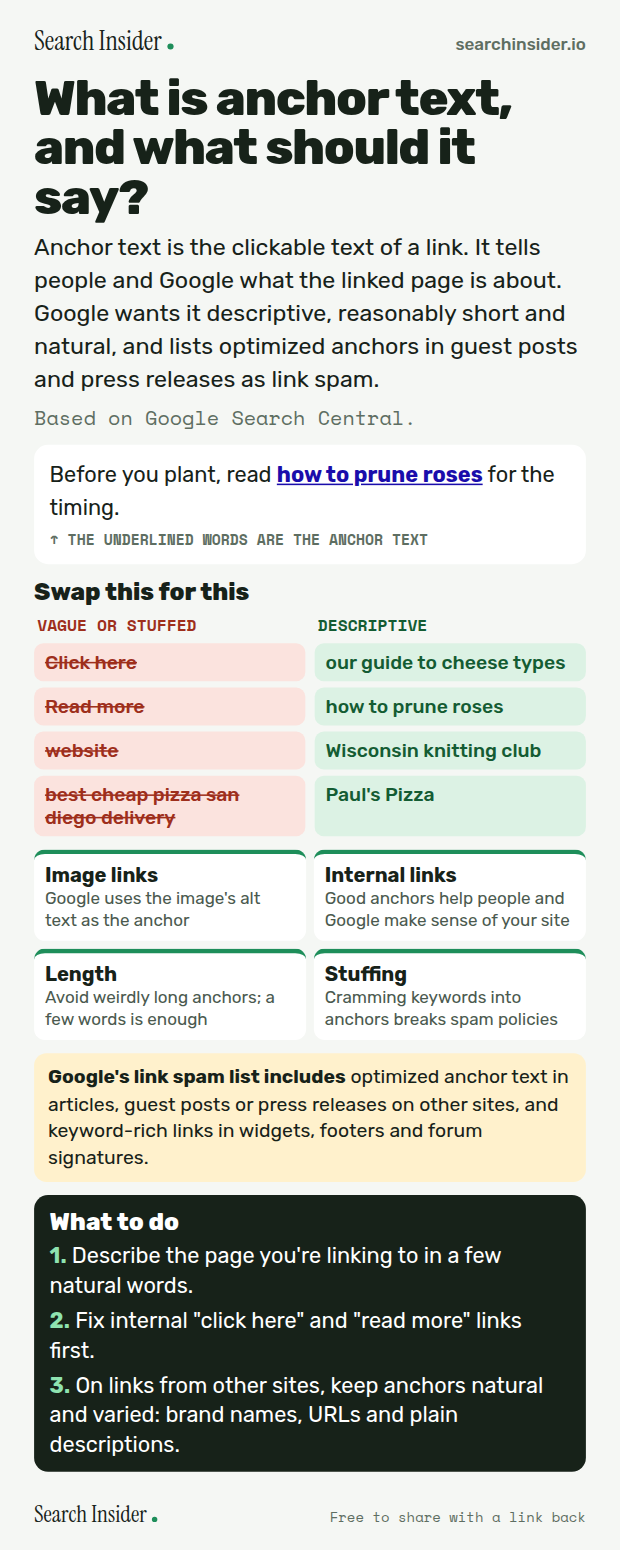
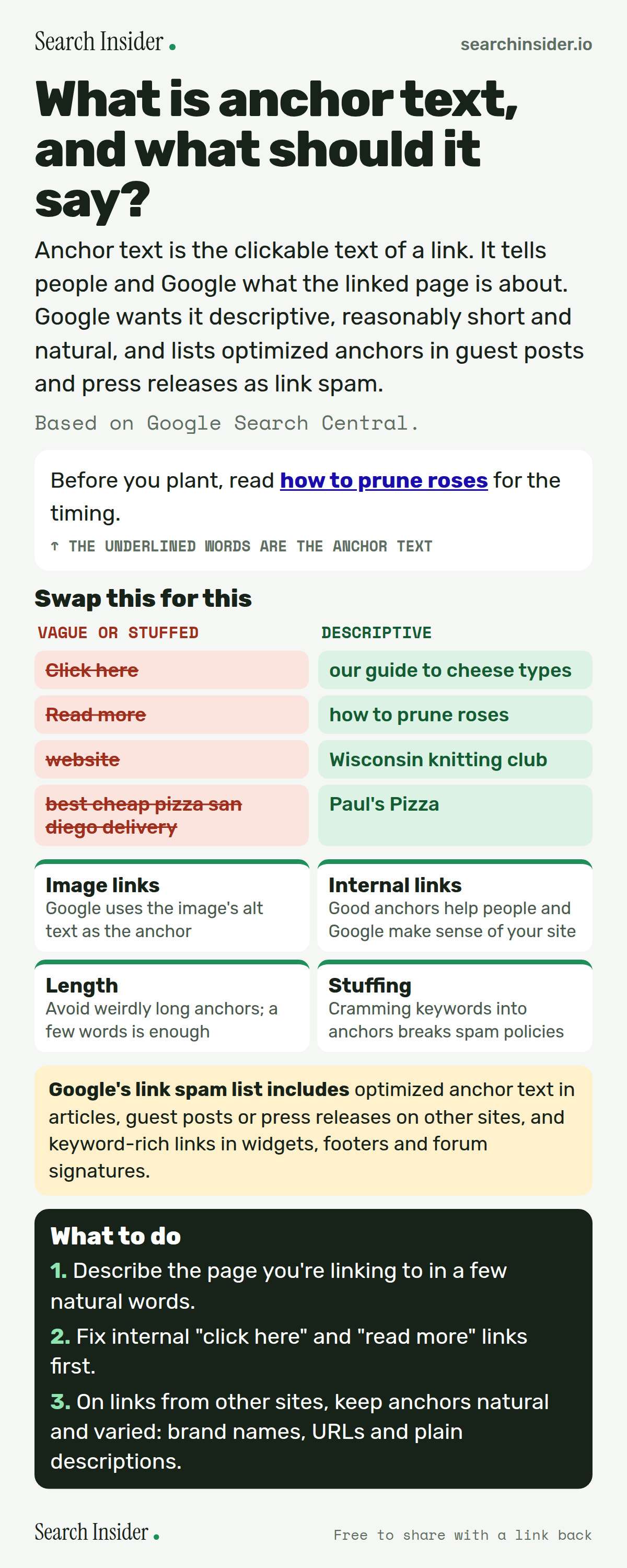
Anchor text infographic: an example link with the anchor text underlined, four vague or stuffed anchors swapped for descriptive ones, four rules on image links, internal links, length and keyword stuffing, a note on Google's link spam examples, and three steps on what to do.

SEO · Oct 6, 2026

What is anchor text, and what should it say?

What anchor text is, what Google says it should say, good and bad examples, image link alt text, and which anchor practices Google lists as link spam.

Embed code
<a href="https://searchinsider.io/infographics/anchor-text"><img src="https://searchinsider.io/research/anchor-text/anchor-text-infographic.png" alt="Anchor text infographic: an example link with the anchor text underlined, four vague or stuffed anchors swapped for descriptive ones, four rules on image links, internal links, length and keyword stuffing, a note on Google's link spam examples, and three steps on what to do." style="max-width:680px;width:100%;height:auto;" /></a><p>Source: <a href="https://searchinsider.io/infographics/anchor-text">Anchor text infographic</a> by Search Insider.</p>