Skip to content
← SEO Infographics
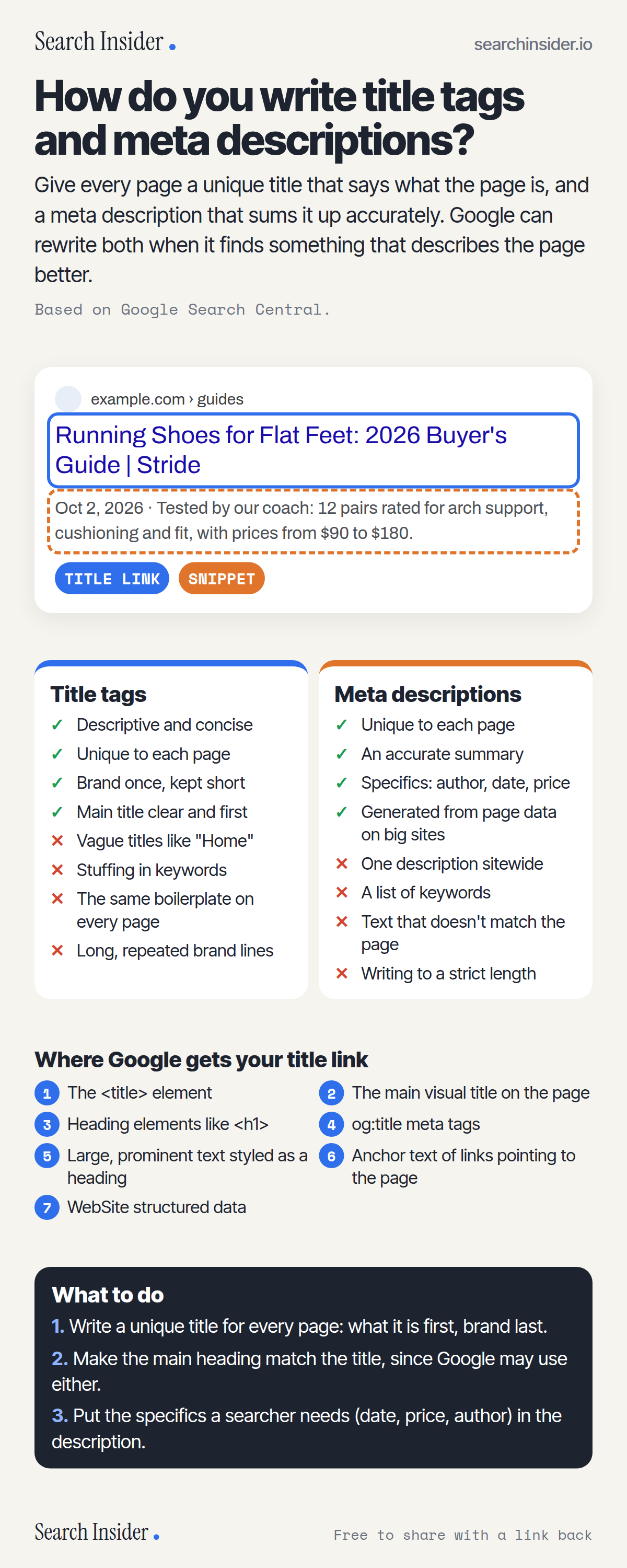
Title tags and meta descriptions infographic: a Google search result with the title link and snippet labeled, do and don't lists for title tags and meta descriptions, the seven sources Google uses for title links, and three steps on what to do.

Oct 5, 2026

How to Write Title Tags and Meta Descriptions (Infographic)

How to write title tags and meta descriptions Google will use: what makes a good title and description, the 7 places Google takes title links from, and what to avoid.

Embed this infographic

Every infographic here is free to republish, on any site, with a link back to the study it comes from. Paste this code and the credit is done for you.

<a href="https://searchinsider.io/infographics/title-tags-meta-descriptions"><img src="https://searchinsider.io/research/title-tags-meta-descriptions/title-tags-meta-descriptions-infographic.png" alt="Title tags and meta descriptions infographic: a Google search result with the title link and snippet labeled, do and don't lists for title tags and meta descriptions, the seven sources Google uses for title links, and three steps on what to do." style="max-width:680px;width:100%;height:auto;" /></a><p>Source: <a href="https://searchinsider.io/infographics/title-tags-meta-descriptions">Title tags and meta descriptions infographic</a> by Search Insider.</p>

How do you write title tags and meta descriptions?

The short answer: Give every page a unique title that says what the page is, and a meta description that sums it up accurately. Google can rewrite both when it finds something that describes the page better.

Based on Google Search Central.

What it shows

  • Every page should have a title in its title element.
  • Good titles are descriptive and concise, without keyword stuffing or repeated boilerplate, with the brand kept short.
  • Google builds title links from seven sources, including the title element, the main visual title, headings, og:title and anchor text.
  • Snippets come mainly from page content. Google uses the meta description when it describes the page better.
  • Meta descriptions should be unique, accurate and can include specifics like author, date or price.
  • There's no length limit for meta descriptions, but snippets are truncated to fit the device.

What to do

  • Every page: Write a unique title: what it is first, brand last.
  • On the page: Make the main heading match the title.
  • Descriptions: Include the specifics a searcher needs, like date, price or author.

The walkthrough

What is the difference between a title tag and a title link?

The title tag is the title element in your page's HTML. The title link is the clickable headline Google shows in search results. Google uses the title tag for the title link most of the time, but it can also draw on other text from the page [1].

Where does Google get title links from?

Google lists seven sources: the content in title elements, the main visual title shown on the page, heading elements such as h1, og:title meta tags, other large and prominent text styled as a heading, anchor text on the page and links pointing to it, and WebSite structured data [1].

How do you write a good title tag?

Make sure every page has a title in its title element, and make it descriptive and concise [1]. Avoid vague titles like "Home", don't stuff in keywords, avoid repeating the same boilerplate text across pages, and keep any branding short [1].

How long should a title tag be?

Google sets no fixed character limit. Title links are truncated, typically to fit the device width, so put the most important words first [1].

Does Google use your meta description?

Sometimes. Google primarily uses the content on the page to create snippets, and uses the meta description when it might give users a more accurate description of the page than content taken directly from the page [2].

How do you write a good meta description?

Write a unique description for each page that accurately summarizes it [2]. Descriptions can include specific details a searcher would want, such as the author, publication date or price [2]. For large sites, Google encourages generating descriptions programmatically from page data [2].

How long should a meta description be?

Google says there is no limit on how long a meta description can be, but snippets are truncated in search results as needed, typically to fit the device width [2].

More digital marketing infographics

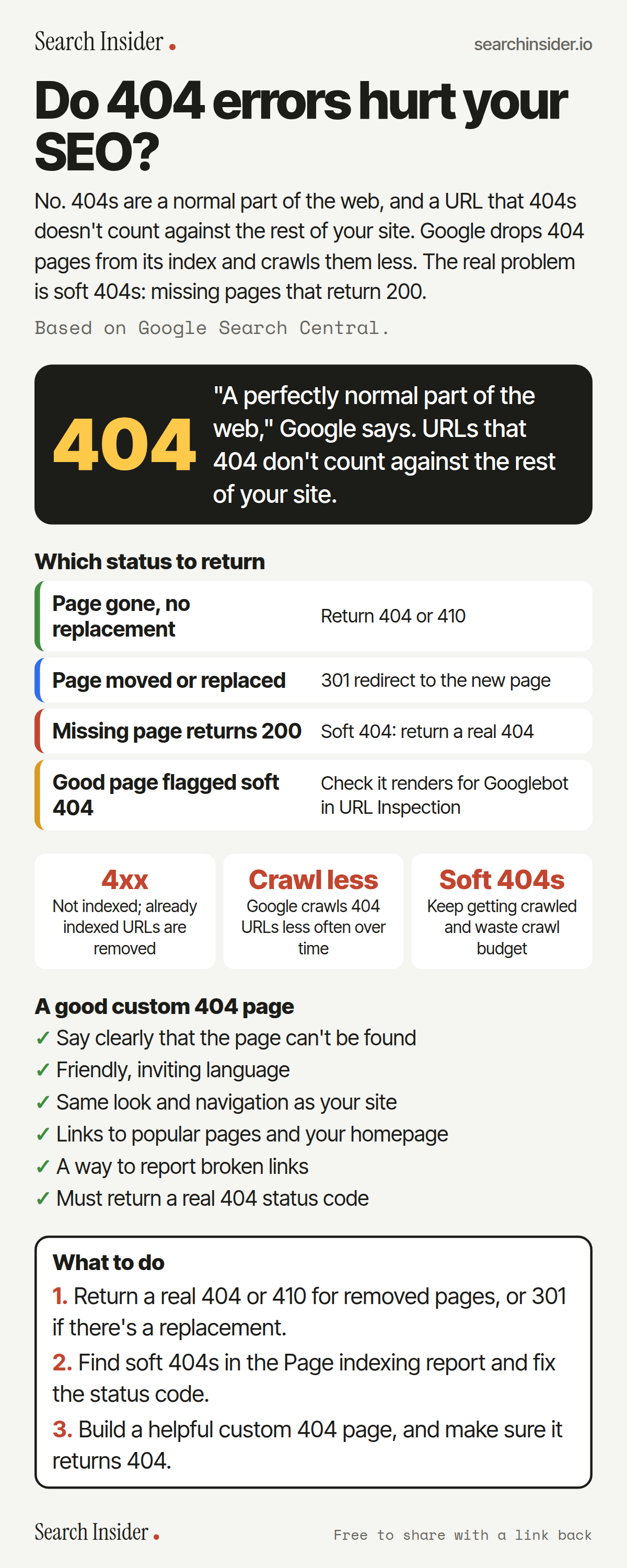
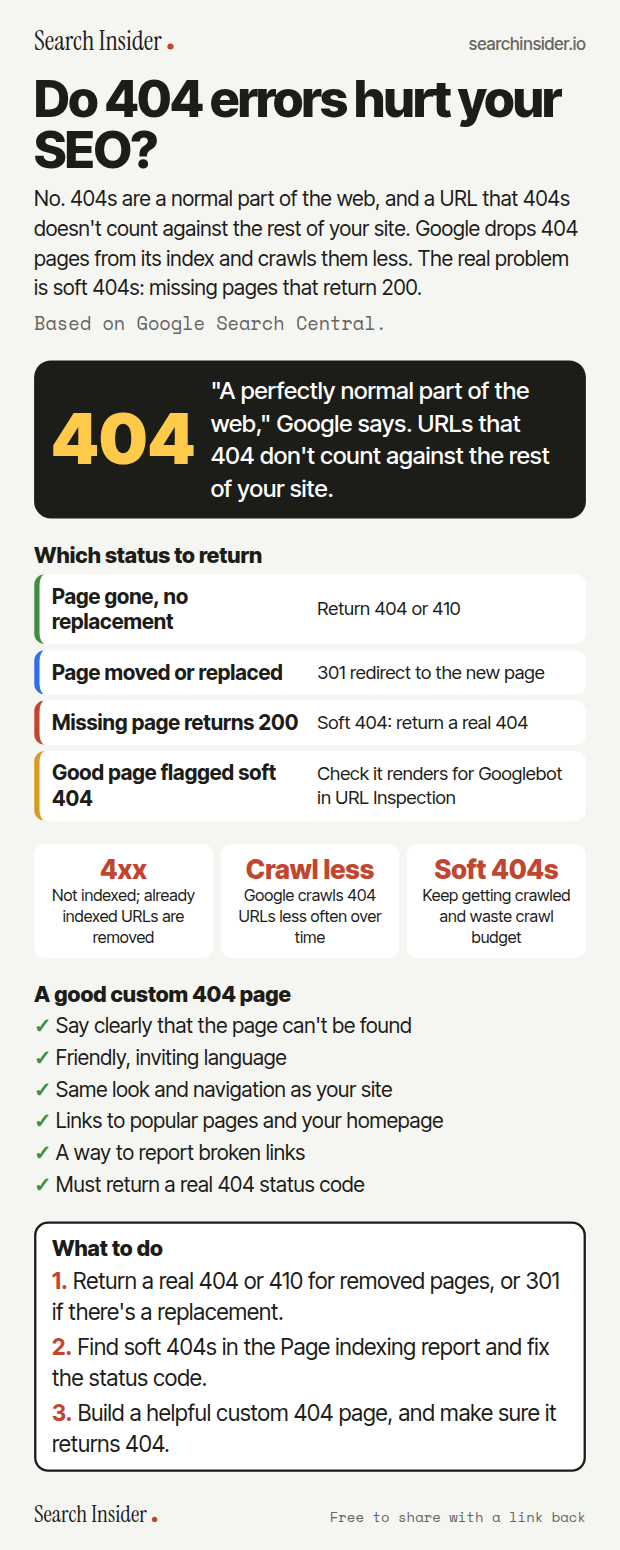
404 errors infographic: a 404 banner with Google's view that 404s are normal, which status to return in four cases, three facts on how Google treats 4xx and soft 404s, a checklist for a good custom 404 page, and three steps on what to do.

SEO · Oct 6, 2026

Do 404 errors hurt your SEO?

Do 404 errors hurt SEO? How Google treats 404s, why soft 404s are the real problem, which status code to return, and how to build a good custom 404 page.

Embed code
<a href="https://searchinsider.io/infographics/404-errors"><img src="https://searchinsider.io/research/404-errors/404-errors-infographic.png" alt="404 errors infographic: a 404 banner with Google's view that 404s are normal, which status to return in four cases, three facts on how Google treats 4xx and soft 404s, a checklist for a good custom 404 page, and three steps on what to do." style="max-width:680px;width:100%;height:auto;" /></a><p>Source: <a href="https://searchinsider.io/infographics/404-errors">404 errors infographic</a> by Search Insider.</p>
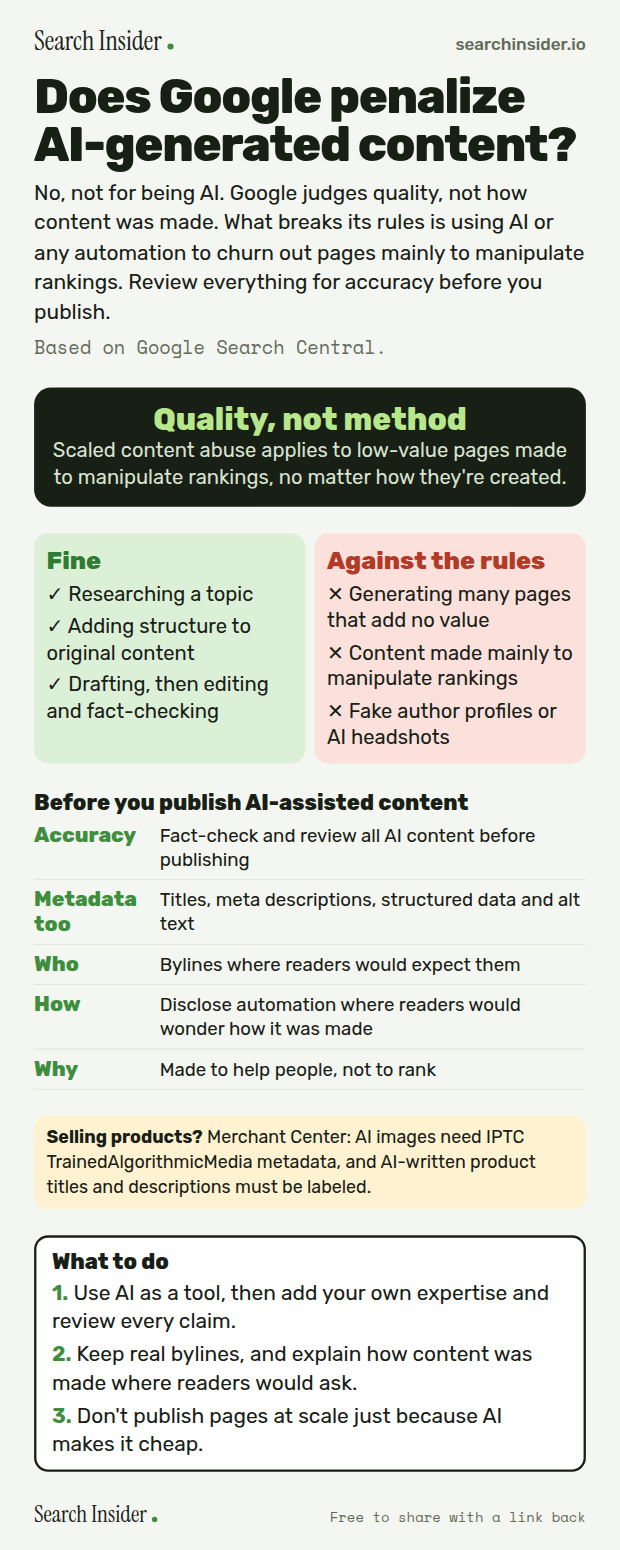
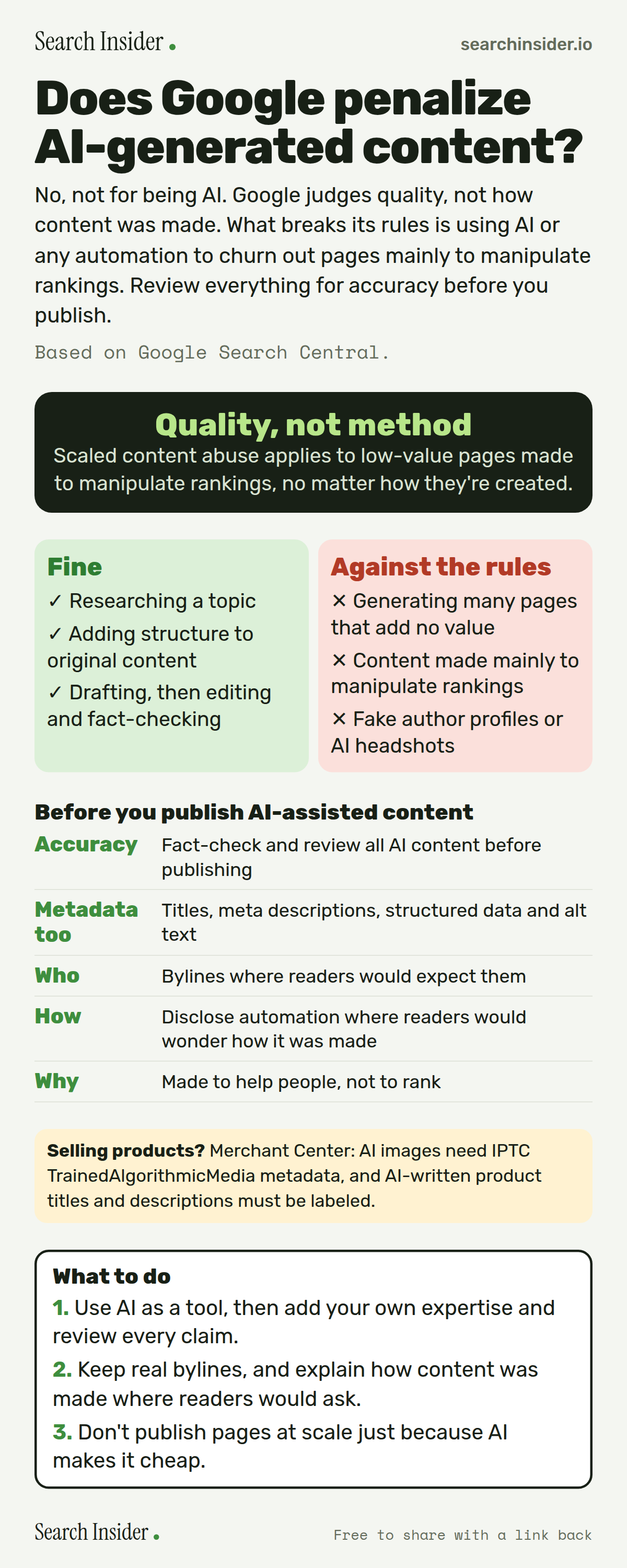
AI-generated content infographic: a quality not method banner, a split of fine uses versus uses against Google's rules, a pre-publish checklist (accuracy, metadata, who, how, why), a Merchant Center note on labeling AI images and product data, and three steps on what to do.

AI search · Oct 6, 2026

Does Google penalize AI-generated content?

Google's stance on AI-generated content: quality over production method, what breaks the scaled content abuse policy, and a checklist before publishing AI-assisted content.

Embed code
<a href="https://searchinsider.io/infographics/ai-generated-content"><img src="https://searchinsider.io/research/ai-generated-content/ai-generated-content-infographic.png" alt="AI-generated content infographic: a quality not method banner, a split of fine uses versus uses against Google's rules, a pre-publish checklist (accuracy, metadata, who, how, why), a Merchant Center note on labeling AI images and product data, and three steps on what to do." style="max-width:680px;width:100%;height:auto;" /></a><p>Source: <a href="https://searchinsider.io/infographics/ai-generated-content">AI-generated content infographic</a> by Search Insider.</p>
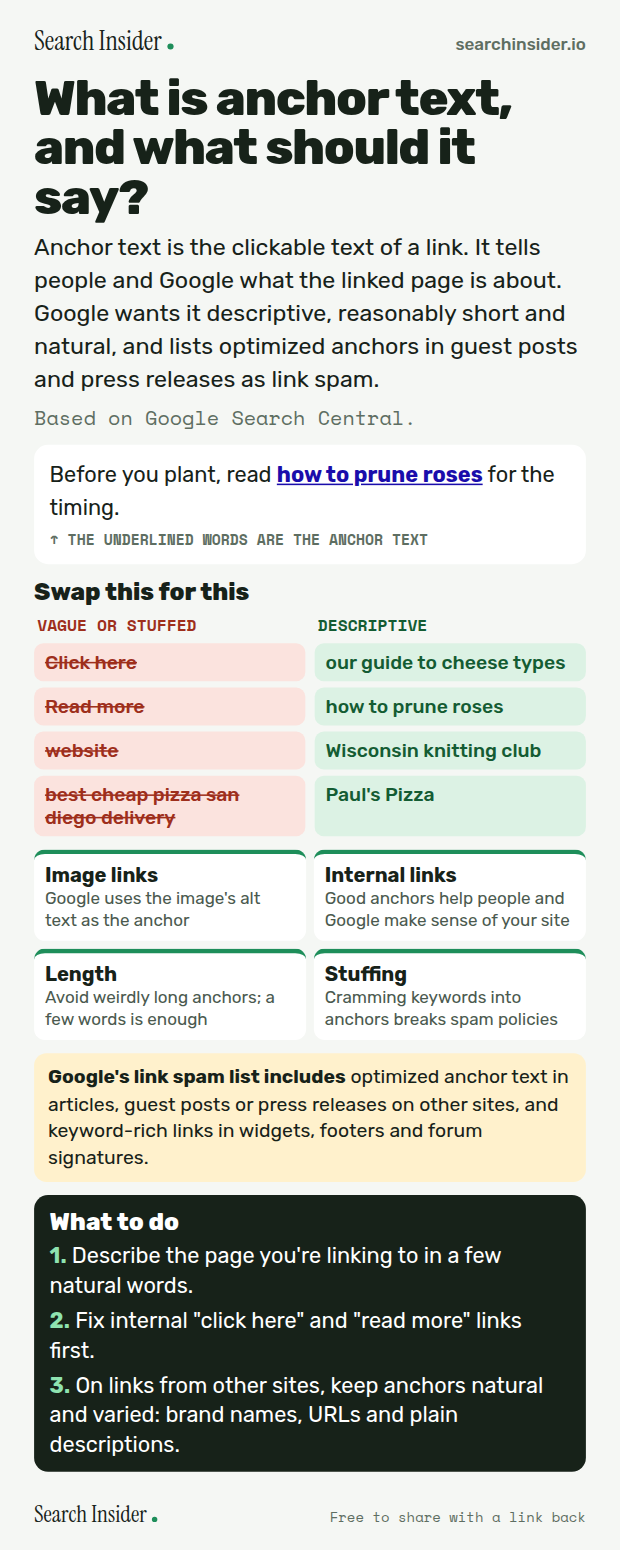
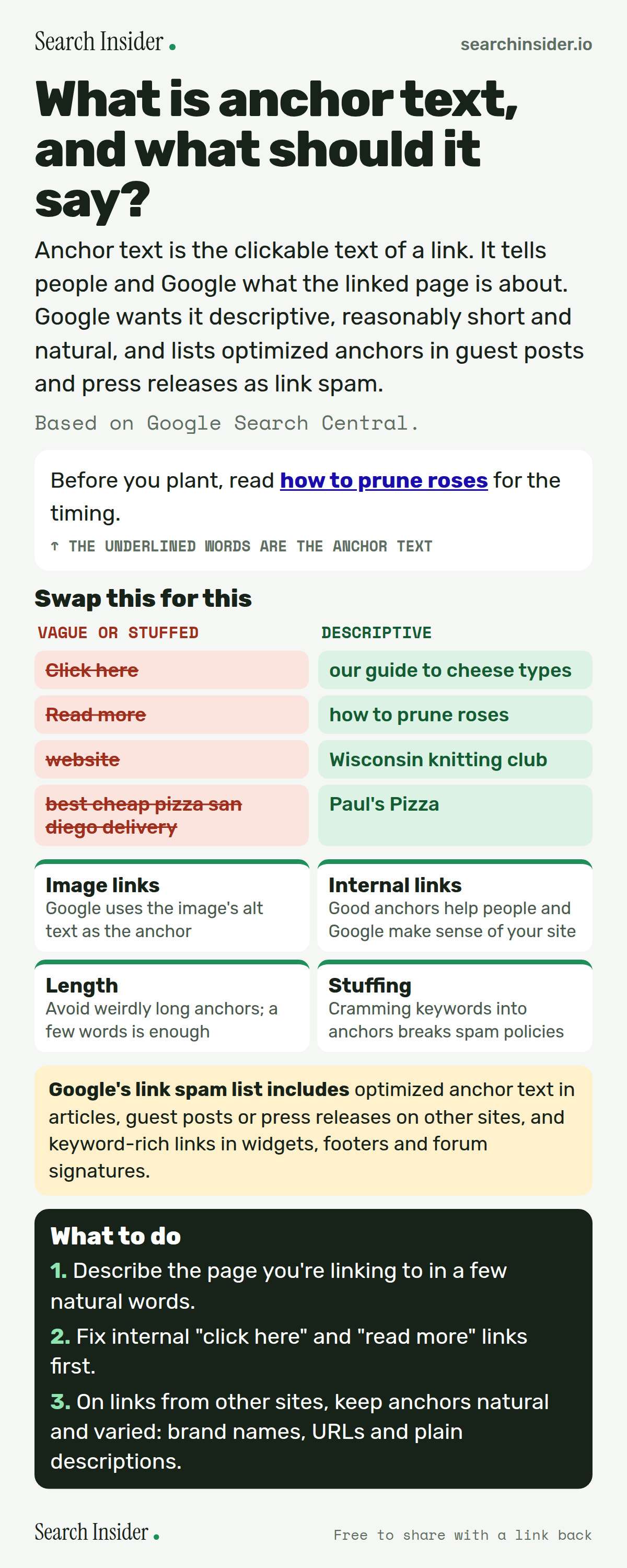
Anchor text infographic: an example link with the anchor text underlined, four vague or stuffed anchors swapped for descriptive ones, four rules on image links, internal links, length and keyword stuffing, a note on Google's link spam examples, and three steps on what to do.

SEO · Oct 6, 2026

What is anchor text, and what should it say?

What anchor text is, what Google says it should say, good and bad examples, image link alt text, and which anchor practices Google lists as link spam.

Embed code
<a href="https://searchinsider.io/infographics/anchor-text"><img src="https://searchinsider.io/research/anchor-text/anchor-text-infographic.png" alt="Anchor text infographic: an example link with the anchor text underlined, four vague or stuffed anchors swapped for descriptive ones, four rules on image links, internal links, length and keyword stuffing, a note on Google's link spam examples, and three steps on what to do." style="max-width:680px;width:100%;height:auto;" /></a><p>Source: <a href="https://searchinsider.io/infographics/anchor-text">Anchor text infographic</a> by Search Insider.</p>