Skip to content
← SEO Infographics
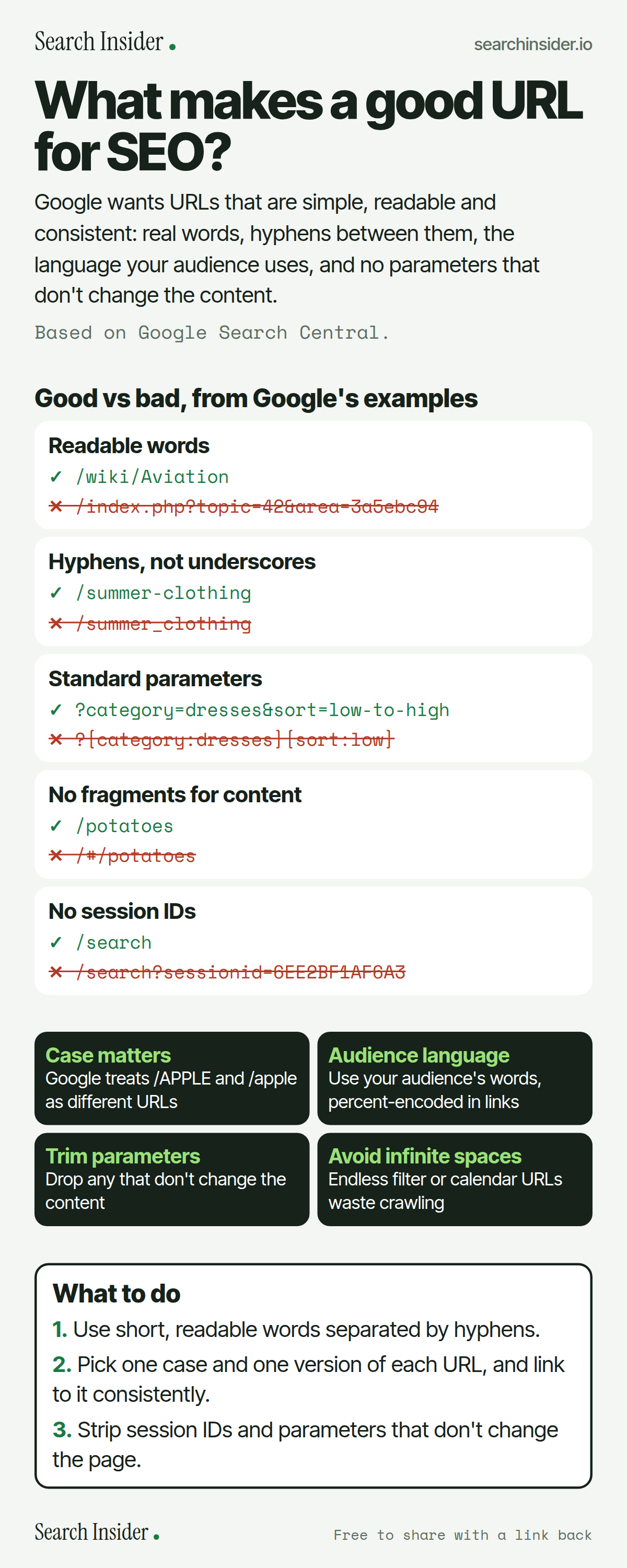
URL structure infographic: five good versus bad URL pairs from Google's examples (readable words, hyphens not underscores, standard parameters, no fragments, no session IDs), four notes on case, language, parameters and infinite spaces, and three steps on what to do.

Oct 6, 2026

URL Structure Best Practices for SEO (Infographic)

What makes a good URL for SEO, using Google's own good and bad examples: readable words, hyphens, standard parameters, no fragments or session IDs.

Embed this infographic

Every infographic here is free to republish, on any site, with a link back to the study it comes from. Paste this code and the credit is done for you.

<a href="https://searchinsider.io/infographics/url-structure"><img src="https://searchinsider.io/research/url-structure/url-structure-infographic.png" alt="URL structure infographic: five good versus bad URL pairs from Google's examples (readable words, hyphens not underscores, standard parameters, no fragments, no session IDs), four notes on case, language, parameters and infinite spaces, and three steps on what to do." style="max-width:680px;width:100%;height:auto;" /></a><p>Source: <a href="https://searchinsider.io/infographics/url-structure">URL structure infographic</a> by Search Insider.</p>

What makes a good URL for SEO?

The short answer: Google wants URLs that are simple, readable and consistent: real words, hyphens between them, the language your audience uses, and no parameters that don't change the content.

Based on Google Search Central.

What it shows

  • Google recommends readable words rather than long ID numbers in URLs.
  • Use hyphens rather than underscores to separate words.
  • Use the standard key=value format for parameters, joined with &.
  • Google generally doesn't support URL fragments, so don't use them to change content.
  • URLs are case sensitive: /APPLE and /apple are different URLs.
  • Avoid session IDs and trim parameters that don't change the content.

What to do

  • Naming: Short readable words with hyphens.
  • Consistency: One case and one version of each URL.
  • Cleanup: Remove session IDs and pointless parameters.

The walkthrough

What makes a good URL for SEO?

Google recommends simple, descriptive URLs that use readable words rather than long ID numbers, such as /wiki/Aviation instead of /index.php?topic=42&area=3a5ebc944f41daa6f849f730f1 [1].

Should URLs use hyphens or underscores?

Google recommends hyphens to separate words, for example /summer-clothing rather than /summer_clothing [1].

How should URL parameters be formatted?

Use an equal sign to separate key-value pairs and an ampersand to add more parameters, such as ?category=dresses&sort=low-to-high [1]. Trim parameters that don't change the content [1].

Can you use # fragments in URLs?

Don't use fragments to change a page's content, because Google Search generally doesn't support URL fragments [1].

Are URLs case sensitive for Google?

Yes. Google treats /APPLE and /apple as distinct URLs with their own content [1].

Can URLs use other languages?

Yes. Google recommends words in your audience's language, and percent-encoding non-ASCII characters in link href attributes as needed [1].

What URL problems waste crawling?

Session IDs in URLs (use cookies instead), and infinite URL spaces created by additive filtering or dynamically generated calendar pages [1].

More digital marketing infographics

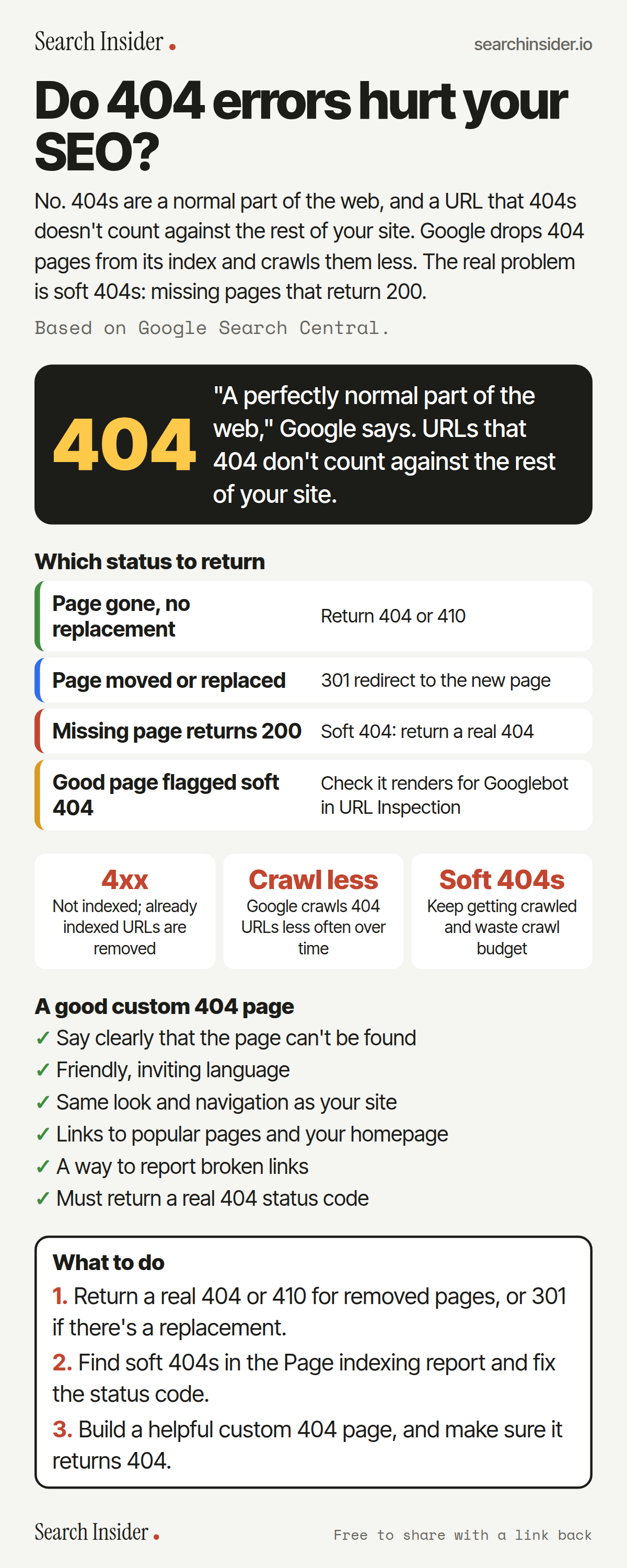
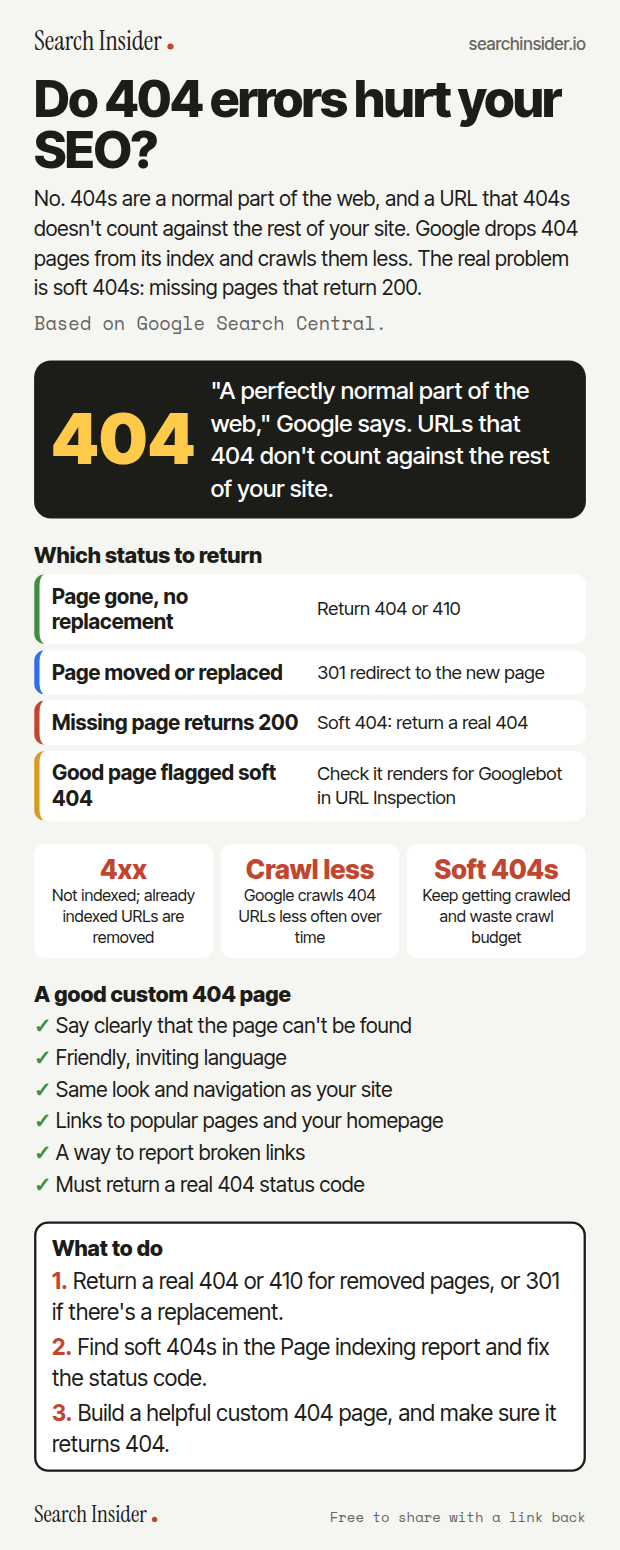
404 errors infographic: a 404 banner with Google's view that 404s are normal, which status to return in four cases, three facts on how Google treats 4xx and soft 404s, a checklist for a good custom 404 page, and three steps on what to do.

SEO · Oct 6, 2026

Do 404 errors hurt your SEO?

Do 404 errors hurt SEO? How Google treats 404s, why soft 404s are the real problem, which status code to return, and how to build a good custom 404 page.

Embed code
<a href="https://searchinsider.io/infographics/404-errors"><img src="https://searchinsider.io/research/404-errors/404-errors-infographic.png" alt="404 errors infographic: a 404 banner with Google's view that 404s are normal, which status to return in four cases, three facts on how Google treats 4xx and soft 404s, a checklist for a good custom 404 page, and three steps on what to do." style="max-width:680px;width:100%;height:auto;" /></a><p>Source: <a href="https://searchinsider.io/infographics/404-errors">404 errors infographic</a> by Search Insider.</p>
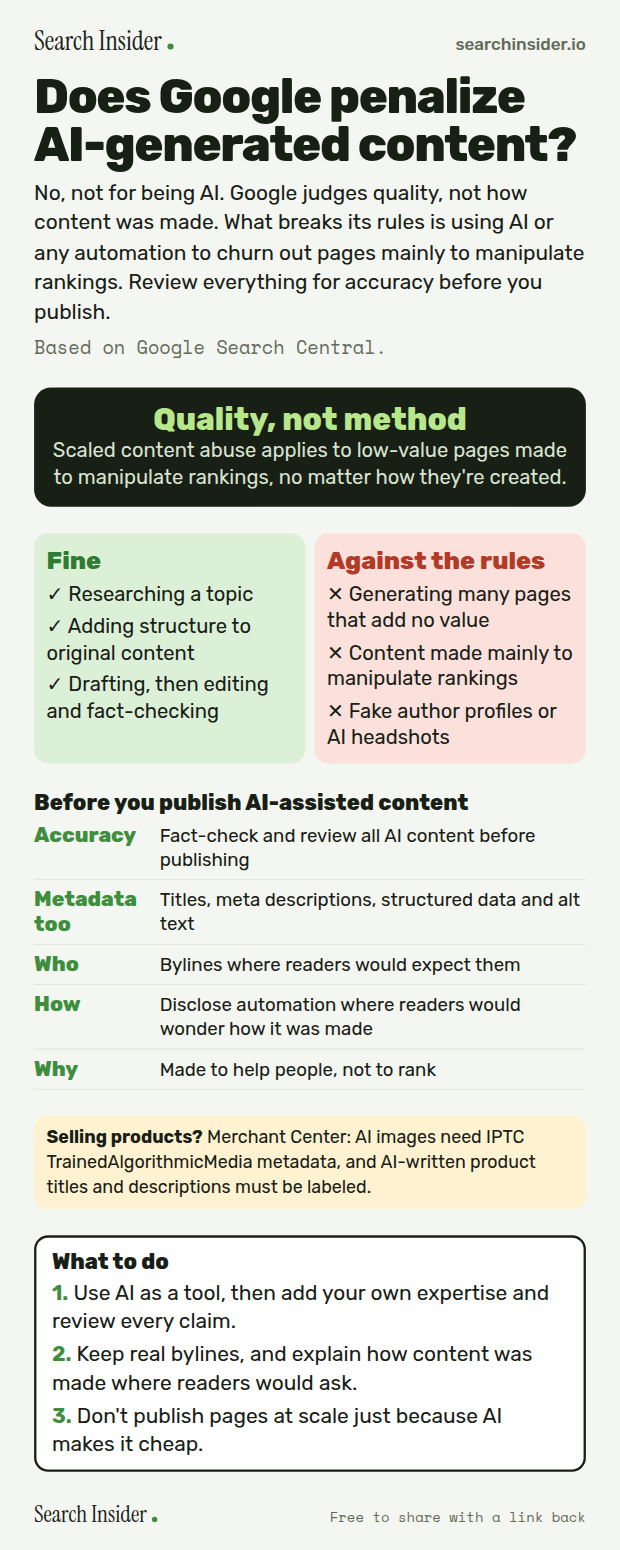
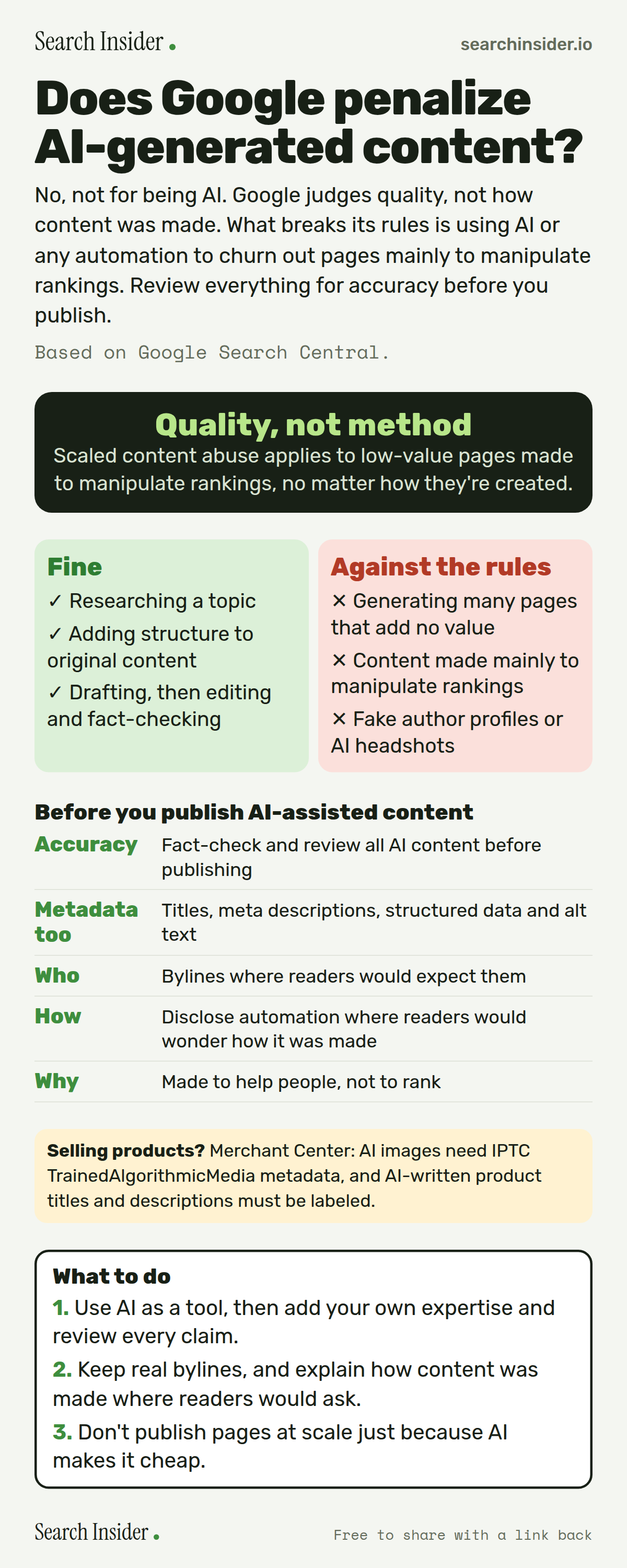
AI-generated content infographic: a quality not method banner, a split of fine uses versus uses against Google's rules, a pre-publish checklist (accuracy, metadata, who, how, why), a Merchant Center note on labeling AI images and product data, and three steps on what to do.

AI search · Oct 6, 2026

Does Google penalize AI-generated content?

Google's stance on AI-generated content: quality over production method, what breaks the scaled content abuse policy, and a checklist before publishing AI-assisted content.

Embed code
<a href="https://searchinsider.io/infographics/ai-generated-content"><img src="https://searchinsider.io/research/ai-generated-content/ai-generated-content-infographic.png" alt="AI-generated content infographic: a quality not method banner, a split of fine uses versus uses against Google's rules, a pre-publish checklist (accuracy, metadata, who, how, why), a Merchant Center note on labeling AI images and product data, and three steps on what to do." style="max-width:680px;width:100%;height:auto;" /></a><p>Source: <a href="https://searchinsider.io/infographics/ai-generated-content">AI-generated content infographic</a> by Search Insider.</p>
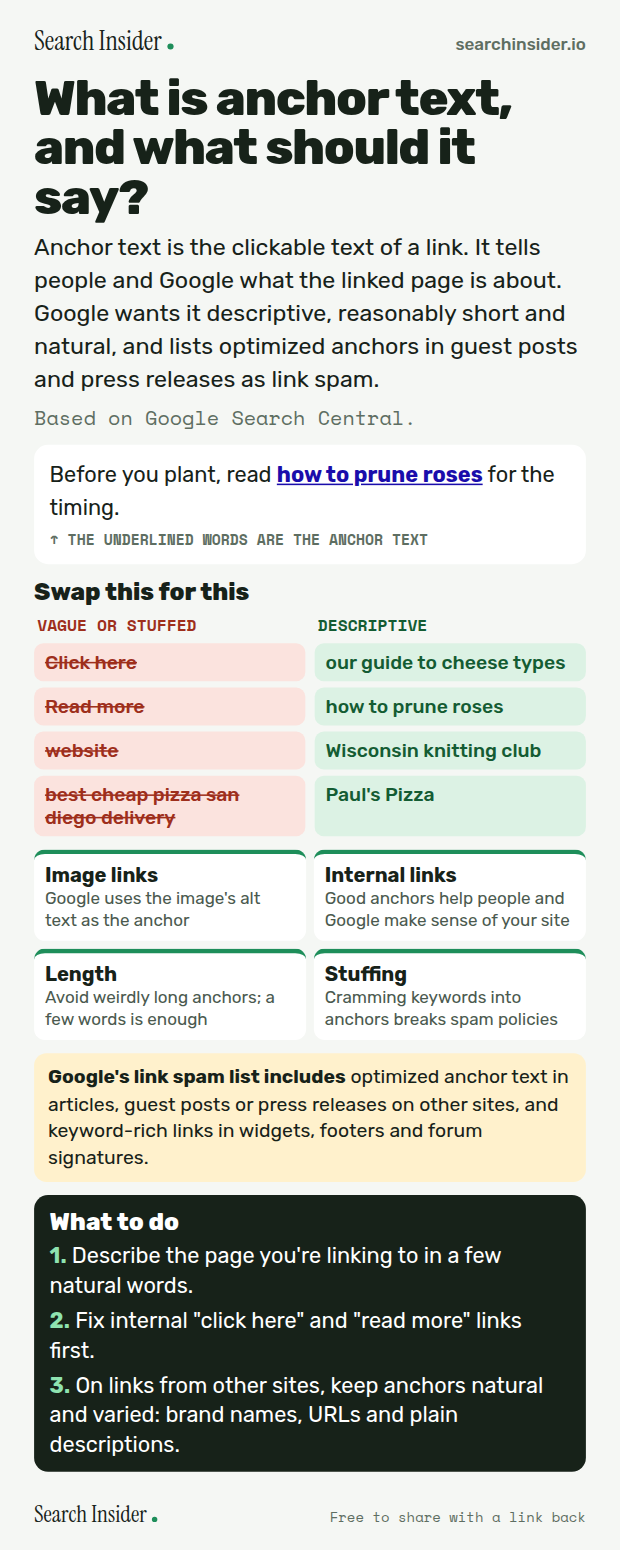
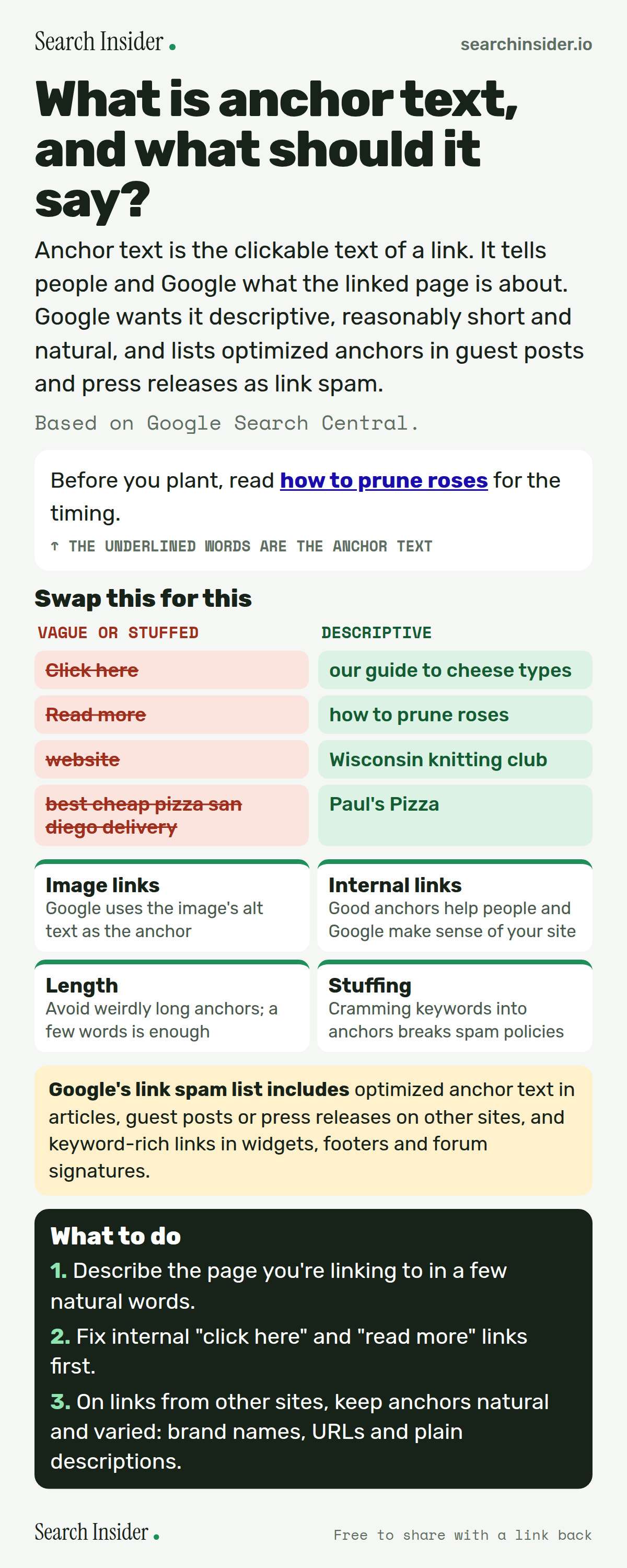
Anchor text infographic: an example link with the anchor text underlined, four vague or stuffed anchors swapped for descriptive ones, four rules on image links, internal links, length and keyword stuffing, a note on Google's link spam examples, and three steps on what to do.

SEO · Oct 6, 2026

What is anchor text, and what should it say?

What anchor text is, what Google says it should say, good and bad examples, image link alt text, and which anchor practices Google lists as link spam.

Embed code
<a href="https://searchinsider.io/infographics/anchor-text"><img src="https://searchinsider.io/research/anchor-text/anchor-text-infographic.png" alt="Anchor text infographic: an example link with the anchor text underlined, four vague or stuffed anchors swapped for descriptive ones, four rules on image links, internal links, length and keyword stuffing, a note on Google's link spam examples, and three steps on what to do." style="max-width:680px;width:100%;height:auto;" /></a><p>Source: <a href="https://searchinsider.io/infographics/anchor-text">Anchor text infographic</a> by Search Insider.</p>