
IN SHORT
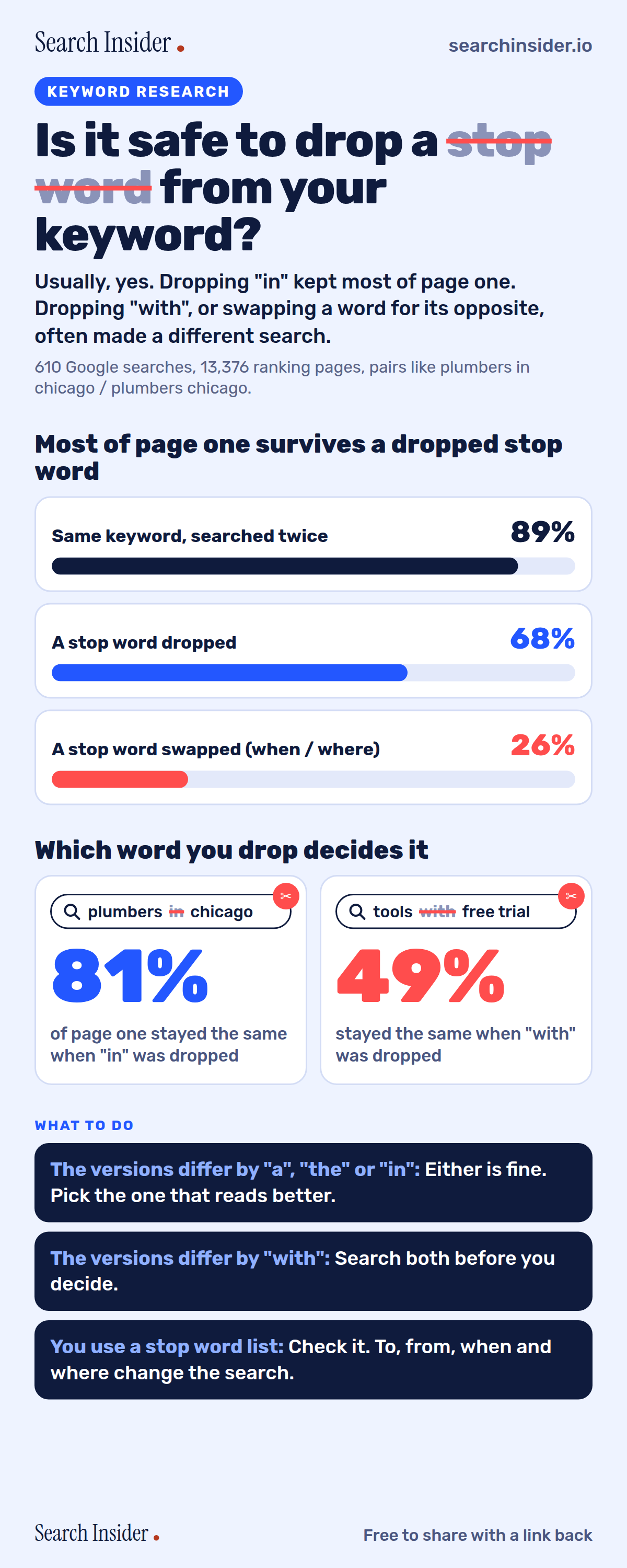
Usually, yes. Deleting a stop word from a keyword left 7 of the same 10 websites on page one, and a #1 ranking carried over to the shortened version 89% of the time. The exception is "with", where the two versions were least likely to match. Swapping a stop word for its opposite, such as "when" for "where", returns a different search altogether.
Deleting a stop word left 7 of the same 10 websites on page one, against 9 in 10 for the same keyword searched twice.
Rank #1 for "plumbers in chicago" and you were on page one for "plumbers chicago" 9 times in 10. One page can cover both.
Removing "with" kept under half of page one, and 7 of the 12 worst-affected keywords in the study were "with" removals. It was also the least predictable, ranging from no change at all to nothing in common.
"Tools with free trial" searched twice returned the identical page one. Delete "with" and it shared nothing with the original.
Swap a stop word for its opposite and about a quarter of page one survives. The published lists include to, from, when, where, under, over, before and after.
AI Overview citations moved with the organic results. No evidence that stop words need separate handling there.
The practice is broadly safe. The lists telling you which words are disposable are not.
What the advice says
Stop words are the small connecting words a search engine was once assumed to throw away. A, the, in, for, with, to, from. SEO tools publish lists of them and strip them out of keyword research, and people build keyword sets without them.
The advice has softened over the years. The lists have not. So I tested two separate things: whether deleting a stop word changes what Google returns, and whether the words sitting on those lists deserve to be there.
Method
Six hundred and ten live Google searches, US desktop, organic top 20, collected on 27 September 2026 and giving 13,376 ranking pages and 4,860 AI Overview citations. Three conditions, built as 150 keyword pairs with a stop word deleted, 75 with a stop word swapped for its opposite, and 80 pairs firing the same keyword at Google twice.
Both halves of every pair were searched within seconds of each other. Twenty industries, matched to the frame used in earlier studies in this series so the results sit alongside them.
The percentages below are calculated on 216 of those 305 pairs: 102 removals, 39 swaps and 75 repeats. For the other 89, the data provider returned a US-localized result for one half of the pair and a mis-localized one for the other, which makes the two halves incomparable. Those pairs were re-requested up to three times and dropped if they never agreed.
Same keyword, searched twice
9 in 10
The websites that stayed the same. This is the figure the other two are read against.
A stop word deleted
7 in 10
Across 102 keyword pairs where one small word was removed.
A stop word swapped for its opposite
2 in 10
Across 39 pairs where "when" became "where", or "under" became "over".
Is it safe to delete a stop word?
Usually. Across 102 keyword pairs, removing a stop word left 7 of the 10 websites the same. The rankings held up better than that. If you ranked #1 for the version with the stop word, you appeared on page one for the version without it 89% of the time. In reverse, 86%. Neither direction had a meaningful advantage.
Five pairs returned completely identical page ones.
| Keyword pair | Page one shared |
|---|---|
| plumbers in chicago / plumbers chicago | 100% |
| electricians in portland / electricians portland | 100% |
| dermatologists in nashville / dermatologists nashville | 100% |
| earbuds with noise cancelling / earbuds noise cancelling | 100% |
| how to read a blood test / how to read blood test | 100% |
So if you are choosing between two versions of a keyword that differ only by a stop word, the choice matters less than you would think. One page can cover both. Target the version that reads better for a customer.
Which stop word is not safe to delete?
How safe removal is depends on which word you remove.
Removing "with" left 49% of page one intact, against 73% for the other four words combined. Source: 102 removal pairs, Google organic top 10, US desktop, 27 September 2026.
Seven of the 12 worst-affected keywords in the whole study were "with" removals.
| Keyword pair | Page one shared |
|---|---|
| tools with free trial / tools free trial | 0% |
| cameras with image stabilization / cameras image stabilization | 0% |
| homes with acreage / homes acreage | 0% |
| protein with no sugar / protein no sugar | 0% |
| houses with basements / houses basements | 10% |
The first row is the one I keep going back to. "Tools with free trial" was also in the repeat-keyword condition, so I have it searched against itself, seconds apart. That returned 10 of the same 10 websites. Delete "with" and it returns nothing the original returned. Same keyword, same minute, one word shorter, and a completely different page one.
"With" was also the least consistent word in the study. Across the 20 "with" pairs the result ranged from 0% to 100%, and "earbuds with noise cancelling" was one of the five pairs that came back identical. So this is not a word that always breaks the search. It is the word where you cannot predict what will happen, which is a different and more awkward problem if you are editing keywords at scale.
"With" isn't filler. It states a relationship between two things: this product, that has this feature. Take it out and you are left with two nouns next to each other and no instruction about how they connect. "In" and "a" carry no such load, which may be why dropping them changed so little.
Reuse this
What is wrong with published stop word lists?
Semrush now says search engines "often need to take stop words into account", and its published list still includes to, from, when, where, how, why, before, after, under, over, for, against, in, out, up and down. Swap any of those for its opposite and the keyword means something different, which is not how a word on a discard list should behave.
Across 39 pairs, swapping one of these words left only a quarter of page one the same, and the #1 result matched 28% of the time. Against the same-keyword figure of 9 in 10, that is a different search.
| Keyword pair | Shared | What each one returned |
|---|---|---|
| when to sell a car / where to sell a car | 0% | Reddit threads on market timing, then Kelley Blue Book's sell-my-car tool |
| when to buy stocks / where to buy stocks | 0% | Discussion of entry points, then Fidelity's trading platform |
| tents under 200 / tents over 200 | 0% | Budget backpacking tents, then 200-foot commercial event tents |
A list can tell you a word is common. It can't tell you whether that word is carrying the meaning of your query.
"Under 200" and "over 200" look like the same query with a different number range. Google read the second one as a length in feet and returned event marquees.
Why do some stop words matter and others do not?
Across both conditions, the words that mattered were the ones doing a job in the keyword. "In" connects a service to a city that Google already works out from the rest of the query, so deleting it changed almost nothing. "With" states a feature the product has to have. "Under" sets a boundary. "When" sets the type of question being asked.
I didn't test that as a rule, so treat it as the pattern I noticed rather than a finding. But it fits the results better than sorting words into a safe list and an unsafe list does, and it gives you something to apply to a word I didn't test.
Do stop words change AI Overview citations?
I captured the AI Overview for every search in the same call as the organic results. They appeared on 84% of searches, and the citations moved with the organic results rather than independently. Deleting a stop word left 69% of the cited sources the same. Swapping one left 20%.
I found no evidence that stop words need separate handling for AI Overview citation. That matches what came out of the study on whether a year in your title gets you cited by AI Overviews, where the citation behavior also tracked what was already ranking rather than responding to the edit made to the page.
What to do with this
| Situation | What the data supports |
|---|---|
| Choosing between two keywords that differ only by "a", "the" or "in" | Either is fine. Pick the version that reads better for a customer. |
| The two versions differ by "with" | Search both before you decide. This is the word where the two versions were least likely to behave the same. |
| Wondering whether ranking for one version gets you the other | Usually, yes. One page can cover both, and a #1 ranking carried over 89% of the time. |
| Using a stop word list to build keyword sets | Check what it is stripping. To, from, when, where, under, over, before and after are all on the standard lists and all change the search. |
| Targeting AI Overview citations | No evidence this needs separate handling. The citations moved with the organic results. |
Where this breaks down
It measures stop words in the query. That is the decision you make when you pick a keyword to target. Whether a stop word inside your body copy does anything is a separate test with a separate design.
Grammatical naturalness is not separated from the missing word. A keyword with a stop word deleted is sometimes slightly unnatural, and Google may be responding to that rather than to the word itself. No part of this design separates the two.
Thirty-nine swap pairs across eight word pairs supports the finding in aggregate and not a ranking of which swapped word matters most.
One snapshot, US desktop. The swap condition shows the published lists contain meaning-carrying words. It does not show that any particular tool acts on that, or what it has cost anyone.
The wider pattern
This is not the first piece of standard advice I have put through this treatment, and the shape of the answer keeps repeating. Putting the current year in your title works, but it is worth about half a ranking position rather than the step change it gets described as. Stop words can be deleted, but the lists telling you which words are disposable include words that reverse the meaning of the search.
In each case the advice was not wrong so much as pointed slightly to one side of the thing that matters. The year is a proxy for whether the page was updated. A stop word list is a proxy for whether a word carries meaning. Both proxies hold most of the time, which is exactly why they survive, and the cases where they fail are the ones worth knowing about.
I have used a stop word list to build keyword sets without ever opening it. It did not occur to me that "under" and "over" would be sitting inside it.
Data availability. The pair-level dataset (305 keyword pairs with overlap, rank carry-over, AI Overview citation and flavour fields) is available on request. Collection: Google organic top 20 via DataForSEO, US desktop, 27 September 2026. Conditions, hypotheses and analysis plan fixed prior to collection.
Corrections. If you spot an error in the method or the figures, I would rather know. Corrections are noted inline and dated.