
IN SHORT
It depends on how long the keyword is, not on whether it is singular or plural. Across 129 keyword pairs the two forms shared 47% of page one, against 86% when the identical keyword was searched twice. But one-word keywords shared only 27%, and keywords of three words or more shared 66%. For anything two words or longer, one page covers both forms.
Singular and plural shared 47% of their top 10. The same keyword searched twice shared 86%. Two different words shared 14%.
The same page held the #1 spot for both forms 36% of the time, against 83% for the same keyword searched twice.
Keyword length predicts the risk better than grammar does. One-word keywords shared 27% of results. Three-word keywords shared 66%.
For keywords of two words or more, a #1 ranking carried into the other form about 7 times in 10. For one-word keywords it was closer to 1 in 3.
Irregular plurals like mouse and mice are separate keywords. Not one of the 29 pairs tested shared 70% or more.
AI Overview citations were slightly more stable across the two forms than the organic results. No evidence these need a separate strategy.
None of this means you should build two pages. At 47% overlap, plenty of pages already rank for both forms.
What the tools tell you
Every keyword tool lists "running shoe" and "running shoes" as two separate keywords, with two separate volumes and two separate difficulty scores. That presentation invites a decision: pick one, or split them across two pages.
What it does not tell you is whether Google treats them as two searches. So I tested it.
Method
Six hundred and ninety live Google searches, US desktop, organic top 20, collected on 27 September 2026 and giving 14,360 ranking pages and 5,717 AI Overview citations across 20 industries.
Three conditions. The test pairs were a keyword in its singular and plural form. Alongside them I ran the identical keyword twice, seconds apart, and a set of pairs where the plural means something else entirely, glass and glasses, good and goods. Without those two reference points a 47% overlap is an unreadable number, because there is no way to know how much any two Google searches differ in the first place.
Both halves of every pair were searched within seconds of each other, so nothing could drift between them.
The percentages below are calculated on 224 of the 335 pairs collected: 129 singular and plural pairs, 70 repeats and 25 different-meaning pairs. For the other 111, the data provider returned a US-localized result for one half of a pair and a mis-localized one for the other, which makes the two halves incomparable. Those pairs were re-requested and dropped if they never agreed.
Same keyword, searched twice
86%
Of page one stayed the same. This is the figure the other two are read against.
Singular vs plural
47%
Across 129 keyword pairs, roughly halfway between the two reference points.
Two genuinely different words
14%
Pairs like glass and glasses, where the plural means something else.
Do singular and plural keywords return different results?
Yes, about half the time.
47% sits roughly halfway between the two reference points. Source: 224 keyword pairs, Google organic top 10, US desktop, 27 September 2026.
The ranking at the top moves even more than the list as a whole. Search the same keyword twice and the same page holds #1 83% of the time. Search the singular and the plural and it is 36%.
Search the same thing twice and the same page is #1 more than 8 times in 10. Search the singular and the plural and it is closer to 3 times in 10.
So these are different searches. The useful question is which ones, because the average hides an enormous spread.
Does it matter which one you target?
Much less than the 47% suggests, and the answer depends on the length of the keyword rather than on which form you pick.
I checked whether the page ranking #1 for one form appears anywhere on page one for the other.
| Keyword | #1 for singular, ranks top 10 for plural | #1 for plural, ranks top 10 for singular | Same page at #1 for both |
|---|---|---|---|
| Two or more words | 68% | 74% | 52% |
| One word | 38% | 33% | 13% |
| All pairs | 56% | 57% | 36% |
Two things fall out of that table.
Neither direction is the safer bet. Targeting the plural is not more likely to win you the singular than the other way round. The two columns sit on top of each other in every cut I ran, so a house rule of "always go plural" has nothing behind it.
And for keywords of two words or more, one page genuinely does cover both. Seven times in ten, the page that wins one form is already sitting on page one of the other.
What actually predicts the difference?
Keyword length, by a distance. I had not expected that, and it was not something the study was designed to test.
Adding one word to the front of a keyword removes most of the problem. Source: 129 singular and plural pairs.
Half of all one-word keywords came back sharing under 30% of results. For keywords of two words or more, that fell to 8%.
There is a second thing worth checking before you commit. When a knowledge panel appeared on either form, shared results fell to 26%. That panel means Google has matched one of the two forms to a specific entity, usually a brand, band or team, and the two searches are no longer about the same subject. This was 16 pairs out of 129, so treat it as a thing to look for rather than a measured rule.
Reuse this
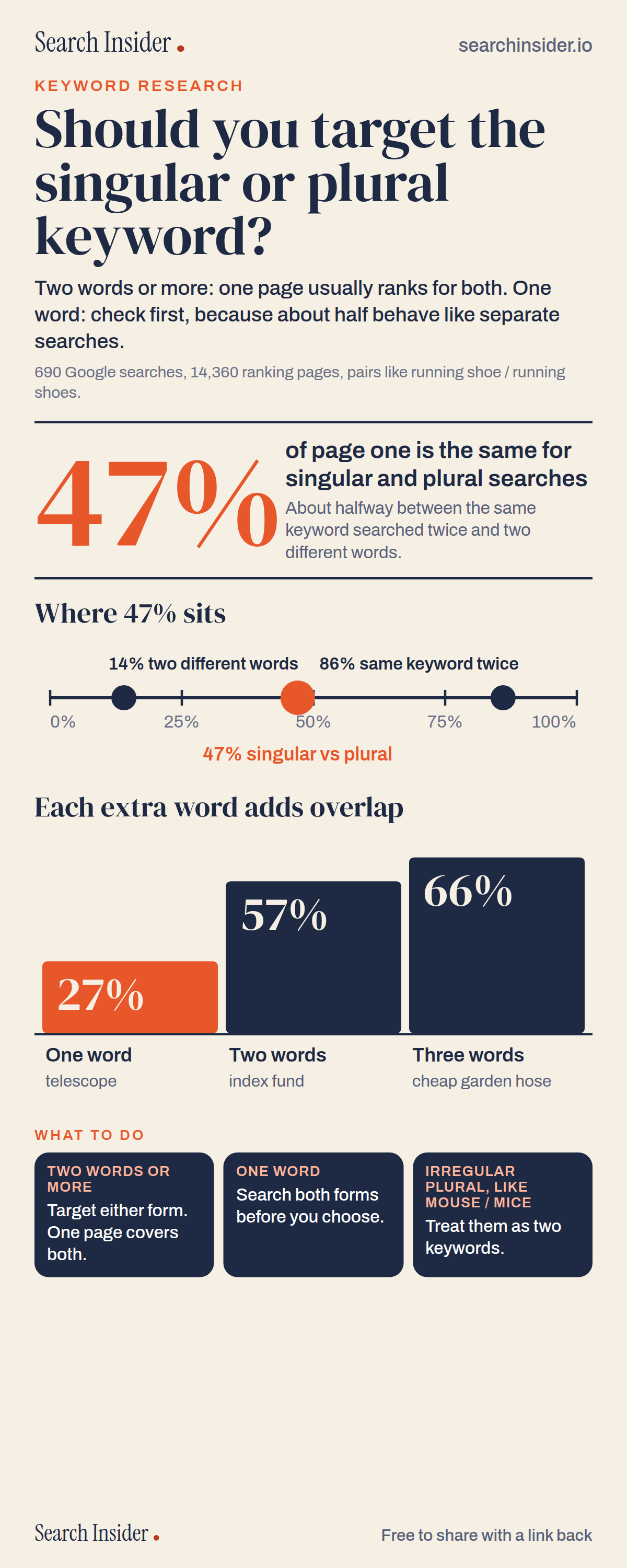
Which keywords behave like one search, and which like two?
The pairs that behaved like a single search all have something in front of the noun.
| Keyword | Page one shared | What ranks #1 |
|---|---|---|
| cheap garden hose / hoses | 100% | The same Amazon best sellers page for both |
| best jump starter / starters | 90% | The same Car and Driver roundup |
| cheap lipstick / lipsticks | 90% | The same Reddit thread |
| index fund / funds | 90% | The same investor.gov page |
| best crib / cribs | 80% | The same Wirecutter review |
| best stroller / strollers | 80% | The same Forbes article |
Not one of them is a single word. Every one has "best" or "cheap" or a second noun sitting in front of it.
| Keyword | Page one shared | What each one returns |
|---|---|---|
| telescope / telescopes | 0% | An astronomy study guide, then Celestron's shop |
| car seat / car seats | 0% | Graco toddler seats, then rotating infant seats |
| earring / earrings | 10% | Made by Mary, then Pandora |
| planner / planners | 20% | Microsoft Planner the software, then Bloom paper planners |
| joystick / joysticks | 20% | Thrustmaster's store, then a film on IMDb |
| seo agency / agencies | 30% | One agency's own site, then Clutch's directory |
Telescope is the one I would keep in mind. It is a commercial keyword, one word long, and the two forms share nothing at all. Search the singular and Google explains how telescopes work. Search the plural and it shows you where to buy one.
Car seat presents a different problem. Both forms return shops, but they sell different products, toddler seats one way and infant seats the other, so a brand ranking for one is invisible on the other.
Across the low-overlap examples the singular usually landed on one specific product or brand while the plural landed on a category page or a directory. Planner, joystick and seo agency all did this. I noticed it, but I have not tested it properly, so treat it as something to look at rather than a finding.
Are irregular plurals different?
Yes, and they are the clearest result in the study. When the plural is not just an added s, mouse and mice, person and people, index and indices, the two forms behave like separate keywords.
| Regular (+s) | Irregular | |
|---|---|---|
| Share of page one in common | 55% | 21% |
| Keyword pairs sharing 70% or more | 40% | 0% |
| Keyword pairs sharing under 30% | 13% | 66% |
| #1 for singular, ranks top 10 for plural | 64% | 34% |
| Same page at #1 for both | 45% | 17% |
Not one of the 29 irregular pairs reached 70% overlap. The highest was 60%. If you have these in a keyword set, track both forms.
Are commercial keywords safer than informational ones?
They look it, until you account for length. Commercial keywords shared 56% of results against 41% for informational ones. That gap is mostly the length effect wearing a different hat.
Informational keywords are often single words like algorithm, tendon or symptom. Commercial keywords usually arrive with a modifier already attached, like best stroller or cheap garden hose. In this set, 41 of 73 informational keywords were one word, against 11 of 56 commercial ones.
Informational keywords diverge more because they are shorter, not because they are informational.
Which matters if you sell things. A one-word product keyword carries the same risk as any other one-word keyword. Telescope is about as commercial as a keyword gets, and it produced the worst result in the set.
Do singular and plural need different AI Overview strategies?
No evidence of it. I captured the AI Overview for every search in the same call as the organic results, so both come from the same moment rather than from two separate studies. They appeared on 91% of searches.
I expected the AI Overview to vary more than the organic results, since it writes a fresh answer on each request instead of serving a stored ranking. It came out the other way. Citations shared 51% across singular and plural, slightly ahead of the 47% the organic results managed.
The likely explanation is that the AI is reading the page it was handed. Over half the sources it cited were also ranking in that same search's top 20, and when the organic results diverged the citations diverged with them. The same thing turned up in the study on whether a year in your title gets you cited by AI Overviews, where citation behavior tracked what was already ranking rather than the edit made to the page.
What to do with this
| If your keyword is | What the data supports |
|---|---|
| Two or more words (best stroller, cheap garden hose) | Pick whichever has the volume and move on. One page covers both, and a #1 ranking carried over about 7 times in 10. |
| A single word (telescope, earring, planner) | Look at both results pages before you commit. Half of these behaved like different searches and there is no way to tell which half you are in without checking. |
| Showing a knowledge panel | Assume the two forms are different. Google has resolved one of them to a brand, band or team. |
| An irregular plural (mouse/mice, person/people) | Treat them as two keywords. Track both. |
| Being targeted for AI citations | No evidence this needs separate handling. The citations mostly moved with the organic results. |
Where this breaks down
Different results pages is not the same as build two pages. At 47% overlap, around five in ten results are shared, which means plenty of pages already rank for both forms today. I measured how much the results pages differ, not whether a second page would earn anything, and nothing here says it would.
The length finding was not predicted. It came out of the data rather than being something the study set out to test, which makes it the first thing I would want someone else to try to replicate.
Sixteen pairs carried a knowledge panel. That is enough to notice and not enough to put a number on with any confidence.
One snapshot, US desktop. Collected on a single day.
The wider pattern
This is the same shape as the other studies in this series. The advice is not wrong so much as aimed slightly to one side of the thing that matters.
The keyword tool is not lying when it reports two keywords with two volumes. It is reporting what people type. What it cannot tell you is whether Google resolves those two strings to the same intent, and the honest answer is that it usually does, unless the keyword is short enough to be ambiguous on its own.
The same thing showed up with a year in your title, which works but is worth about half a ranking position rather than the step change it gets described as, and with stop words, where deleting one is mostly safe but the published lists include words that reverse the meaning of the search. In every case the useful knowledge was not the average. It was knowing which cases sit at the ends.
I have split singular and plural across two pages before, on a client site, because the tool showed two volumes and it looked like free traffic. On a two-word commercial keyword, which is exactly the case where one page would have done the job.
Data availability. The pair-level dataset (335 keyword pairs with overlap, rank carry-over, AI Overview citation and locale fields) is available on request. Collection: Google organic top 20 via DataForSEO, US desktop, 27 September 2026. Conditions, hypotheses and analysis plan fixed prior to collection.
Corrections. If you spot an error in the method or the figures, I would rather know. Corrections are noted inline and dated.