Skip to content
← Content Marketing Infographics
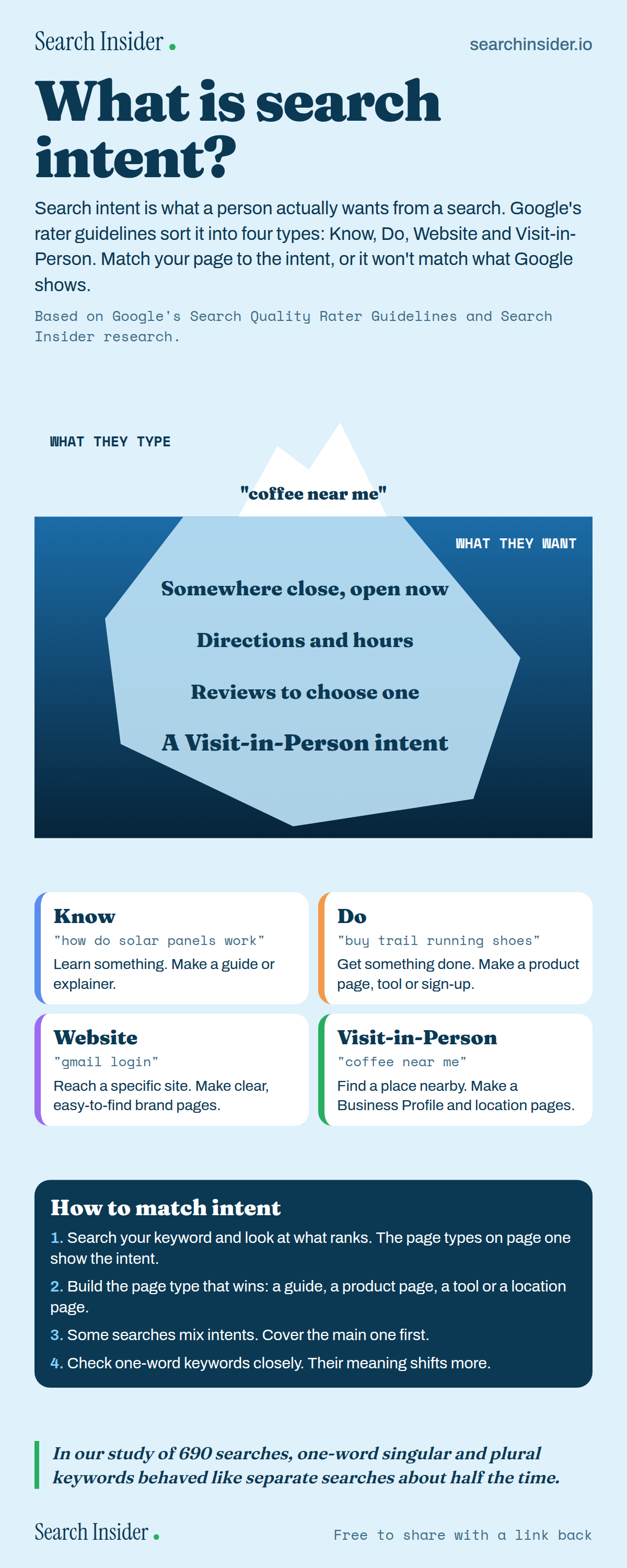
Search intent infographic with an iceberg showing the search coffee near me above the water and what the person really wants below, four cards for Know, Do, Website and Visit-in-Person intent with example searches, and four steps to match intent.

Oct 5, 2026

Search Intent Infographic: The 4 Types and How to Match Them

Search intent explained: the four types from Google's rater guidelines (Know, Do, Website and Visit-in-Person), what to build for each, and how to check intent.

Embed this infographic

Every infographic here is free to republish, on any site, with a link back to the study it comes from. Paste this code and the credit is done for you.

<a href="https://searchinsider.io/infographics/search-intent"><img src="https://searchinsider.io/research/search-intent/search-intent-infographic.png" alt="Search intent infographic with an iceberg showing the search coffee near me above the water and what the person really wants below, four cards for Know, Do, Website and Visit-in-Person intent with example searches, and four steps to match intent." style="max-width:680px;width:100%;height:auto;" /></a><p>Source: <a href="https://searchinsider.io/infographics/search-intent">What is search intent? infographic</a> by Search Insider.</p>

What is search intent?

The short answer: Search intent is what a person actually wants from a search. Google's rater guidelines sort it into four types: Know, Do, Website and Visit-in-Person. Match your page to the intent, or it won't match what Google shows.

Based on Google's Search Quality Rater Guidelines and Search Insider research.

What it shows

  • Know: learn something. Build a guide or explainer. Know Simple searches want a quick fact.
  • Do: get something done. Build a product page, tool or sign-up.
  • Website: reach a specific site. Make brand pages easy to find.
  • Visit-in-Person: find a place nearby. Use a Business Profile and location pages.
  • Some searches mix intents.
  • In our study, one-word singular and plural keywords behaved like separate searches about half the time.

What to do

  • Before writing: Search the keyword and look at the page types on page one.
  • Building: Make the page type that wins.
  • One-word keywords: Check them closely; their meaning shifts more.

The walkthrough

What is search intent?

Search intent is the goal behind a search: what the person wants to know, do or find. Google's Search Quality Rater Guidelines include a section on understanding user intent, with Know and Know Simple, Do, Website, and Visit-in-Person queries [1].

What are the four types of search intent?

Know queries seek information, such as how a technology works; Know Simple queries want a short fact. Do queries aim to get something done, like buying or downloading. Website queries look for a specific site. Visit-in-Person queries look for a place to go, where the searcher's location matters [1].

How do you find the intent of a keyword?

Search the keyword and look at what ranks. The types of pages on page one, such as guides, product pages, tools or local listings, show what Google has learned people want for that search.

Can a search have more than one intent?

Yes. Google's rater guidelines include a section on queries with multiple user intents [1]. When page one mixes guides and shops, cover the main intent first.

Does the singular or plural form change intent?

Sometimes. In Search Insider's study of 690 Google searches, one-word singular and plural pairs behaved like separate searches about half the time, while longer phrases usually shared results [2].

More digital marketing infographics

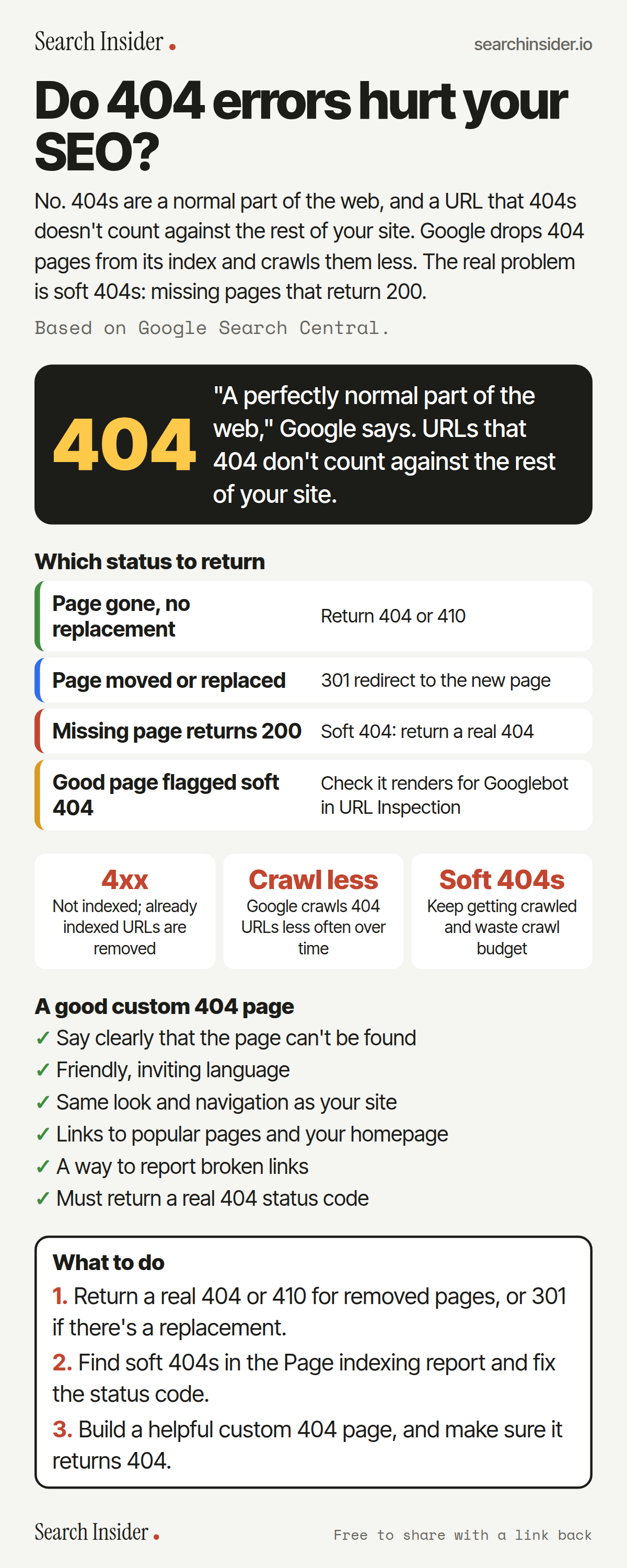
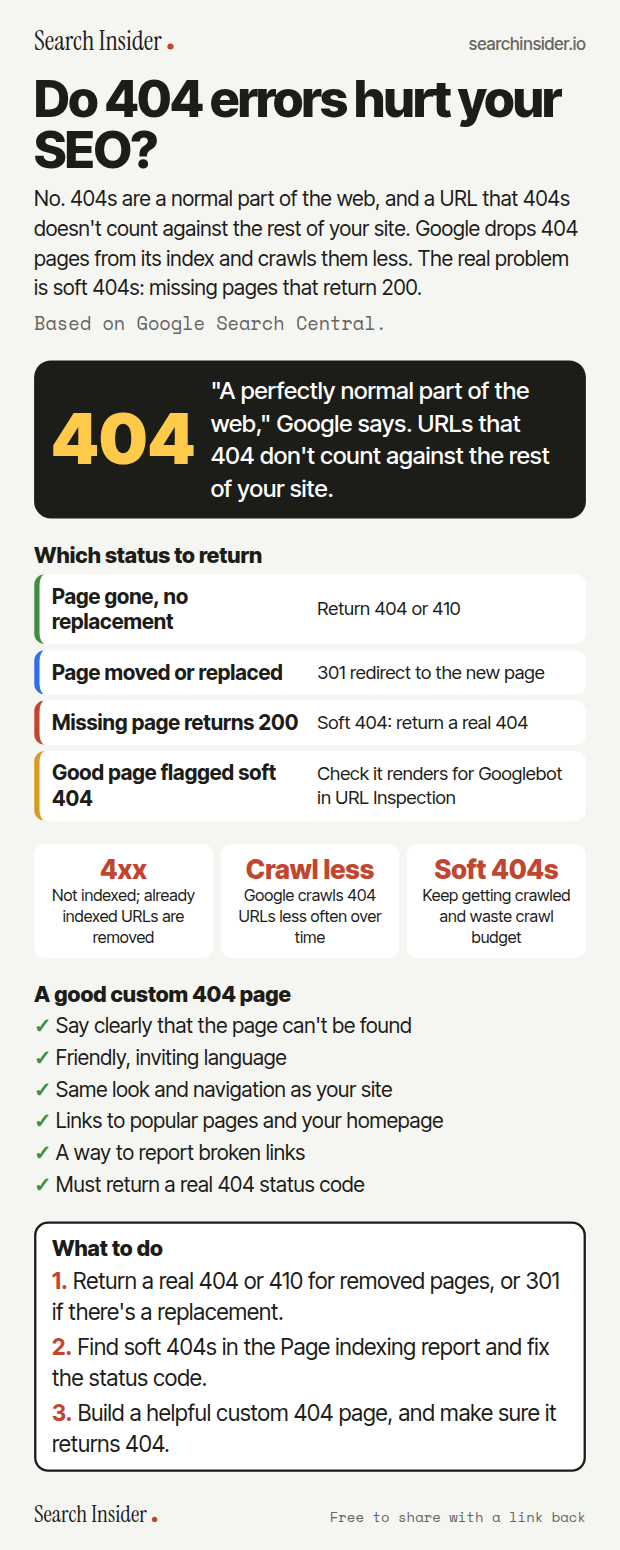
404 errors infographic: a 404 banner with Google's view that 404s are normal, which status to return in four cases, three facts on how Google treats 4xx and soft 404s, a checklist for a good custom 404 page, and three steps on what to do.

SEO · Oct 6, 2026

Do 404 errors hurt your SEO?

Do 404 errors hurt SEO? How Google treats 404s, why soft 404s are the real problem, which status code to return, and how to build a good custom 404 page.

Embed code
<a href="https://searchinsider.io/infographics/404-errors"><img src="https://searchinsider.io/research/404-errors/404-errors-infographic.png" alt="404 errors infographic: a 404 banner with Google's view that 404s are normal, which status to return in four cases, three facts on how Google treats 4xx and soft 404s, a checklist for a good custom 404 page, and three steps on what to do." style="max-width:680px;width:100%;height:auto;" /></a><p>Source: <a href="https://searchinsider.io/infographics/404-errors">404 errors infographic</a> by Search Insider.</p>
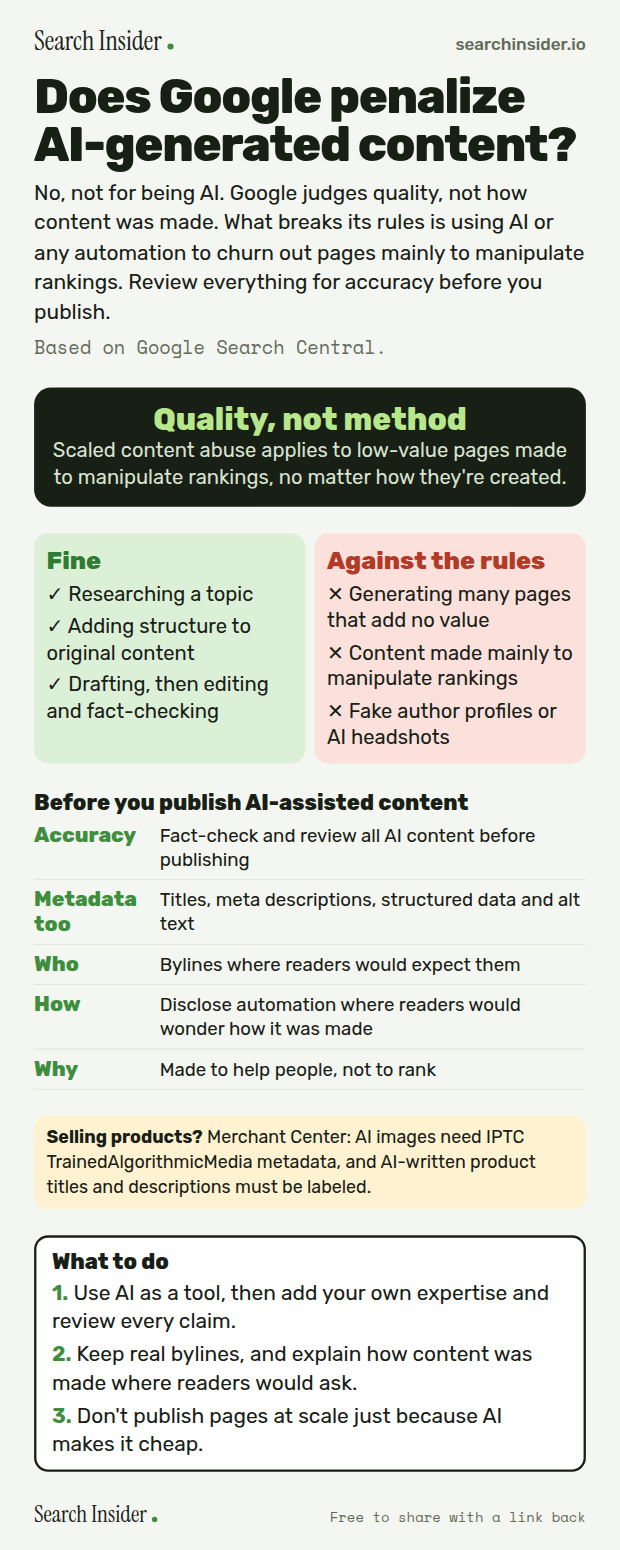
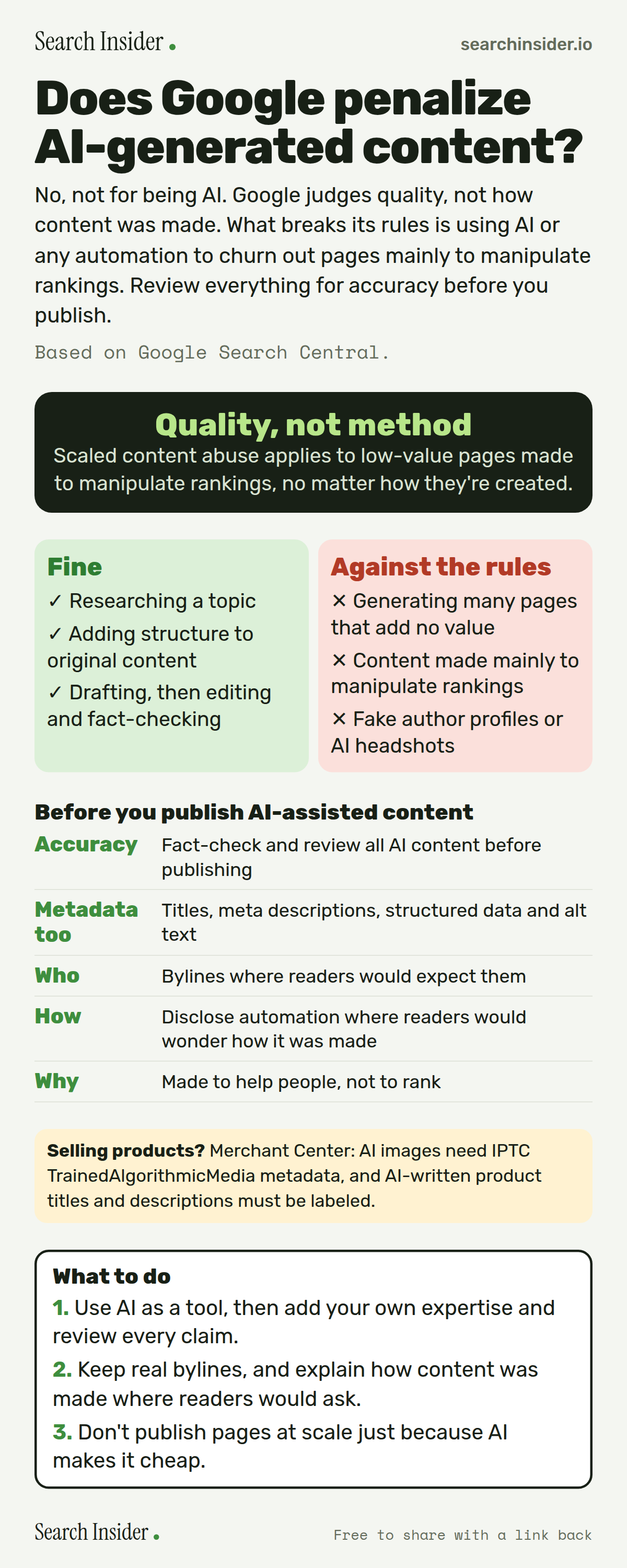
AI-generated content infographic: a quality not method banner, a split of fine uses versus uses against Google's rules, a pre-publish checklist (accuracy, metadata, who, how, why), a Merchant Center note on labeling AI images and product data, and three steps on what to do.

AI search · Oct 6, 2026

Does Google penalize AI-generated content?

Google's stance on AI-generated content: quality over production method, what breaks the scaled content abuse policy, and a checklist before publishing AI-assisted content.

Embed code
<a href="https://searchinsider.io/infographics/ai-generated-content"><img src="https://searchinsider.io/research/ai-generated-content/ai-generated-content-infographic.png" alt="AI-generated content infographic: a quality not method banner, a split of fine uses versus uses against Google's rules, a pre-publish checklist (accuracy, metadata, who, how, why), a Merchant Center note on labeling AI images and product data, and three steps on what to do." style="max-width:680px;width:100%;height:auto;" /></a><p>Source: <a href="https://searchinsider.io/infographics/ai-generated-content">AI-generated content infographic</a> by Search Insider.</p>
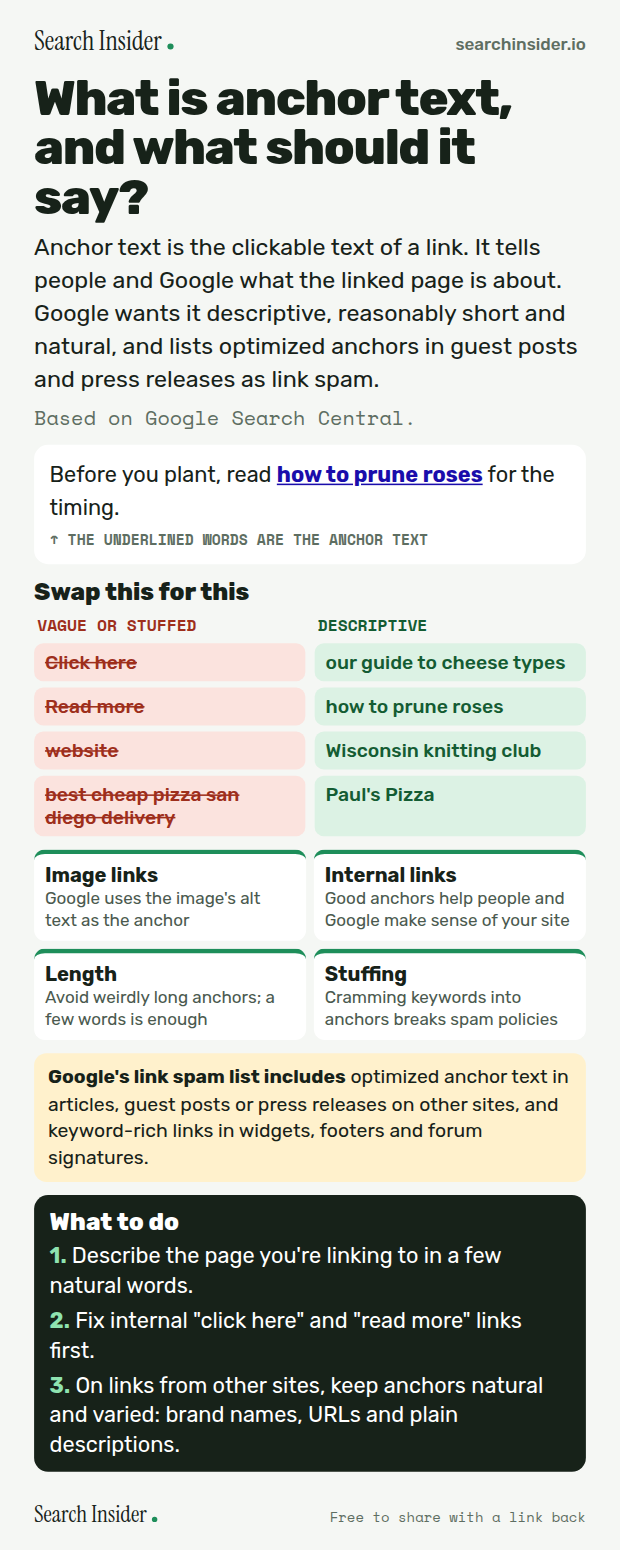
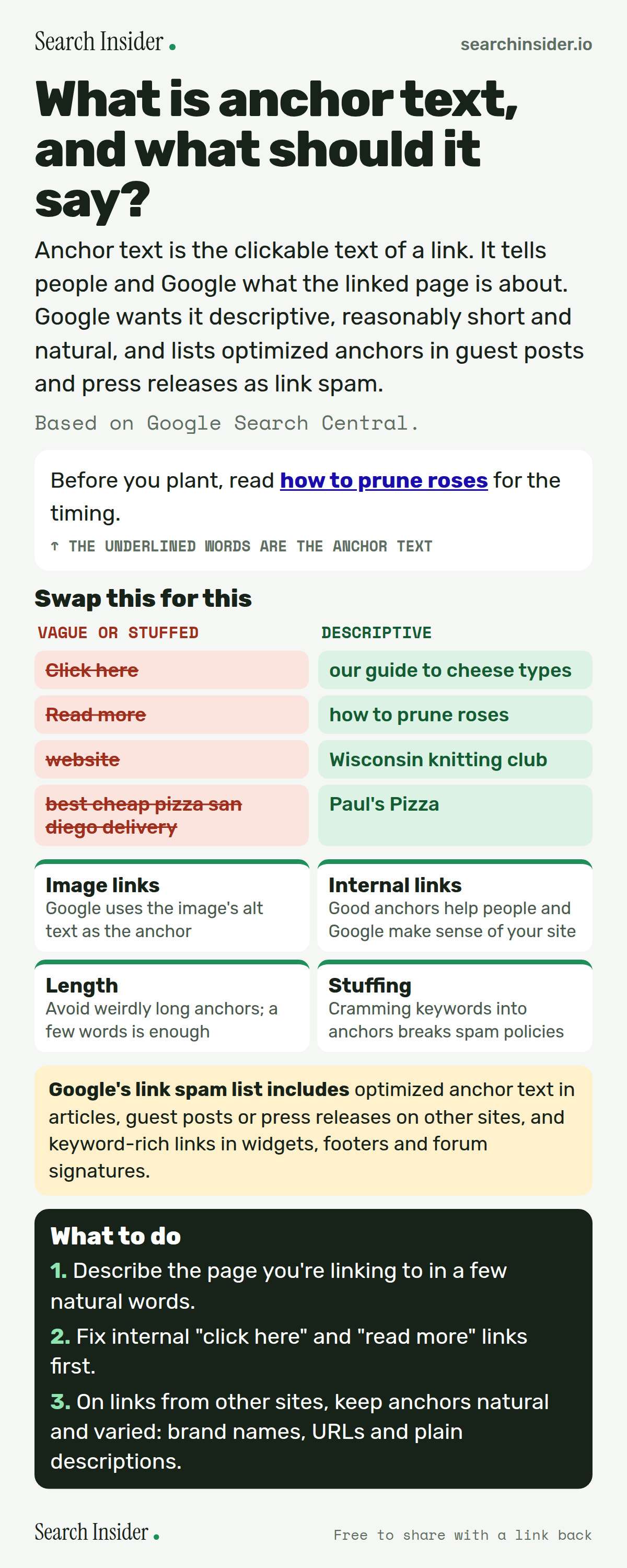
Anchor text infographic: an example link with the anchor text underlined, four vague or stuffed anchors swapped for descriptive ones, four rules on image links, internal links, length and keyword stuffing, a note on Google's link spam examples, and three steps on what to do.

SEO · Oct 6, 2026

What is anchor text, and what should it say?

What anchor text is, what Google says it should say, good and bad examples, image link alt text, and which anchor practices Google lists as link spam.

Embed code
<a href="https://searchinsider.io/infographics/anchor-text"><img src="https://searchinsider.io/research/anchor-text/anchor-text-infographic.png" alt="Anchor text infographic: an example link with the anchor text underlined, four vague or stuffed anchors swapped for descriptive ones, four rules on image links, internal links, length and keyword stuffing, a note on Google's link spam examples, and three steps on what to do." style="max-width:680px;width:100%;height:auto;" /></a><p>Source: <a href="https://searchinsider.io/infographics/anchor-text">Anchor text infographic</a> by Search Insider.</p>