
IN SHORT
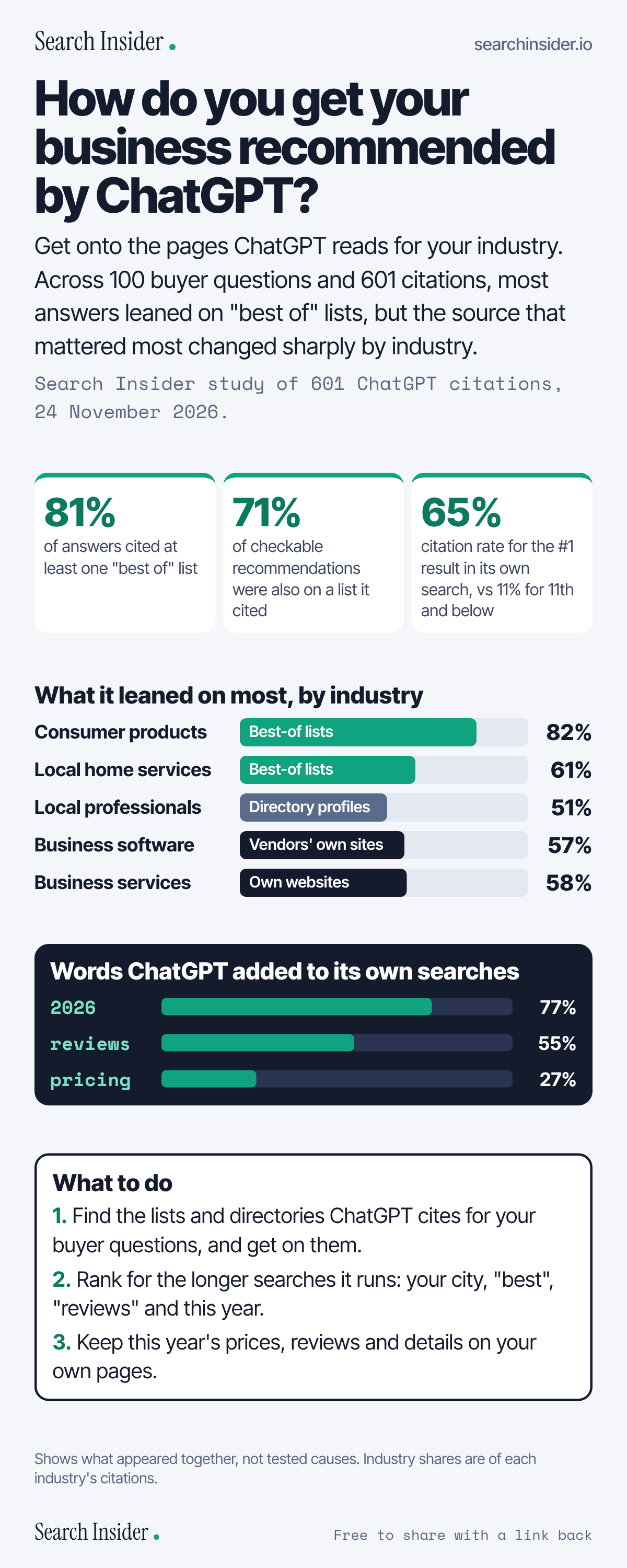
To get your business recommended by ChatGPT, find the sources it reads for your industry and earn a place on them. In a Search Insider study of 601 citations, 81% of answers cited a "best of" list, but local professionals' answers leaned on directory profiles and software answers on vendors' own websites.
Ask ChatGPT for "the best emergency plumber in Denver" and it names a handful of companies.
When I asked, it cited four pages alongside its answer: three "best of" lists and a plumbing directory. None of the plumbers' own websites were among them.
That raises the question every business owner now asks: which pages does ChatGPT read before it recommends someone, and how do you get onto them? This study, part of Search Insider's ongoing series testing SEO and AEO advice against live data, set out to measure it.
What does it mean to be recommended by ChatGPT?
Being recommended by ChatGPT means being named in its answer as a business or product to consider. That's different from being retrieved by its search, being cited as a source, or receiving a visit from it. This study measured the first three. It didn't measure traffic.
| Stage | What happens | Measured here |
|---|---|---|
| Retrieval | ChatGPT runs a web search and gets back a list of results | Yes: 1,254 results across 100 answers |
| Citation | ChatGPT shows a page as a source for its answer | Yes: 601 citations |
| Recommendation | ChatGPT names a business or product as one to consider | Yes: 559 named, 331 checkable against a cited list |
| Referral traffic | A buyer clicks through to a website | No |
A page can be retrieved and never cited. A business can be recommended without its own site being cited, or without being cited at all. Keeping these apart matters, because each needs different work.
How does ChatGPT find and choose the pages it cites?
ChatGPT finds pages by rewriting the buyer's question into its own web search, then choosing a few of the results to cite. In this study it retrieved a median of 12 results per answer and cited a median of 5 pages. Most of what it retrieved was never cited.
Of the 1,189 distinct results it retrieved, 334 were cited, or 28.1%. Another 245 cited pages didn't appear in the retrieved results the data showed, so ChatGPT also cited pages it found some other way, possibly through searches the data didn't report.
The rewriting step is worth looking at closely. "Who should I hire to replace my roof in Dallas" became this search:
Dallas TX best roof replacement contractors reviews licensing insurance warranties 2026
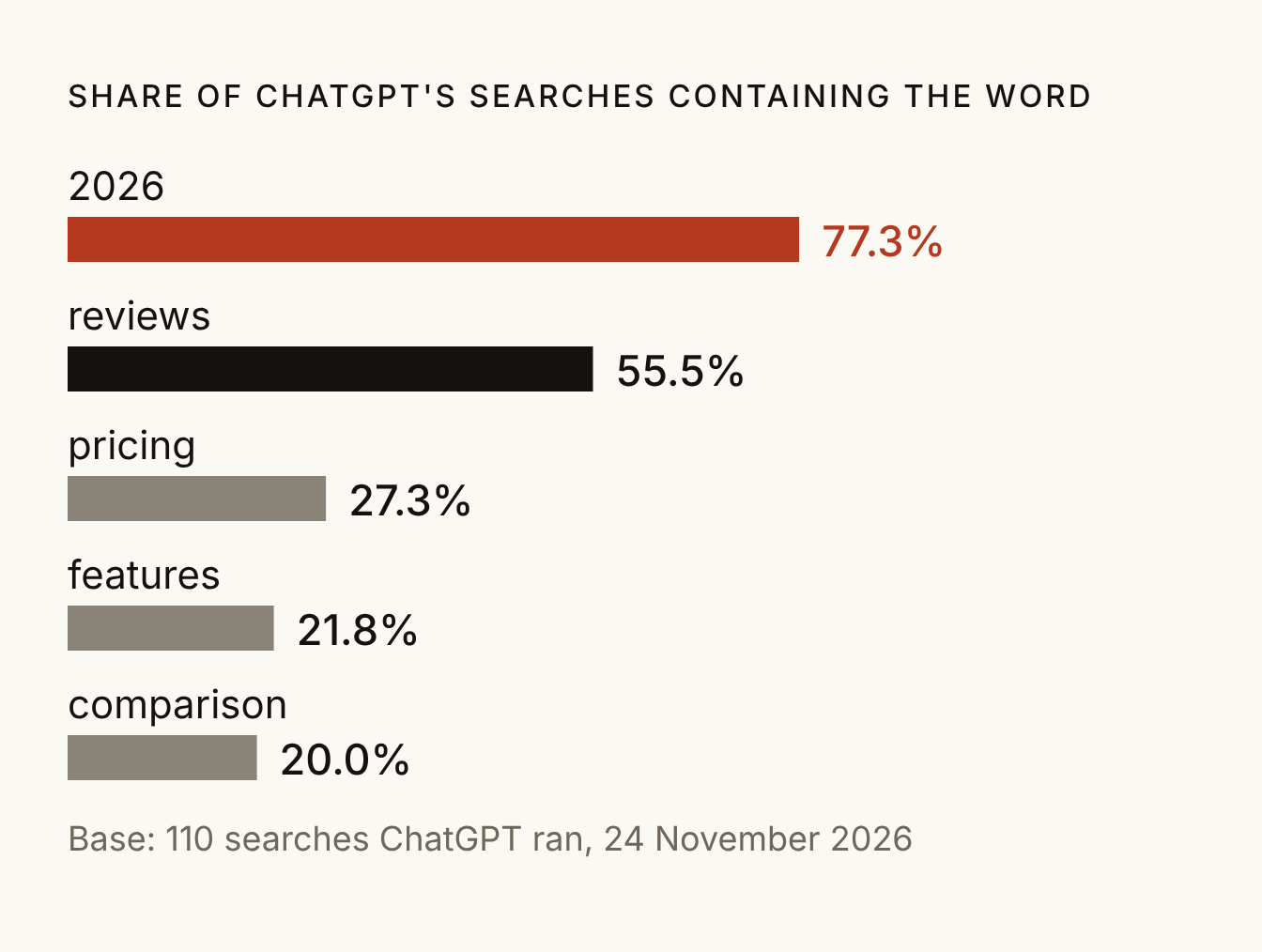
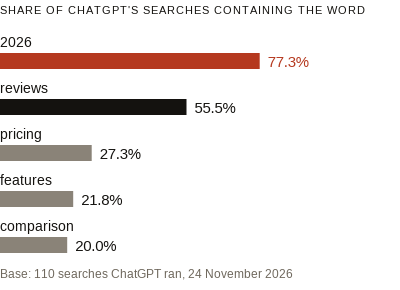
Every one of the 100 answers involved at least one rewritten search. Across all 110 searches, ChatGPT added the current year to 77.3% and "reviews" to 55.5%, words the buyer never typed. "Pricing", "features" and "comparison" followed.
This tells you the kind of page ChatGPT goes looking for: current, reviewed, priced and licensed. I noticed the pattern across the searches but didn't test whether pages carrying these details were more likely to be retrieved, so treat it as a guide to what buyers' rewritten questions contain rather than a ranking rule.
Where does ChatGPT get its business recommendations?
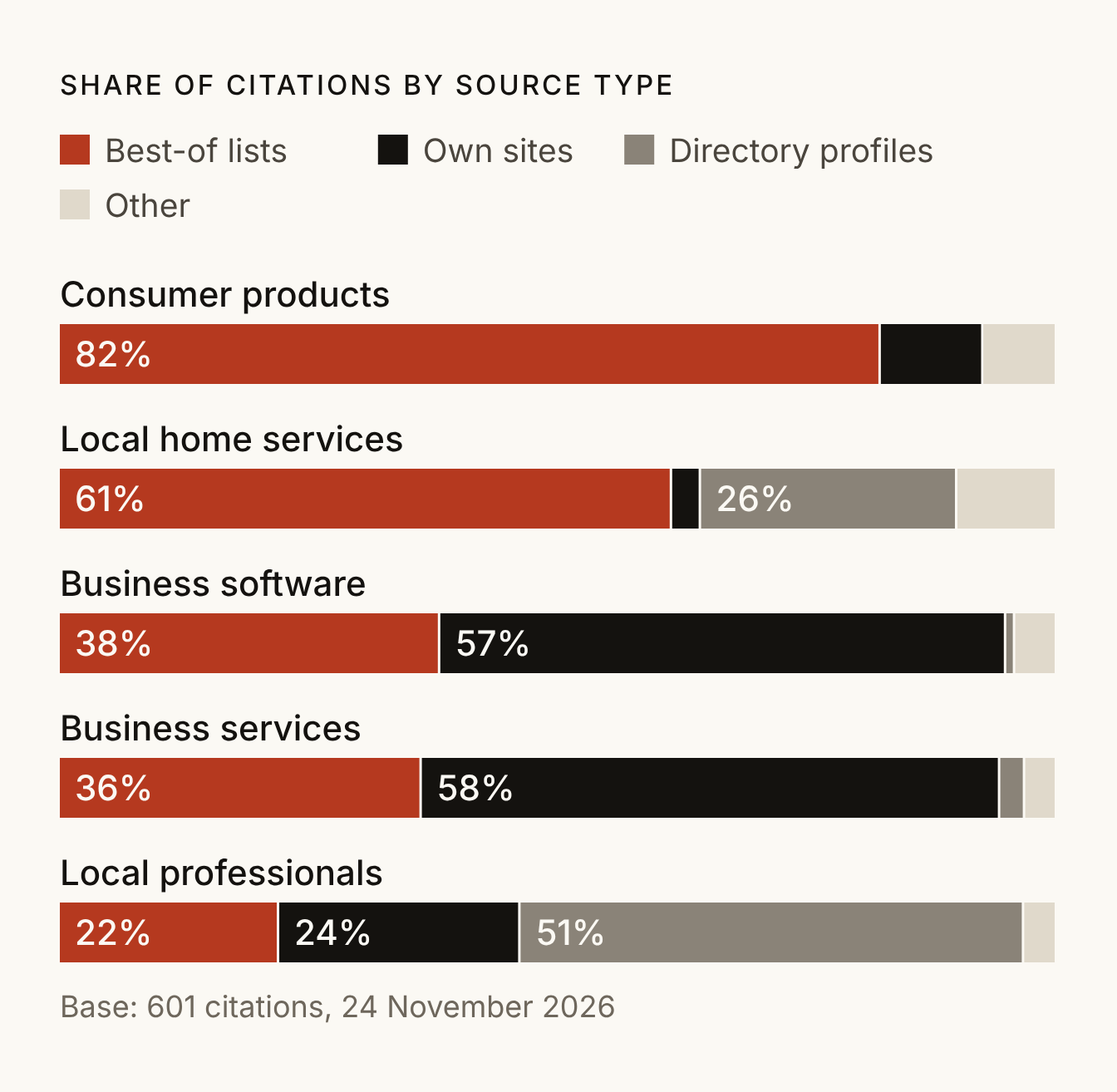
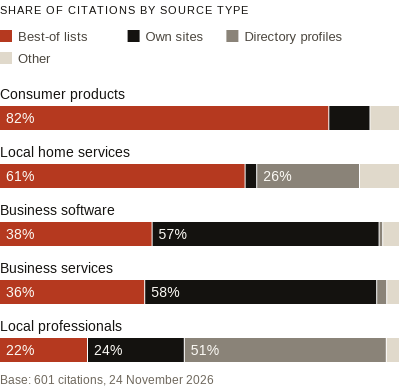
ChatGPT's business recommendations most often sat alongside third-party "best of" lists. In a Search Insider study of 100 buyer questions, 81% of answers cited at least one list, and lists made up 43% of all citations. Businesses' own websites made up 41%, review and directory profiles 12%, and other pages 5%.
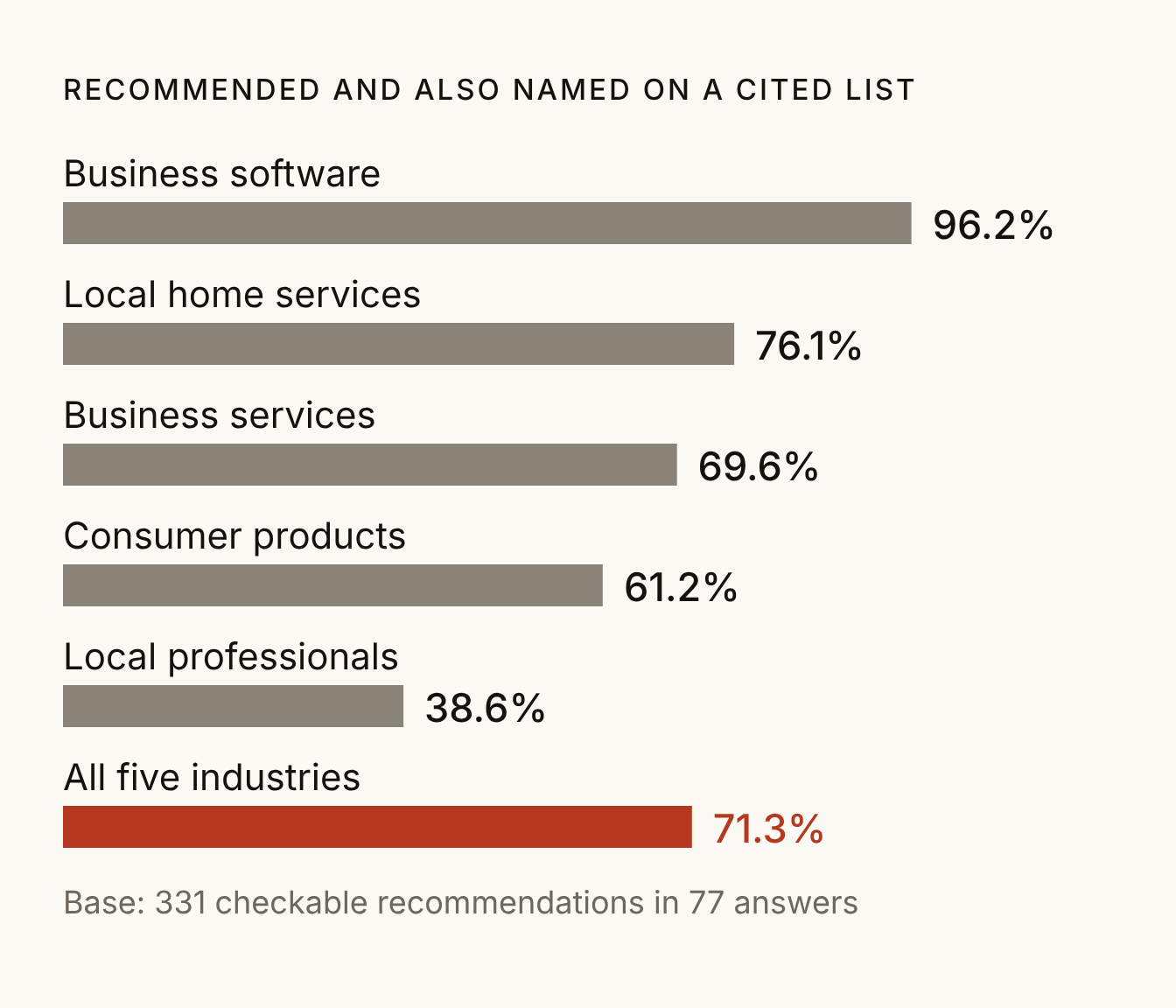
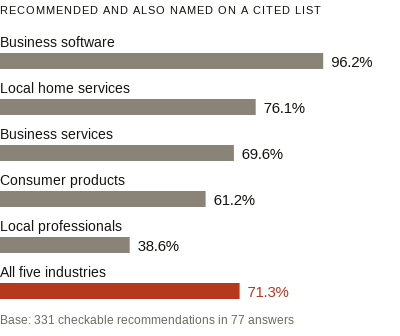
Lists weren't only background reading. For each answer that cited at least one list I could read, I checked whether the businesses ChatGPT recommended were named on those lists. That covered 331 recommendations across 77 answers. Of those, 71.3% appeared on at least one list the same answer cited.¹
That's a strong overlap, and it's still an overlap. It doesn't show that the lists caused the recommendations. ChatGPT may have known about these businesses from other sources, and a business that appears on lists is often well known for other reasons too.
It also doesn't mean you need to be on a list to be recommended. In local professional answers only 38.6% of recommendations appeared on a cited list. Ten of the 100 answers cited nothing at all and still named businesses, from what ChatGPT already knew.
Why do different industries need different AEO strategies?
Different industries need different AEO strategies because ChatGPT leaned on different sources for each one. In this study, lists dominated consumer product and local trade answers, directory profiles dominated local professional answers, and vendors' own websites dominated software and business service answers. The same tactic won't carry equal weight everywhere.
Each industry looked different enough to treat on its own.
Consumer products. Answers ran almost entirely on tested-and-ranked roundups: 82.4% of citations. For "best mattress for back pain" ChatGPT cited three review roundups and no mattress brand. Brands' own sites made up 10.3%. For a product brand, being in the roundups that review your category appears to matter far more than your own product pages.
Local home services. Answers leaned on city "best of" lists (61.4%) and directory pages (25.7%). The tradespeople's own websites made up 2.9% of citations, and only 1 in 20 of these answers cited a recommended business's site at all. A plumber's or roofer's website can still help it rank and convert, but it rarely appeared as ChatGPT's source.
Local professionals. Lawyers, accountants, agents and advisers were the one group where directory profiles led, at 50.5% of citations. For a Dallas divorce lawyer, ChatGPT cited Avvo, Google Maps and Yelp profiles for each firm it named, then the firms' own sites. Lists made up only 22.0%.
Business software. Vendors' own sites made up 56.7% of citations, and every software answer linked at least one vendor's site, often its plans page. Comparison lists made up 38.1%. For "best CRM for a small sales team" it linked six vendors' plan pages alongside four comparison lists.
Business services. Agencies, consultants and outsourced services looked similar to software: 58.0% own sites and 36.3% lists.
| Industry | Most-cited source | Share of citations | What it suggests prioritizing |
|---|---|---|---|
| Consumer products | Best-of lists and roundups | 82.4% | Coverage in tested-and-ranked reviews |
| Local home services | Best-of lists | 61.4% | City "best of" lists, then directories |
| Local professionals | Review and directory profiles | 50.5% | Complete, reviewed directory profiles |
| Business software | Vendors' own sites | 56.7% | Clear pricing, plans and comparison pages, then lists |
| Business services | Businesses' own sites | 58.0% | Clear service pages, then roundups |
Each industry here is 20 questions, so treat the exact shares as indicative. The size of the differences between industries is the finding I'd rely on.
How do SEO and AEO relate?
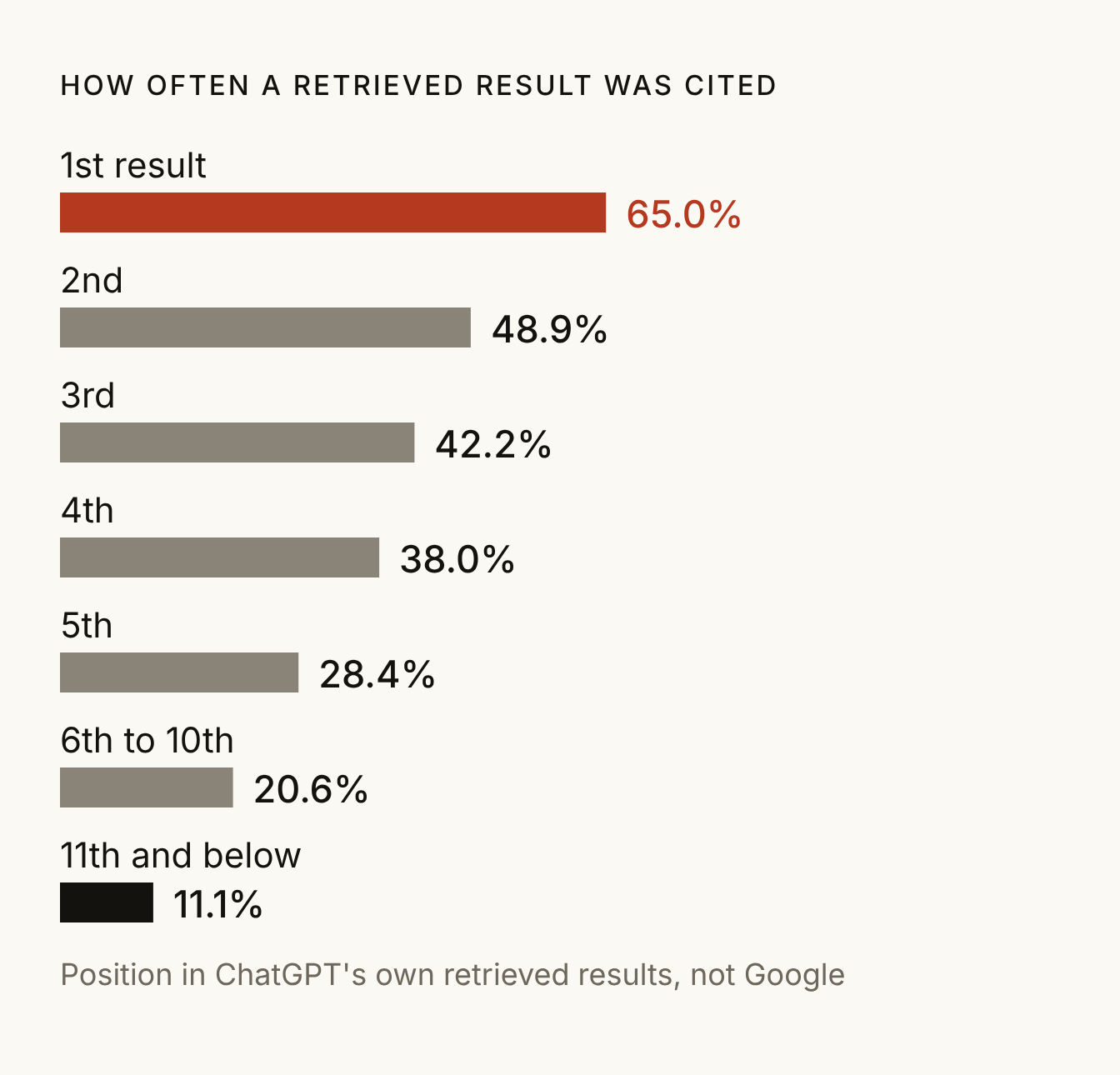
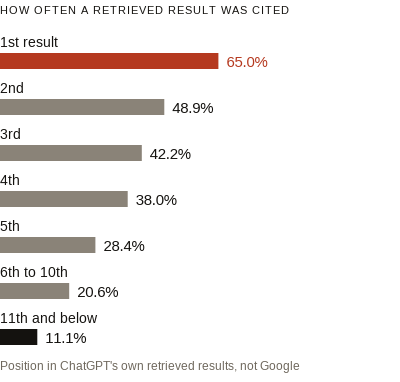
SEO and AEO overlap at the retrieval stage. ChatGPT can only cite what its search returns, and in this study the first result it retrieved was cited 65.0% of the time, about 5.9 times the 11.1% rate for results in 11th place or lower. Where a page sits in ChatGPT's search matters a great deal.
What this doesn't show is the same relationship with Google. The positions here are the order of ChatGPT's own retrieved results, not Google or Bing rankings, and I didn't measure either. ChatGPT also searches with its rewritten query, not the buyer's words, so the search it runs may not be the one you track.
What it does suggest is that ranking work still counts, aimed at a slightly different target: the rewritten, longer searches that include the city, "best", "reviews" and the current year. I'd treat organic search work as the foundation of AEO rather than a separate discipline.
The year appears again here. 59% of the readable pages ChatGPT retrieved had "2026" in the title, which fits its habit of adding the year to searches. Once a page was retrieved, though, the year in the title made little difference to whether it was cited.
Do common AEO tactics like schema, question headings and dated titles help?
Among the pages ChatGPT retrieved, headings that closely matched the buyer's question showed the largest difference in citation rates of the features I checked. Schema, question-style headings and a year in the title showed differences of a few points, or none. These are observations from 809 pages, not tested effects.
| Page feature | Cited, with it | Cited, without it | Observed difference |
|---|---|---|---|
| A heading using every key word of the question | 35.7% | 27.4% (fewest key words matched) | 8.3 points |
| "Best", "top" or "vs" in the title | 32.7% | 26.2% | 6.5 points |
| Dated 2026 in the page's data | 31.7% | 29.4% | 2.3 points |
| Question-style H2 or H3 | 31.6% | 30.0% | 1.6 points |
| "2026" in the title | 31.6% | 30.2% | 1.4 points |
| Structured data (schema) | 30.6% | 36.2% | 5.6 points lower |
The heading result fits what you'd expect. A page whose heading uses the buyer's own words is plainly about their question. A question mark on its own doesn't make a heading match the question being asked.
I wouldn't read the schema row as evidence that schema hurts. Only 58 retrieved pages had no structured data at all, too few to separate the effect of schema from everything else that differs between those pages. Schema still helps search engines read a page, and this study can't rule out an effect on retrieval, which it didn't test.
The broader point is that these features were measured on pages ChatGPT had already retrieved. A tactic could still matter earlier, in getting a page found, without changing whether it's cited once found.
Why isn't ChatGPT recommending my business?
When ChatGPT doesn't recommend a business, the data points to three common gaps: the business is missing from the lists ChatGPT cites for its category, it's missing from the directories ChatGPT cites for its industry, or its pages sit too low in the searches ChatGPT runs. Which gap matters most depends on the industry.
For a local trade, a strong website on its own rarely appeared as a source. For a local professional, a thin or unreviewed directory profile is the more likely gap. For a software company, the gap is often on its own site: no clear pricing, plans or comparison pages for ChatGPT to link to.
None of these is the whole story. ChatGPT also draws on what it already knows, and ten answers in this study named businesses without citing anything. Being on the cited pages improves your odds. It doesn't guarantee a recommendation, and missing from them doesn't rule one out.
How to get your business recommended by ChatGPT, step by step
Getting your business recommended by ChatGPT starts with finding where the gap is for your industry. These steps begin with a competitor citation gap analysis, which shows you which sources to pursue, then work through lists, directories, search visibility, your own pages and measurement.
1. Run a competitor citation gap analysis
A competitor citation gap analysis finds the pages ChatGPT keeps citing for your category that name your competitors but not you. Those pages are your shortlist, ranked by how much each is worth pursuing.
- Write 20 buyer questions in your customers' words, with your service and location where it applies: "best emergency plumber in Denver", "best CRM for a small sales team". Take them from sales calls, enquiries and search data, not from your own marketing language.
- Ask each question 3 times in a new chat with search on. Answers vary between runs, so one answer is a sample, not a verdict.
- Log every cited page in a spreadsheet: the question, the page, the type of page (list, directory, a business's own site, other) and every business it names.
- Mark the gaps. Flag each page that names at least one competitor and doesn't name you.
- Score each gap on four things, then work down the list from the highest score.
| Factor | What to check | Higher priority when |
|---|---|---|
| Relevance | Does the page cover your exact service, product and location? | It matches what you sell and where |
| Citation frequency | How many of your questions and runs cited it? | It appears across several questions or runs |
| Commercial intent | Was it cited for buying questions or for research questions? | It appears in "best", "who should I hire" or "vs" answers |
| Editorial eligibility | Could you realistically qualify for it? | You meet its criteria and it accepts suggestions or updates |
A page cited in 6 of your 60 answers, for buying questions, that you qualify for, is worth far more than a page cited once for a general research question.
2. Earn a place on the lists ChatGPT cites
Earning a place on a list means meeting the publisher's criteria and making it easy for them to include you. For consumer products and local trades, lists made up most of what ChatGPT cited, so these pages usually head the gap analysis.
- Read each list's criteria and check you meet them before you get in touch.
- Contact the editor or author with what you do, where you operate, a verifiable proof point and a short description they can use.
- Offer something useful to their readers: a product to test, customer numbers, a pricing range, a credential they can check.
- Ask partners and suppliers whether they publish roundups you belong in.
If you'd rather have help, Search Insider's Listicles service places businesses in relevant "best X for Y" roundups on established sites.
3. Build the directory and reputation profiles ChatGPT reads
Claim and complete your profiles on the directories your industry uses, and keep them current. For local professionals, directory and review profiles were 50.5% of everything ChatGPT cited.
- Find the directories that appeared in your gap analysis: Google Maps, Yelp, Avvo, Houzz, Clutch and so on.
- Complete every field: categories, services, service area, hours, photos, licenses and credentials.
- Keep your details identical on every profile: name, address, phone and services.
- Invite genuine customers to share their experiences, as a normal part of finishing each job. Ask everyone, not only the customers you expect to be happy.
Search Insider's free Foundation Links tool, part of The Search Insider Toolkit, lists the profile and directory sites worth setting up first for your country and industry.
Most directory reviews share one limitation: they rarely tell you much about the person writing them. A recommendation from a named accountant who has referred clients to a business for years tells a reader more than an anonymous five stars.
Acclaimedly is one example of a reputation platform built around that idea. Each business gets a comprehensive profile covering its services, products, staff, credentials, awards and links to its other review platforms and social accounts, with verifiable claims marked as verified. Recommendations come from verified members, and each recommender has their own profile, so a reader can judge how credible the person recommending is. This study didn't test Acclaimedly or any other platform's effect on ChatGPT.
4. Rank in the searches ChatGPT runs
Treat ChatGPT's rewritten searches as keywords in their own right. The first retrieved result was cited about 5.9 times as often as results in 11th place or lower, so standard search visibility work still underpins AEO.
- Write out the rewritten version of your buyer questions: service, location, "best", "reviews", the current year.
- Check where you appear for those searches in Google and Bing, as a working proxy. This study didn't measure how closely either matches ChatGPT's own results.
- Keep current details on your service pages: this year's prices, review counts, license numbers and warranties, the details ChatGPT added to its searches.
- Verify your site in Google Search Console and Bing Webmaster Tools, and submit your sitemap to both.
5. Make your own pages easy for ChatGPT to quote
Answer each heading's question directly, use your buyers' words in headings, and make sure ChatGPT's crawler can read the page. This matters most for software and service businesses, whose own sites were 56.7% and 58.0% of citations.
- Put the answer first. Kevin Indig's analysis of 18,012 verified ChatGPT citations found 44.2% came from the first 30% of a page.
- Use the buyer's words in your headings. In this study, pages with a heading matching every key word of the question were cited 35.7% of the time, against 27.4% for the weakest match. That's an observed difference, not a tested effect.
- Publish pricing and comparison pages. Every software answer linked at least one vendor's own site, often its plans page.
- Let ChatGPT's search crawler in. OpenAI's publisher guidance says to make sure you aren't blocking OAI-SearchBot if you want to appear in ChatGPT search. Check your robots.txt and any "block AI bots" setting on your host or CDN.
6. Measure your AI visibility
Measure AI visibility with four separate numbers, because each tells you something different. Track them monthly against the same set of buyer questions, so changes reflect ChatGPT rather than your question list.
| Measure | How to calculate it | What it tells you |
|---|---|---|
| Recommendation rate | Answers that name you ÷ all answers checked | How often buyers see your name |
| Citation rate | Answers that cite one of your pages ÷ all answers checked | How often ChatGPT uses your own content as a source |
| Share of recommendations | Times you're named ÷ all businesses named across those answers | Your position against competitors |
| Referral traffic | Visits from ChatGPT in your analytics | Whether visibility turns into visits |
For referral traffic, OpenAI says ChatGPT adds utm_source=chatgpt.com to referral links, so those visits appear as their own source in Google Analytics. A business can have a high recommendation rate and little traffic, or the reverse, which is why the four are worth keeping apart.
If you'd like this done for your business, Search Insider's SEO Consulting covers AI search visibility as part of a site audit and plan.
Where should you start?
Start with the source ChatGPT cited most for your industry, then fill the gaps your citation analysis finds. The table below summarizes where this study suggests each type of business should begin.
| If you are | Start with | Why, from this study |
|---|---|---|
| A local trade (plumber, roofer, cleaner) | City "best of" lists, then directories | Lists 61.4%, directories 25.7%, own sites 2.9% of citations |
| A local professional (lawyer, accountant, agent) | Complete, reviewed directory profiles | Directory profiles 50.5% of citations |
| A software company | Pricing, plans and comparison pages, then comparison lists | Own sites 56.7%, lists 38.1% |
| A service business (agency, consultant) | Clear service pages, then roundups | Own sites 58.0%, lists 36.3% |
| A consumer product brand | Tested-and-ranked review roundups | Lists 82.4% |
| Any business low in ChatGPT's search | Search visibility for the rewritten searches | First retrieved result cited 65.0%, 11th and below 11.1% |
Can you pay ChatGPT to recommend your business?
No. ChatGPT now shows ads to some users, but OpenAI states that "Ads do not influence the answers ChatGPT gives you", and ads are labeled as sponsored and shown separately from the answer. Ads run on the Free and Go plans in the US and several other countries. Paid placement can put a business beside an answer, not inside one.
How this study was conducted
The study used a fixed set of 100 buyer questions, asked once each in ChatGPT search on a single day, with every search, retrieved result, citation and named business recorded for analysis.
- Collection. Answers were collected through DataForSEO's ChatGPT LLM Scraper (live advanced endpoint), which records what a user sees in ChatGPT search. Settings: United States location, English, web search forced on, desktop. The model field returned for all 100 answers was gpt-6.
- Timing. All 100 questions were asked once each between 09:58 and 10:41 UTC on 24 November 2026.
- Questions. I wrote 20 buyer questions for each of five industries: local home services, local professionals, business software, business services and consumer products. They were phrased the way people ask chat assistants for recommendations ("best…", "who should I hire…", "recommend a…"), and local questions named a US city. They weren't drawn from search volume data. The full list is in the downloads below.
- Recorded per answer. The searches ChatGPT ran, the results it retrieved in order, the pages it cited, and the businesses and products it named.
- Retrieved results. The data showed 1,254 retrieved results across the 100 answers, a median of 12 per answer (range 6 to 60). Removing the same URL appearing twice in one answer left 1,189. Tracking parameters were stripped before comparing URLs.
- Citations. 601 citations, covering 579 distinct URLs within answers and 561 distinct URLs overall. 334 of the 579 also appeared in that answer's retrieved results.
- Recommendations. 559 businesses and products named across the answers. Some of these were generic labels, such as "dental marketing agency", rather than business names. 433 could be matched by name to the answer text, and 331 of those sat in the 77 answers that cited at least one readable list.
- Source classification. Each citation was sorted into best-of lists and comparisons, review and directory profiles, a recommended business's own site, government and education, or other, using its title, page title and web address. Samples from every category were checked by hand.
- Page retrieval. I fetched every cited URL and the top 15 retrieved results for each answer, 1,368 distinct URLs in all, with a standard browser request from a single machine. 998 returned a readable page. The rest blocked automated visits (305), timed out or didn't respond (23), limited requests (12) or returned other errors.
- Feature comparison. The page feature comparison uses the 809 retrieved results whose page returned in full, comparing those ChatGPT cited with those it didn't, within the same answers.
Limitations
- One day, one market. All answers were collected in a 43-minute window on 24 November 2026, in US English. ChatGPT's sources and behavior change over time and by market.
- One run per question. Each question was asked once. ChatGPT's answers vary between runs, so individual answers may not repeat.
- Sample size. 100 questions, 20 per industry. Industry-level shares are indicative, and small differences between them shouldn't be over-read.
- Question selection. The questions were written to reflect buyer intent rather than sampled from real query logs, which may not match how your customers phrase things.
- Inaccessible pages. 370 of the 1,368 pages couldn't be read, mostly because they blocked automated visits. Blocked pages may differ from readable ones.
- Matching names and classifying pages. Recommendations were matched by name and pages classified by rules, with hand checks. Some errors remain possible at the edges.
- Observational design. Every finding describes what appeared together. None tests what causes ChatGPT to retrieve, cite or recommend a page or business.
- Not traffic. The study didn't measure clicks or visits from ChatGPT.
Research data and downloadable charts
The full dataset, every chart and the infographic are free to download and republish with a link back to this page and credit to Search Insider.
Charts. Each chart states its base and collection date.
- Figure 1, words ChatGPT added to its searches: PNG, SVG
- Figure 2, recommended businesses also named on a cited list: PNG, SVG
- Figure 3, what ChatGPT cited by industry: PNG, SVG
- Figure 4, citation rate by position in ChatGPT's retrieved results: PNG, SVG
To embed a chart, use the same code as the infographic and swap in the chart's PNG address.
Dataset (CSV).
- Prompts: all 100 questions by industry
- Answers: model, time, counts and the searches ChatGPT ran for each answer
- Citations: all 601 citations with their category and retrieved position
- Retrieved results: all 1,189 results with cited status and the page features compared
- Recommendations: all 559 named businesses and products, with whether each could be checked and whether it appeared on a cited list
This study sits alongside my test of whether a year in the title gets you cited in AI Overviews. In both, the year shaped what got found more than what got quoted.
ChatGPT's sources shift month to month. The Monday Brief sends the changes worth acting on, every Monday, with what they mean for your site.
¹ The 71.3% figure covers 331 recommendations in the 77 answers that cited at least one readable list. Of the 1,368 pages fetched, 998 could be read; the other 23 answers either cited no list or cited only lists that blocked automated visits. Recommendations in those answers couldn't be checked and aren't counted.
Disclosure: Alex Marjanovic has a commercial interest in Visibility Group Limited.